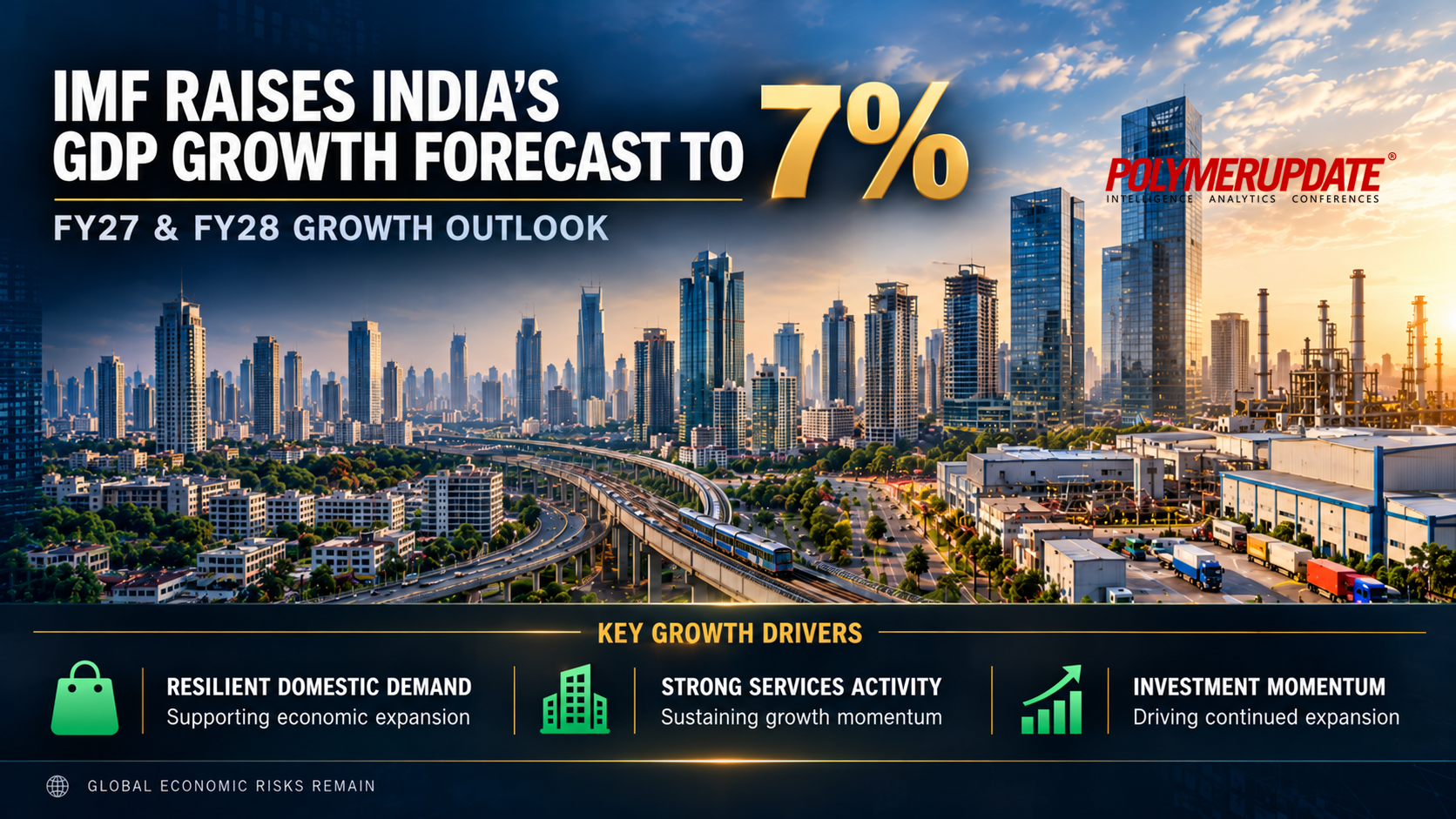
India’s economic growth outlook has strengthened, with the International Monetary Fund (IMF) raising its gross domestic product (GDP) growth forecast for the financial year 2026-27 to 7 percent from its earlier projection of 6.4 percent, citing stronger-than-expected economic momentum, resilient domestic demand and robust services activity. In its October 2026 edition of the World Economic Outlook (WEO), released on Tuesday, the IMF also raised its growth projection for India for 2027-28 to 7 percent from 6.7 percent estimated in July.
The upward revision reinforces India’s position among the world’s fastest-growing major economies at a time when the global outlook remains clouded by geopolitical conflicts, elevated energy prices and uncertainty surrounding international trade. The improved outlook follows stronger-than-expected economic activity in the first quarter of the current financial year. India’s GDP grew by 7.8 percent year-on-year in April-June 2026, supported by domestic demand, investment and manufacturing activity.
The stronger performance has prompted several institutions to revise their projections upwards, with the Reserve Bank of India (RBI) raising its FY27 growth estimate to 7.1 percent, while the World Bank also projected growth of 7.1 percent. The IMF’s latest assessment suggests that the Indian economy retains considerable momentum despite an uncertain international environment. The strength of domestic economic activity, the expansion of services and the country’s large consumer market are expected to help sustain growth over the medium term.
 Domestic demand drives growth
A key factor behind the IMF’s improved assessment is the resilience of domestic demand, which provides an important buffer against weakness in external markets. Household consumption, supported by economic activity across urban and rural areas, remains central to India’s growth outlook. A large domestic market allows businesses to rely on internal demand even when global trade conditions become less favourable.
Sustained consumer spending also supports activity across several sectors, including retail, transport, hospitality, housing and other consumer-facing industries. As demand expands, businesses have greater incentives to increase production, invest in capacity and hire workers. This creates a multiplier effect, with higher economic activity generating additional income and supporting further consumption.
The IMF’s assessment of India’s favourable demographic dynamics and expanding domestic market further strengthens the medium-term outlook. A large working-age population can support economic expansion by increasing the supply of labour, broadening the consumer base and strengthening the country’s productive capacity. However, translating this demographic advantage into sustained growth will depend on employment generation, skill development and improvements in labour productivity.
Support from services sectorThe services sector is another major contributor to India’s growth momentum. The IMF specifically cited robust services activity as one of the principal reasons for upgrading its forecast. India’s services economy encompasses information technology, business-process management, financial services, telecommunications, transport, tourism, professional services and other activities. These sectors support domestic economic activity while also generating export earnings and attracting investment.
Technology-enabled services are particularly important because Indian companies serve customers across international markets.
Demand for digital solutions, software development, business consulting and other specialised services can help sustain economic activity even when merchandise trade faces headwinds. The growing integration of technology into business operations also creates opportunities for higher productivity and new services. However, the durability of these gains will depend on continued investment in infrastructure, workforce skills and technological capabilities, particularly as artificial intelligence reshapes global business models.
The IMF has also highlighted the growing influence of technology-related investment and trade on the global economy. It noted that international trade in artificial intelligence-related goods expanded considerably faster than overall global trade between 2023 and 2025. India could benefit from the wider technology investment cycle, although the extent of those gains will depend on its ability to strengthen its position in global supply chains and capture higher-value activities.
Investment, manufacturing and structural reformsInvestment and manufacturing activity provide additional support to the growth outlook. The strong GDP expansion recorded in the April-June quarter indicates that economic momentum remained firm at the beginning of FY27, with investment and manufacturing contributing to the performance. Investment in productive capacity can support growth through higher demand for machinery, construction materials, transport and business services. Over time, it can also improve productivity, expand industrial output and create employment.
Manufacturing growth is particularly important for diversifying the economy, strengthening domestic supply chains and creating jobs for a growing workforce. The IMF has identified continued structural reforms as another factor supporting India’s growth potential. Reforms that improve the business environment, strengthen infrastructure, facilitate investment and enhance competition can help businesses operate more efficiently and encourage private-sector participation.
An expanding domestic market, combined with improvements in productive capacity, can also make India more attractive to domestic and international investors. Nevertheless, the long-term benefits of these factors will depend on consistent policy implementation, the availability of skilled labour and the ability of businesses to translate investment into sustained productivity gains.
HeadwindsDespite the improved forecast, the IMF cautioned that the global economic outlook remains vulnerable to geopolitical tensions and economic shocks. The prolonged conflict in the Middle East is a particular concern because disruptions to oil production and shipments through the Strait of Hormuz can push up international energy prices and increase uncertainty across commodity markets. Higher crude oil prices present a significant risk for India, a major importer of petroleum and related products.
An increase in the cost of imported energy can raise the country’s import bill, put pressure on the current account balance and increase costs for transport, manufacturing and other energy-intensive industries. If higher fuel and freight costs persist, businesses may pass some of the additional expenses on to consumers, adding to inflationary pressures. Elevated inflation could, in turn, erode household purchasing power and weigh on discretionary consumption. The government could also face difficult choices over fuel taxation, subsidies and fiscal expenditure if energy prices remain high.
The IMF warned that a more prolonged Middle East conflict, keeping crude oil prices above US$ 130 a barrel through the first quarter of 2027, could reduce global economic growth by 0.5 percentage points in 2027. Although this is a global estimate rather than a specific projection for India, such a scenario would pose additional challenges for energy-importing economies.
Technology-related risks also warrant attention. The IMF cautioned that a sharp correction in artificial intelligence-related investment and asset valuations could weaken investment, reduce demand and tighten financial conditions. For India, weaker global growth or a slowdown in technology spending could affect services exports, investor sentiment and corporate investment.
Policy prioritiesThe IMF’s upward revision provides a positive assessment of India’s near-term economic prospects, but sustaining growth at around 7 percent will require continued policy attention. Managing inflation, preserving macroeconomic stability and maintaining investor confidence will remain important, particularly if global energy prices rise further. Equally important will be the quality and inclusiveness of growth.
Expanding employment opportunities, improving workforce skills, strengthening infrastructure and encouraging private investment will be essential to ensure that economic expansion translates into higher household incomes and broader improvements in living standards. India’s favourable demographics and large domestic market offer considerable advantages, but these strengths must be supported by productivity improvements and the creation of sufficient productive jobs. The country will also need to strengthen its competitiveness in manufacturing and higher-value services to benefit more fully from changing global supply chains and technology investment.
The IMF’s latest projections therefore point to a relatively strong growth trajectory for India, supported by resilient domestic demand, robust services activity, favourable demographics and structural reforms. However, the outlook is not without risks. The extent to which India can maintain its growth momentum will depend on domestic policy execution as well as its ability to withstand external shocks, particularly those arising from higher energy prices and a weaker global economy.
DILIP KUMAR JHA
Editor
dilip.jha@polymerupdate.com