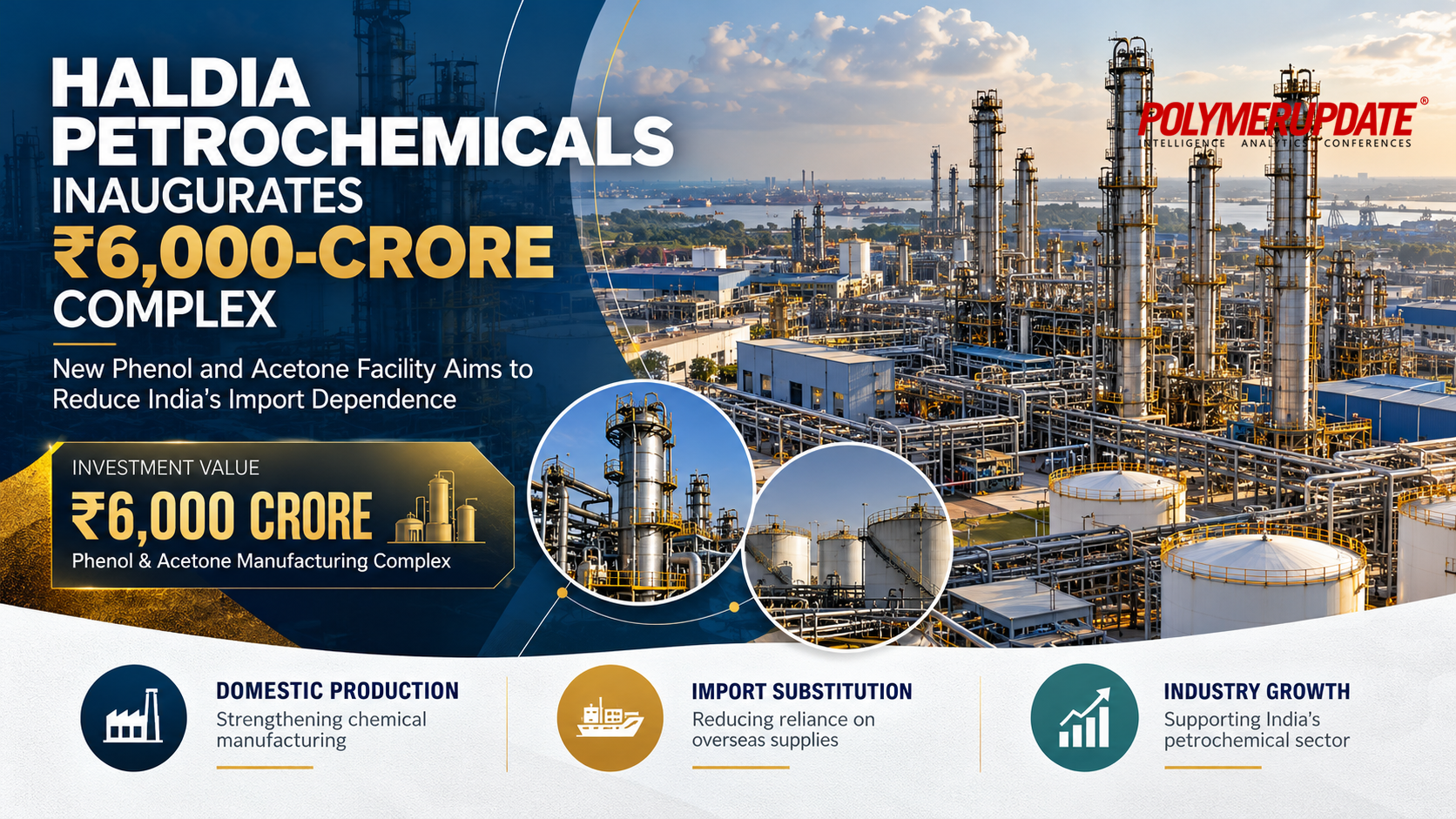
Kolkata-headquartered India’s major petrochemical company Haldia Petrochemicals Ltd (HPL) expanded its petrochemical operations with the inauguration of a Rs 6,000-crore phenol and acetone complex at Haldia in West Bengal on Wednesday. The project is expected to strengthen domestic production of key chemical intermediates, reduce import dependence and support the growth of downstream manufacturing industries. West Bengal Chief Minister Suvendu Adhikari is scheduled to inaugurate the facility, developed through HPL’s subsidiary, Adplus Polymers & Chemicals, also referred to as Adperma in reports.
The project marks a significant addition to the company’s manufacturing capabilities and is expected to establish HPL as India’s first integrated player in the phenolics value chain. The complex will have an annual phenol production capacity of 400,000 tonnes and acetone capacity of 248,000 tonnes. It will also house India’s first on-purpose propylene plant based on Olefin Conversion Technology (OCT), licensed by Lummus Technology, and the country’s largest phenol production unit.
The investment comes as India continues to depend on imports to meet a substantial share of its requirements for phenol and acetone. According to officials, imports account for around 50 per cent of domestic phenol demand and 40 per cent of acetone consumption. The new capacity is expected to improve local availability of these chemicals and provide a domestic source of feedstock for a range of industrial applications.
 Import substitution and downstream opportunities
Phenol and acetone are important chemical intermediates used in several manufacturing industries. Phenol is a key raw material for phenolic resins, bisphenol-A and other derivatives, which find applications in laminates, plywood adhesives, coatings, moulding compounds and automotive and electrical components. Acetone is widely used as a solvent and chemical intermediate in paints, coatings, adhesives, pharmaceuticals and other industrial products.
A larger domestic supply base could help manufacturers secure raw materials more reliably and reduce their exposure to international freight costs, currency movements and fluctuations in overseas prices. The Haldia facility is expected to serve downstream producers of resins, laminates, adhesives, paints and coatings, among other products. Improved access to domestically manufactured intermediates could also encourage investment in additional processing and value-added chemical production.
However, the extent to which the project reduces imports will depend on actual production levels, operating rates, product quality and the competitiveness of its prices against imported material. Sustained demand from downstream industries will also be important in determining how quickly the new capacity translates into lower import dependence.
Propylene technology adds strategic significanceBeyond phenol and acetone, the complex's on-purpose propylene plant represents another important component of the investment. Propylene is a key building block for the petrochemical industry and is used to manufacture polypropylene and several other chemical derivatives. The use of Olefin Conversion Technology, licensed by Lummus Technology, is expected to expand India's domestic manufacturing capabilities for this important petrochemical feedstock. The addition could strengthen supply options for downstream producers and create opportunities for further integration across the chemical value chain.
The facility is also expected to lay the groundwork for future forward integration, including potential polycarbonate production. Such expansion could enable the development of higher-value products and broaden the range of applications served by HPL's petrochemical operations. With the new complex, HPL aims to move beyond supplying individual chemical products towards a more integrated manufacturing structure.
Such integration can improve coordination between production units and downstream applications, although the commercial benefits will depend on feedstock availability, plant efficiency and market conditions. HPL chairperson Purnendu Chatterjee recently visited the project site to review the final phase of construction. He was accompanied by whole-time director and chief executive officer Navanit Narayan and senior project officials.
Employment and industrial developmentThe Rs 6,000-crore investment is expected to generate direct employment in chemical engineering, plant operations, maintenance, industrial safety, quality control and logistics. Additional opportunities could emerge in procurement, finance, equipment servicing, transportation and other support functions. The wider economic impact may extend to contractors, industrial service providers and downstream manufacturers operating in and around Haldia.
Greater chemical production could encourage the development of ancillary businesses that supply equipment, maintenance services and other industrial requirements. The project could also provide employment opportunities for skilled workers and professionals from Haldia and neighbouring areas, including East and West Midnapore and the Kharagpur region. Recruitment specialists have indicated that the availability of local talent could help meet some of the industry's workforce requirements.
Realising this potential, however, will require coordination between employers, technical institutions, training centres and placement agencies. Specialised chemical manufacturing facilities require trained personnel with expertise in process operations, safety management and quality assurance. Targeted recruitment and skills development will therefore be important to connect local candidates with suitable positions.
Strengthening West Bengal's petrochemical baseThe project comes amid efforts to attract investment and expand industrial activity in West Bengal. Haldia's existing industrial infrastructure provides a base for developing a broader chemical manufacturing ecosystem, with the potential to attract downstream units and related service businesses. For the domestic chemical industry, the complex represents an addition to India's production capacity for essential intermediates at a time when manufacturers are seeking greater supply-chain resilience.
Increased local availability could help reduce exposure to disruptions in international logistics and volatility in global chemical markets. Nevertheless, the project's long-term contribution will depend on more than its announced investment and installed capacity. Competitive production costs, consistent operations, environmental compliance and the expansion of downstream demand will be critical to its performance.
The commissioning of the Haldia complex is expected to strengthen HPL's position in the phenolics value chain while creating opportunities for further petrochemical integration in India. Its broader significance will ultimately be reflected in the volume of imports replaced, the competitiveness of domestically produced chemicals and the extent to which the investment supports industrial development and skilled employment in West Bengal.
DILIP KUMAR JHA
Editor
dilip.jha@polymerupdate.com