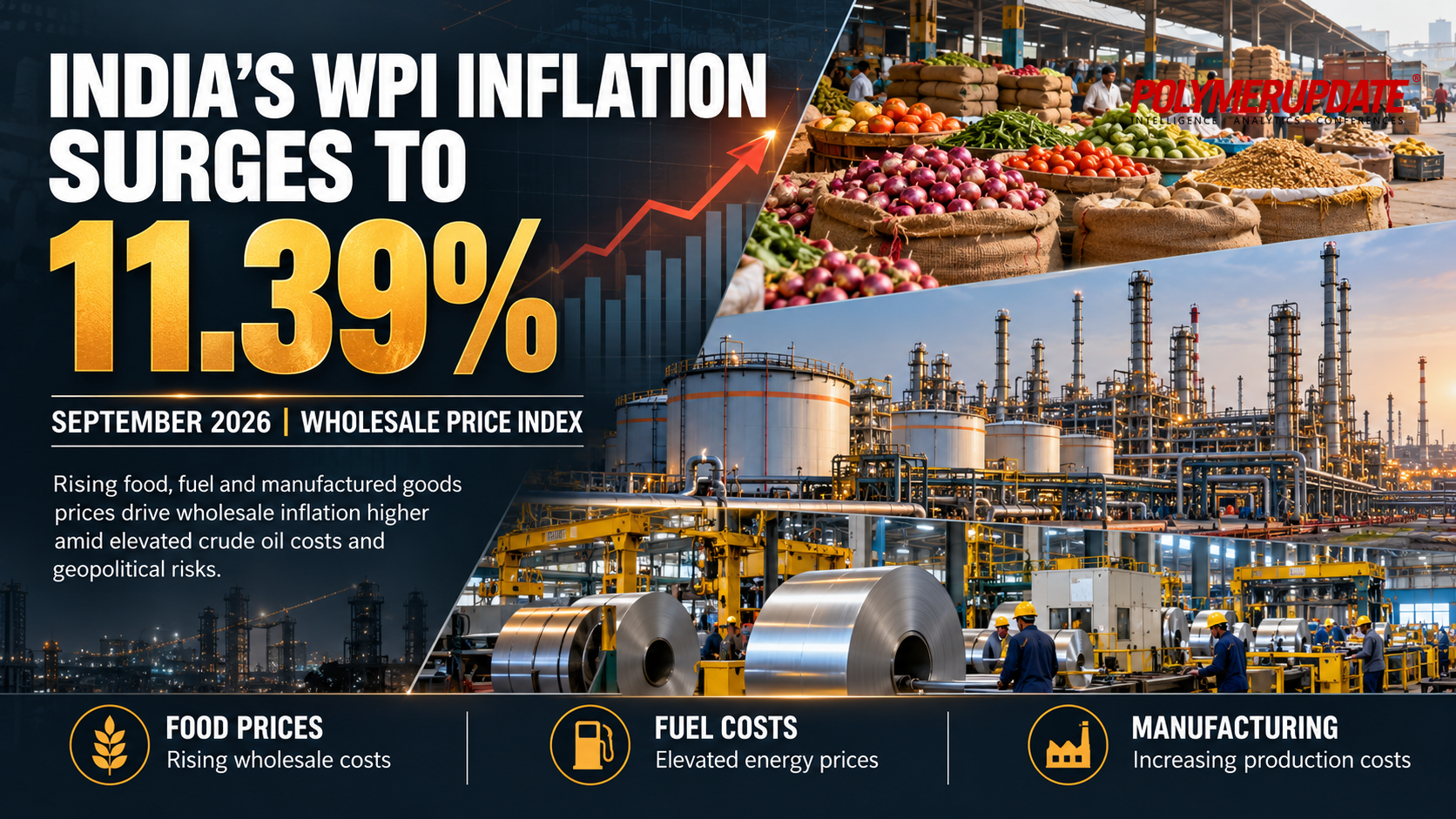
India’s Wholesale Price Index (WPI)-based inflation in bulk commodities rose to a record 11.39 percent in September under the new series, driven by a sharp increase in food prices, manufactured products, and fuel and electricity prices, according to data released by the Ministry of Commerce and Industry on Wednesday. The increase marked a substantial rise from 9.92 percent in August and 9.97 percent in July. Notably, headline WPI inflation stood at (-)0.2 percent in September 2025 under the old series. Headline output Purchase Price Index (PPI) inflation also rose by 11.4 percent, compared with zero growth in the corresponding period last year.
Madan Sabnavis, chief economist at Bank of Baroda, said, “In the latest WPI series, all major group heads (food, fuel and manufactured products) have contributed to the elevated inflation print. Food inflation remains a major driver, with food grains (both cereals and pulses), vegetables, fruits, milk, eggs and meat products all exhibiting upward price pressures. Within fuel inflation, the mineral oil index remains on the higher side, with the indices for crude petroleum, natural gas, aviation turbine fuel (ATF), liquefied petroleum gas (LPG), petrol and furnace oil all rising notably.”
 Food inflation up
Headline WPI inflation accelerated to 11.4 percent in September 2026 from (-)0.2 percent in September 2025 and 9.9 percent in August 2026. Compared with September 2025, food inflation was significantly higher at 8.7 percent against (-)3.4 percent a year earlier. A broad-based increase was visible across most sub-segments, including food grains, fruits, milk, eggs, meat and fish, and condiments and spices. Vegetable inflation rose to 16.5 percent from (-)30 percent a year earlier.
Among vegetables, the price indices for onion, ginger, cauliflower, cabbage and cucumber recorded the sharpest increases. As El Niño conditions continue to strengthen, food prices also face upside risks. Among meat and fish products, the price indices for eggs, beef and buffalo meat, goat meat, marine fish and pork recorded the sharpest increases. The condiments and spices index was driven higher by all sub-components except betel nut and tamarind. Food grain inflation also rose to 5.4 percent from (-)3.8 percent a year earlier, reflecting increases in the indices for both cereals and pulses.
Within cereals, all sub-indices gathered pace except for bajra. Similarly, within pulses, the price indices for all commodities increased in September 2026 compared with a year earlier, except for masur and khesari. Internationally, World Bank Pink Sheet data indicate a similar upward trend in paddy and wheat prices. Wheat prices increased by 41.9 percent in September 2026, compared with a decline of 9.8 percent in September 2025. Rice prices rose by 25 percent, against a decline of 34.5 percent a year earlier. These factors are expected to keep headline WPI inflation under pressure in the near term.
Purchase Price Index upSimilar trends are evident in output PPI as well. Input PPI has also begun to show month-on-month (MoM) upward pressure across 13 of the 21 manufactured product indices, including basic metals, chemicals, pharmaceuticals, textiles, motor vehicles, and computers and electronics. Going forward, as tensions in the Middle East continue to escalate and Brent crude has averaged around $103 per barrel so far in October 2026, inflationary pressure on fuel and manufactured products is likely to persist for some time. Volatility in oil prices could also intensify ahead of the US midterm elections.
PPI inflation in the mining of metal ores remained broadly stable, at 23.4 percent in September 2026 compared with 24 percent in September 2025, as increases in the indices for bauxite, copper ore and other metallic minerals were offset by declines in those for iron ore and manganese. The index for crude petroleum extraction rose by 78.8 percent, compared with 3.9 percent in September 2025, while the index for natural gas extraction increased by 26.9 percent against a decline of 2.5 percent a year earlier.
Among manufactured products, output PPI data also indicate upward price pressures in tobacco products; textiles, including cotton, woollen yarn and textiles, synthetic fibres, yarns and textiles; chemicals, including organic and inorganic chemicals, fertilisers and paints; basic metals, including non-ferrous metals and iron and steel castings and forgings; refined petroleum products; and electrical equipment, including cables and wires, electrical appliances and other electrical machinery.
Fuel and power inflationReflecting the impact of including crude petroleum and natural gas in the index, fuel and power inflation rose by 25.9 percent in September 2026, higher than the 22.9 percent increase recorded in August 2026 and the (-)2.6 percent decline reported in September 2025. Compared with a year earlier, the mineral oil segment (40 percent against (-)3.1 percent) and crude petroleum and natural gas (57.3 percent against (-)3.3 percent) recorded the most significant increases. Within the latter category, the index for crude petroleum rose by 78.8 percent, compared with a decline of 3.9 percent a year earlier, while that for natural gas increased by 26.9 percent against a decline of 2.5 percent.
Internationally, crude oil prices were also higher in September 2026, rising by 51 percent year-on-year compared with a decline of 7.3 percent during the same period last year. In October 2026, oil prices have risen further amid escalating tensions in the Middle East, including renewed attacks on Saudi Arabia’s critical infrastructure, registering a year-on-year increase of 60 percent so far.
Rajani Sinha, chief economist at Care Ratings Ltd, said, “Fuel and power inflation remained elevated as crude petroleum, natural gas and mineral oil prices continued to rise amid uncertainty surrounding key maritime chokepoints. Both India’s crude basket and spot Brent crude prices are trading well above Brent crude futures, indicating tightness in the physical supply of crude oil. The Indian crude basket and spot Brent crude prices averaged around US$ 123 a barrel and US$ 126 a barrel, respectively, in October so far, compared with an average of US$ 103 a barrel for Brent crude futures.”
Persistently elevated crude oil prices could increase freight, agricultural and irrigation, and transportation costs. Beyond energy, prices of select base metals, particularly copper and aluminium, have remained elevated, with copper touching an all-time high. Supply disruptions and strong demand driven by electrification, renewable energy expansion and data centres have supported metal prices. Elevated commodity prices are a concern, as they could sustain wholesale price pressures and indirectly feed into the Consumer Price Index (CPI) basket.
OutlookLooking ahead, the inflation outlook remains vulnerable to geopolitical and weather-related risks. Uncertainty surrounding key shipping routes and attacks on energy infrastructure continue to keep energy prices volatile. On the domestic front, a deficient monsoon poses risks to agricultural production. Although kharif sowing is down by only around 1 percent year-on-year, below-normal rainfall could adversely affect crop yields. Lower reservoir levels and inadequate soil moisture in several regions could also affect rabi crop production. The government may resort to supply-side interventions to contain food inflation. Taking these factors into account, we have revised our projection for average WPI inflation to around 10 percent in FY27.
DILIP KUMAR JHA
Editor
dilip.jha@polymerupdate.com