China’s economic growth accelerated to 4.5 percent year-on-year in the third quarter (Q3 or July-September) of 2026, beating market expectations as strong exports and resilient industrial production offset persistent weakness in household spending and the property sector. The Q3 economic growth data marks an improvement from the figure of 4.3 percent posted in the corresponding previous quarter, but a decline from 4.8 percent reported in the comparable quarter of last year.
Data released by the National Bureau of Statistics (NBS) showed that the world’s second-largest economy expanded by 1.1 percent quarter-on-quarter in July-September, compared with 0.9 percent in the second quarter. The latest performance was marginally above market expectations of 4.4 percent, indicating that economic activity gained momentum towards the end of the third quarter.
China’s economy grew by 4.6 percent year-on-year during the first nine months of 2026, generating approximately 107.11 trillion yuan (US$ 15.94 trillion) in economic output. The corresponding last year period for the first nine months was registered at 5.2 percent with manufacturing sector growing at a rapid pace. The latest figures suggest that Beijing remains on course to achieve its full-year growth target of 4.5-5.0 percent, although the sustainability of the recovery remains uncertain amid uneven economic performance and potential risks to external demand.
Lynn Song, chief economist for Greater China at ING Economics, said third-quarter growth would likely keep the annual target within reach. September’s activity data showed signs of stabilisation, although the recovery remained uneven. “With a few months left in the year, we believe China's economy is well positioned to achieve its 2026 growth target of 4.5-5.0 percent. However, the economy remains quite unbalanced heading into 2027, leaving growth vulnerable to disruptions in external demand. Fortunately, we also saw some favourable signs from the September domestic activity data,” Song added.
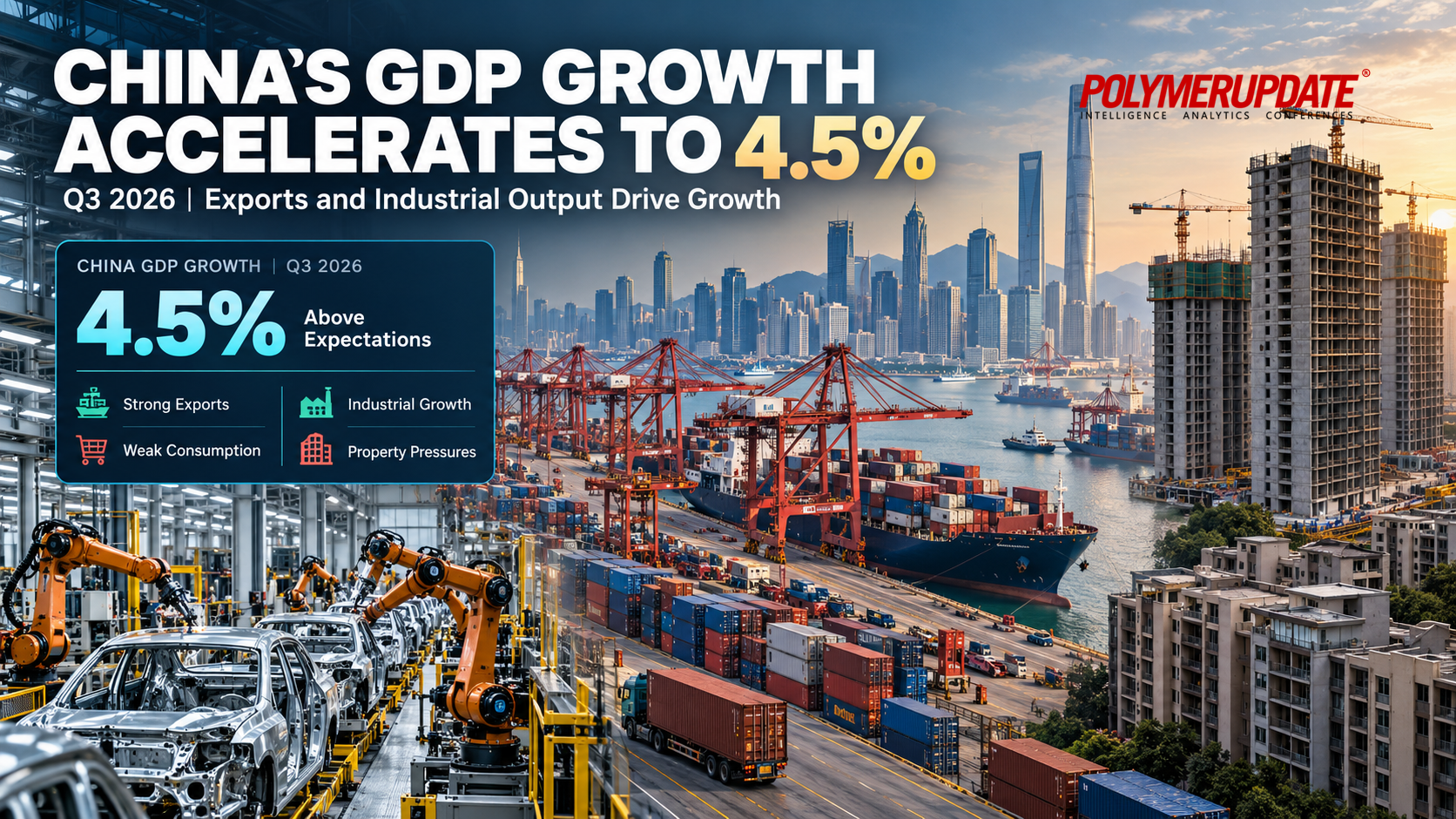 Exports and industrial production drive growth
Strong external demand remained a key contributor to China’s economic expansion during the third quarter. The country’s export-oriented manufacturing sector continued to benefit from demand for high-technology products, including electric vehicles, electronics, computer equipment and other advanced manufactured goods. China’s competitive position in global manufacturing, particularly in emerging technology supply chains, has helped sustain industrial activity despite subdued household spending and continued pressure on domestic investment.
Industrial production rose 5.5 percent year-on-year in September, accelerating from 5.2 percent in August and matching market expectations. High-technology manufacturing remained a major source of strength, expanding 15.3 percent during the month. Production in computers and communications equipment increased 16.4 percent, while output in railways, ships and aerospace rose 11.7 percent. Automobile production grew 6.7 percent, reflecting continued strength in selected manufacturing segments.
The performance highlights the growing importance of advanced manufacturing in China’s economic structure. Investment in technology-intensive industries and established industrial supply chains have supported output even as more traditional sectors, particularly property, continue to struggle. However, reliance on exports also leaves the economy exposed to fluctuations in overseas demand, trade restrictions and intensifying competition in global markets. Any deterioration in external conditions could undermine the manufacturing-led recovery, particularly if domestic spending does not strengthen.
Services sector on growth pathChina’s tertiary sector, which includes services, continued to outperform the primary and secondary industries for the sixth consecutive quarter, reflecting the economy’s gradual structural shift towards services. The services sector expanded 5.2 percent year-on-year in the third quarter, compared with growth of 3.6 percent in the primary sector and 3.4 percent in the secondary sector. The stronger performance indicates that activities beyond traditional agriculture and manufacturing are becoming increasingly important to overall economic growth.
As China’s economy matures, services are expected to account for a larger share of output and economic activity. Nevertheless, the sector’s performance has not been sufficient to offset the relatively weak contribution from consumption. Final consumption expenditure contributed 2.148 percentage points to GDP growth, its lowest contribution since the fourth quarter of 2022, according to ING Economics. This highlights the gap between China’s robust production and export performance and the limited momentum in household spending.
Modest improvement across retail salesSeptember’s retail sales data provided some encouragement, with growth improving to 1.1 percent year-on-year from 0.4 percent in August. The increase was stronger than market expectations of 0.5 percent and ING Economics’ forecast of 0.6 percent, suggesting that consumer activity may be stabilising. Communication appliances recorded particularly strong growth of 31.1 percent, likely supported by the launch of new smartphone models. Sales of tobacco and alcohol rose 13.8 percent, while grains and oils increased 6.7 percent and beverages grew 5.0 percent.
However, the improvement remained concentrated in selected categories rather than reflecting a broad-based revival in household spending. Sales of gold and jewellery declined 9.6 percent, while automobile sales fell 21.2 percent, highlighting continued weakness in several discretionary consumption segments. The mixed performance suggests that households remain cautious about spending, potentially reflecting uncertainty over employment, income prospects and property-related wealth effects. A broader recovery in consumer demand would help reduce China’s dependence on exports and make growth less vulnerable to shifts in global trade.
Investment and property sectors dragFixed-asset investment continued to weigh on the economy, although September’s data indicated that the pace of deterioration had stabilised. Investment declined 7.2 percent year-on-year, compared with a market forecast of a 7.3 percent contraction and ING Economics’ expectation of a 7.5 percent fall. The stabilisation followed a period of monthly deterioration since March. Public-sector investment, which contracted 3.2 percent, and manufacturing investment, down 2.1 percent, showed signs of improvement. However, these gains were offset by a sharper decline in private-sector investment, which fell 10.4 percent.
Real estate investment dropped 20.6 percent, while infrastructure investment declined 4.2 percent, underscoring the continuing weakness in construction-related activity and broader capital expenditure. The stabilisation may indicate that measures to accelerate fiscal spending, outlined at the July Politburo meeting, are beginning to have an impact. However, a sustained recovery will require stronger private-sector confidence and a more durable improvement in property market conditions. The property sector remains one of China’s most significant structural challenges. Falling property values and weak investment have continued to affect construction activity, household confidence and demand for related products, including steel, cement and other industrial materials.
September data showed that property prices were still declining, although at a slower pace than in August. New home prices across 70 major cities fell 0.14 percent month-on-month, marking their smallest decline in 17 months. Prices stabilised or increased in 21 cities. Existing home prices declined 0.26 percent month-on-month, the smallest fall in four months, with prices stabilising or rising in 11 cities. Tier-one cities continued to perform relatively well, while some tier-two cities also showed signs of price recovery. Although the slower pace of decline offers a limited positive signal, the property market has yet to demonstrate a broad-based recovery capable of materially supporting economic activity.
Growth target within reachChina’s third-quarter performance suggests that the economy has retained sufficient momentum to meet its 2026 growth target. Strong exports, high-technology manufacturing and resilient industrial production have provided important support, while September’s retail sales and investment data indicate tentative signs of stabilisation. However, the uneven distribution of growth remains a concern heading into the final quarter of the year and 2027. The economy’s dependence on exports leaves it exposed to weaker global demand and potential disruptions to international trade, while the prolonged property downturn continues to constrain investment and demand for construction materials.
For policymakers, the challenge will be to sustain industrial competitiveness while encouraging households and private businesses to spend and invest more confidently. Further fiscal support, measures to stabilise the property market and policies aimed at boosting consumer demand could become increasingly important. For global commodity markets, China’s industrial resilience offers support to demand for manufacturing inputs.
However, the continued contraction in property investment and weakness in infrastructure spending could limit consumption of steel, cement and other building materials. Overall, the latest GDP figures indicate that China remains on track to meet its annual growth objective, but achieving a more balanced and durable expansion will depend on whether the strength of industrial activity can translate into broader domestic economic momentum.
DILIP KUMAR JHA
Editor
dilip.jha@polymerupdate.com