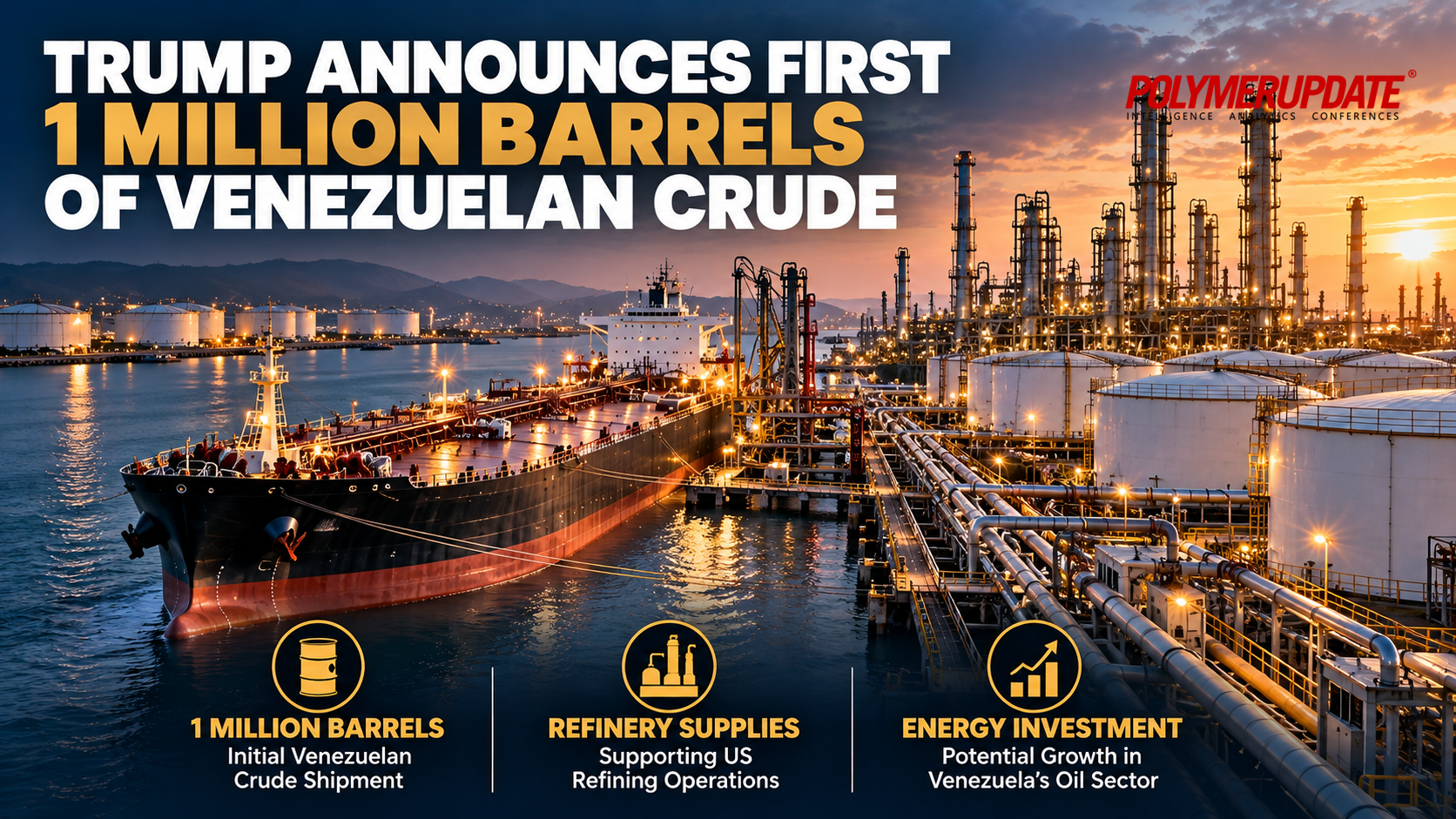
US President Donald Trump has announced the arrival of the first one million barrels of crude oil secured under his administration’s Venezuela oil agreement, describing the deal as a major step towards strengthening American energy security, expanding access to crude supplies and lowering fuel prices for consumers. The administration said the shipment would be processed at refineries in Texas, supporting domestic employment and increasing the availability of petroleum products in the US market. It also claimed that the agreement would deliver oil at no cost to the US government or American taxpayers.
The announcement marks an important development in the Trump administration’s efforts to expand US influence over Venezuela’s oil industry and redirect additional crude supplies towards American refiners. However, the administration’s claims about the scale of the deal, the volume of reserves under US control and the likely impact on fuel prices will depend on the agreement’s implementation, production growth and the economics of transporting and processing Venezuelan crude.
The White House has described the agreement as one of the largest oil deals in history, claiming that it would give the US majority control of access to more than 65 billion barrels of proven Venezuelan oil reserves. This compares with approximately 46 billion barrels of proven reserves within US territory, according to figures cited by the administration. The proposed arrangement is intended to increase the flow of Venezuelan crude to US refineries while attracting investment into an oil industry that has suffered from years of underinvestment, operational difficulties and political instability.
 Focus on private-sector investment
According to the White House, the agreement was signed by US Secretary of State Marco Rubio and Secretary of War Pete Hegseth and provides the US government with governance rights, economic ownership interests and guaranteed low-cost oil offtake from a newly established private Venezuelan oil company. The company, identified by the administration as NABEP, is expected to develop oilfields and expand production with the support of US equipment, drilling rigs, infrastructure and capital. The White House said the venture could become the world's second-largest private oil company by reserves.
The administration has emphasised that the agreement is with a private company rather than Venezuela's interim government. It has also rejected suggestions that the arrangement was negotiated as part of a political agreement with the interim authorities. The White House said the agreement would be governed by US law, with legal advisers and auditors involved in developing safeguards intended to ensure transparency and accountability. It also said financial monitoring mechanisms had been established to ensure that oil revenues were directed towards productive uses in Venezuela.
Any payments allocated by NABEP to Venezuela's state-owned oil company, Petróleos de Venezuela SA (PDVSA), would be channelled through a US-managed and audited account, according to the administration. The White House has argued that these arrangements would distinguish the new investment model from the practices that contributed to the deterioration of Venezuela's oil infrastructure.
Oil production and refinery demandA central objective of the agreement is to bring previously underdeveloped Venezuelan oil resources into production and direct a larger share of the resulting output to the US market. The administration said the 17 oilfields covered by the arrangement had previously been operated or controlled by foreign companies or individuals associated with former Venezuelan leaders Hugo Chávez and Nicolás Maduro. It alleged that Russian and Chinese interests, along with politically connected operators, had failed to invest adequately in the country's energy infrastructure.
Under the proposed framework, US-led operations would replace those arrangements and support higher production through new investment, equipment and technology. The administration said the private company involved already produces around 250,000 barrels of oil per day and could begin supplying materially larger volumes to the US as early as next year. It expects oil to start flowing to the market at cost by the end of this year, with supplies increasing significantly over the following 12 months.
If production expands as projected, US refiners could gain access to additional supplies of Venezuelan crude, potentially reducing their dependence on other international sources. The agreement could also support demand for American oilfield services, drilling equipment, engineering and related infrastructure. Texas is expected to be a major beneficiary because of its extensive refining capacity and established energy infrastructure. Additional crude processing could support employment across refining, transportation, storage and associated industrial activities.
However, the pace of any production increase will depend on the condition of the oilfields, the availability of investment, infrastructure reliability and the operational requirements of Venezuela's heavy-crude resources. Higher output will also require dependable arrangements for transporting, processing and marketing the oil.
Fuel prices and energy securityThe Trump administration has presented the agreement as a way to strengthen American energy dominance and lower petrol and diesel prices. It has argued that securing additional crude supplies from Venezuela would improve domestic availability and help moderate energy costs. The actual impact on retail fuel prices, however, will depend on several factors, including the volume of additional oil reaching US refineries, refinery margins, transportation costs, global crude benchmarks, seasonal demand and conditions in international oil markets.
An increase in Venezuelan supplies could improve the availability of suitable crude for US refiners, particularly those equipped to process heavier grades. Nevertheless, additional supplies would not automatically translate into an equivalent reduction in petrol and diesel prices, which are influenced by global market conditions as well as domestic refining and distribution costs. The administration has also claimed that the agreement would substantially increase America's strategic oil reserves.
Its reference to more than 65 billion barrels, however, relates to the broader claim about proven Venezuelan reserves under the arrangement, rather than a direct addition of that volume to the US Strategic Petroleum Reserve. The two concepts are distinct: oil reserves are underground resources, while strategic reserves generally refer to crude already held in storage. Consequently, the agreement's contribution to US energy security will depend on the extent of effective control, the enforceability of offtake rights and the amount of oil that can actually be produced and delivered.
Venezuela's political transitionBeyond its implications for the US energy sector, the White House has positioned the agreement as a central component of a broader three-stage strategy for Venezuela involving stabilisation, economic recovery and reconciliation, followed ultimately by a democratic transition. The administration argues that sustained private-sector investment and higher oil production are necessary to revive an economy damaged by prolonged inflation, weak and deteriorating infrastructure. It has maintained that economic stabilisation would create conditions conducive to future elections and political reconciliation.
Venezuela possesses substantial petroleum resources, but years of inadequate investment, operational disruption and institutional difficulties have constrained its ability to translate those resources into stable production and public revenue. New capital and technology could help address some of these constraints, provided that the operating framework remains viable and investment is sustained. The agreement nevertheless raises questions about the distribution of economic benefits, the governance of oil revenues and the role of Venezuelan institutions in managing the country's natural resources.
The effectiveness of the proposed financial safeguards will be important in determining whether increased production translates into broader economic gains for the Venezuelan population. The administration has compared the arrangement with the operating model used by Chevron in Venezuela, arguing that established commercial practices and stronger oversight can facilitate production while protecting US interests.
A broader geopolitical strategyThe agreement also reflects Washington's efforts to limit the influence of Russia and China in Venezuela and strengthen American economic and strategic ties across the Western Hemisphere. The White House has framed the initiative as part of President Trump's revival of the Monroe Doctrine, under which Washington seeks to prevent rival powers from establishing dominant strategic positions in the Americas.
By redirecting investment and oil production towards US-linked operators, the administration aims to strengthen regional supply chains and support American manufacturing and energy industries. For global oil markets, the immediate significance of the first million-barrel shipment lies in the potential for additional Venezuelan crude to reach US refiners. The longer-term impact will depend on whether the agreement can deliver sustained production growth rather than merely redirect existing output.
The arrangement could strengthen US access to a major oil-producing country and provide Venezuela with an avenue to attract investment. But its broader promises—including substantially lower fuel prices, a dramatic expansion of effective US oil access and a durable economic recovery in Venezuela—remain contingent on production, investment, governance and market conditions.
For now, the first shipment represents an initial step in an ambitious energy and foreign-policy initiative. Whether it develops into a lasting transformation of Venezuela's oil industry and a material source of relief for American motorists will become clearer as production expands and the agreement moves from announcement to execution.
DILIP KUMAR JHA
Editor
dilip.jha@polymerupdate.com