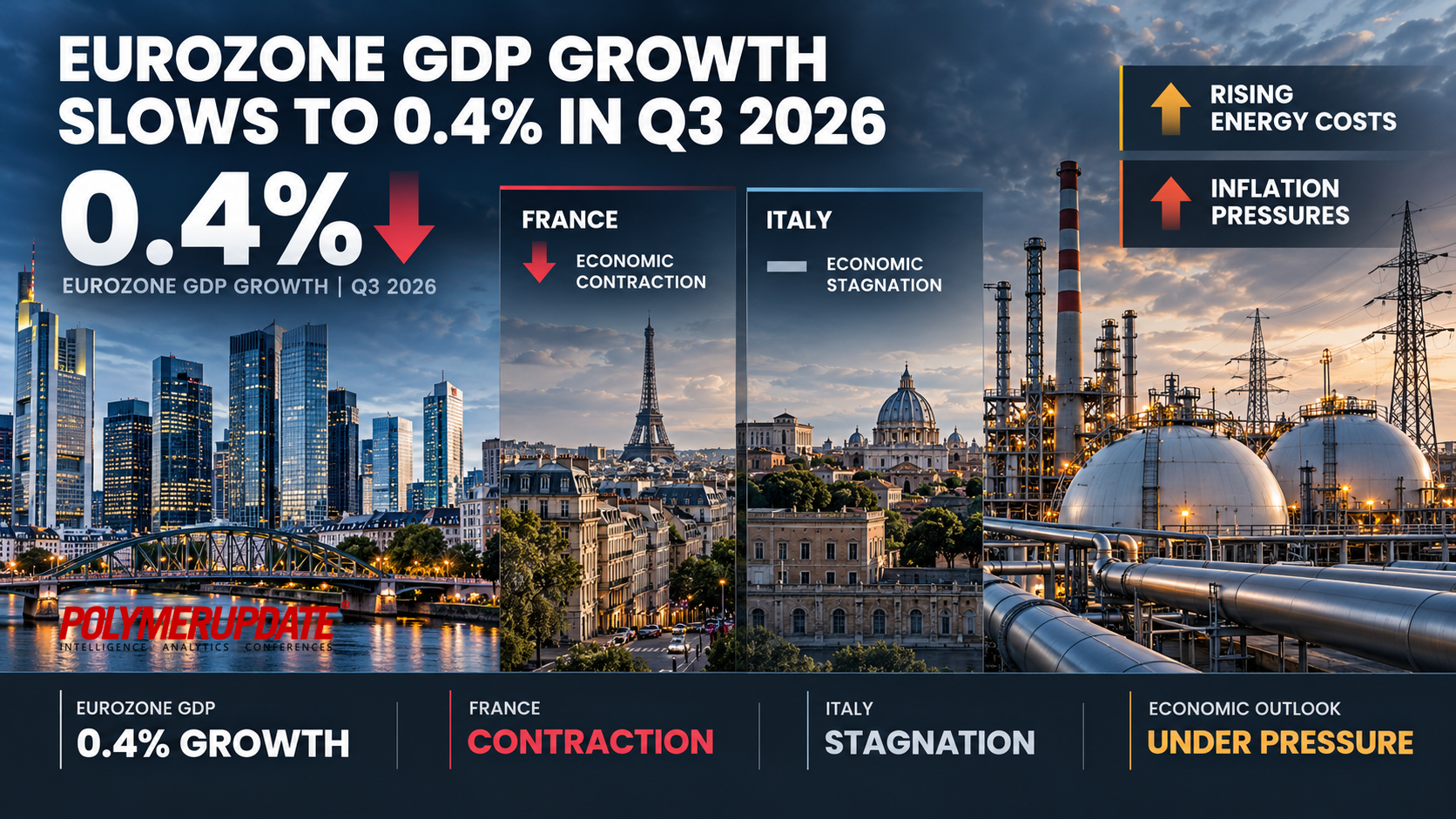
The eurozone economy expanded at a slower-than-expected pace in the July-September (third) quarter of 2026, as weak performances in some of its largest economies offset stronger growth elsewhere, highlighting the challenges facing the region amid geopolitical uncertainties, rising energy costs and persistent inflationary pressures. According to preliminary estimates released by Eurostat on Friday, gross domestic product (GDP) in the euro area increased by 0.4 percent quarter-on-quarter in the July-September period, compared with 0.6 percent growth in the preceding quarter.
However, the expansion exceeded market expectations of 0.2 percent, indicating that economic activity has remained relatively resilient despite the deterioration in the external environment. Across the broader European Union (EU), GDP grew by 0.5 percent in the third quarter, moderating from 0.7 percent in the April-June period. On an annual basis, the eurozone economy expanded by 1.3 percent in the third quarter, accelerating from 1.2 percent in the previous quarter. GDP growth across the EU also improved to 1.5 percent from 1.4 percent in the preceding quarter.
The headline growth figure, however, masks considerable differences in economic performance across member states. Ireland recorded the strongest quarterly expansion at 5.5 percent, although its performance was substantially influenced by volatile multinational corporate and pharmaceutical activities, making it less representative of underlying economic conditions. Among the larger economies, Spain and the Netherlands recorded growth of 0.6 percent each, while Germany expanded by a modest 0.2 percent. Italy's economy stagnated, with zero growth following a 0.2 percent expansion in the second quarter. France unexpectedly contracted by 0.1 percent, performing worse than market expectations.
 Disappointing France and Germany
France's economic performance was particularly disappointing, with preliminary estimates from the national statistics institute INSEE showing that GDP contracted by 0.1 percent during the third quarter. The decline reflected weakness in overall production, investment and external trade, despite an improvement in household consumption. Production of goods and services declined by 0.1 percent between July and September, while household consumption increased by 0.4 percent. However, investment contracted by 0.6 percent, and foreign trade subtracted 0.6 percentage points from GDP growth.
The disappointing performance comes amid domestic budget-related uncertainty and rising government bond yields, which have added to concerns about France's fiscal position and economic outlook. Germany, Europe's largest economy, managed to register modest growth of 0.2 percent, slowing from 0.3 percent in the preceding quarter. Nevertheless, the outcome exceeded market expectations of just 0.1 percent growth. According to Germany's Federal Statistical Office, Destatis, a marginal increase in final consumption expenditure supported economic activity, while investment declined.
The strong export momentum witnessed during the first half of 2026 also moderated considerably during the third quarter. On an annual basis, German GDP increased by 1.2 percent after adjusting for price and calendar effects, marking its strongest growth since the third quarter of 2022. The improvement from the previous quarter's 1 percent expansion suggests some stabilisation in economic activity, although the investment and export environment remains challenging.
Spain outperforms, Italy pangsSpain continued to outperform most major eurozone economies, with GDP expanding by 0.6 percent in the third quarter, although growth moderated from 0.7 percent in the preceding quarter. On an annual basis, the Spanish economy recorded robust growth of 2.7 percent. However, inflation remains a concern. Spain's annual inflation rate stood at 4.9 percent in October, unchanged from September, while monthly inflation accelerated to 0.6 percent from 0.3 percent.
Italy's economic performance was another source of concern. After growing by 0.2 percent in the second quarter, the country's GDP stagnated during the July-September period. Annual growth consequently slowed to 0.8 percent from 1 percent in the previous quarter. Paolo Pizzoli, Senior Economist for Italy and Greece at ING Economics, said, “The positive contribution from domestic demand was offset by weaker net exports. The latest GDP reading was weaker than anticipated and raised doubts about the government's ability to achieve its 1 percent growth target for 2026.”
According to Pizzoli, services and agriculture recorded an expansion in value added, while industrial activity contracted. Although infrastructure-related construction investment may continue to receive support from projects under Italy's National Recovery and Resilience Plan, weakening consumer confidence and inflationary pressures could constrain domestic demand in the coming months. “Deteriorating consumer sentiment was increasingly reflecting concerns about the economy and the impact of higher prices on disposable incomes, with households becoming less inclined to purchase durable goods,” he noted. ING has consequently tilted its 2026 growth forecast of 0.9 percent towards the downside, with a flat fourth quarter potentially leaving annual growth at 0.8 percent.
Energy shockDespite the moderation in quarterly growth, the eurozone economy has demonstrated resilience since the outbreak of the Middle East conflict at the end of February. However, economists caution that the full economic impact of higher energy prices could become more pronounced during the winter months. Bert Colijn, Chief Economist for the Netherlands at ING Economics, said eurozone GDP growth remained relatively strong, notwithstanding the slowdown from 0.6 percent to 0.4 percent in the third quarter.
He observed that the region had so far managed to withstand the economic consequences of the Middle East crisis, partly because the impact on inflation had remained relatively contained and real wage growth was still positive. Industrial activity, however, is increasingly facing pressure from higher energy costs, even as the technology investment boom and increased defence and infrastructure expenditure provide support to economic activity.
Colijn pointed out that excluding Ireland's unusually strong performance, eurozone growth was approximately 0.2 percent in the third quarter, indicating a more moderate underlying expansion. The region's growth rate has also declined for three consecutive quarters when Ireland is excluded. Looking ahead, rising energy and natural gas prices could put additional pressure on businesses and households during the winter. Higher borrowing costs are another potential constraint, with the European Central Bank's bank lending survey indicating reduced appetite among businesses for borrowing.
Lagarde's early departureThe economic outlook is also coinciding with an important leadership transition at the European Central Bank (ECB). ECB President Christine Lagarde announced on October 29 that she would step down on February 7, 2027, approximately nine months before the scheduled conclusion of her eight-year term in October 2027. Lagarde said her decision would allow her to shed the strict political neutrality expected of a central bank president and enjoy greater freedom of speech to participate in wider public and political debates.
Her announcement has prompted speculation about her future involvement in public affairs, particularly in the context of political developments in France and the country's forthcoming spring presidential election. European leaders have initiated discussions on identifying her successor, with former Bank of Spain governor and current Bank for International Settlements General Manager Pablo Hernández de Cos, and former Dutch central bank governor Klaas Knot, emerging among the prominent potential candidates.
Lagarde's announcement came on the same day the ECB decided to keep its key deposit facility rate unchanged at 2.50 percent. However, the central bank faces a difficult policy environment as persistent inflation, reported at 3.8 percent, and higher energy costs threaten to complicate its efforts to maintain price stability while supporting economic activity. The possibility of further monetary tightening cannot be ruled out if energy-related price pressures become entrenched and inflation remains above the ECB's comfort level.
OutlookOverall, the third-quarter GDP figures suggest that the eurozone economy has retained some resilience, but the underlying growth momentum remains uneven. Weakness in France and Italy, subdued German expansion and the prospect of higher energy and financing costs indicate that economic activity could moderate further in the coming quarters. While technology-related investment and higher public expenditure on defence and infrastructure may provide some support, the region's ability to sustain growth will increasingly depend on the trajectory of energy prices, inflation and geopolitical developments.
DILIP KUMAR JHA
Editor
dilip.jha@polymerupdate.com