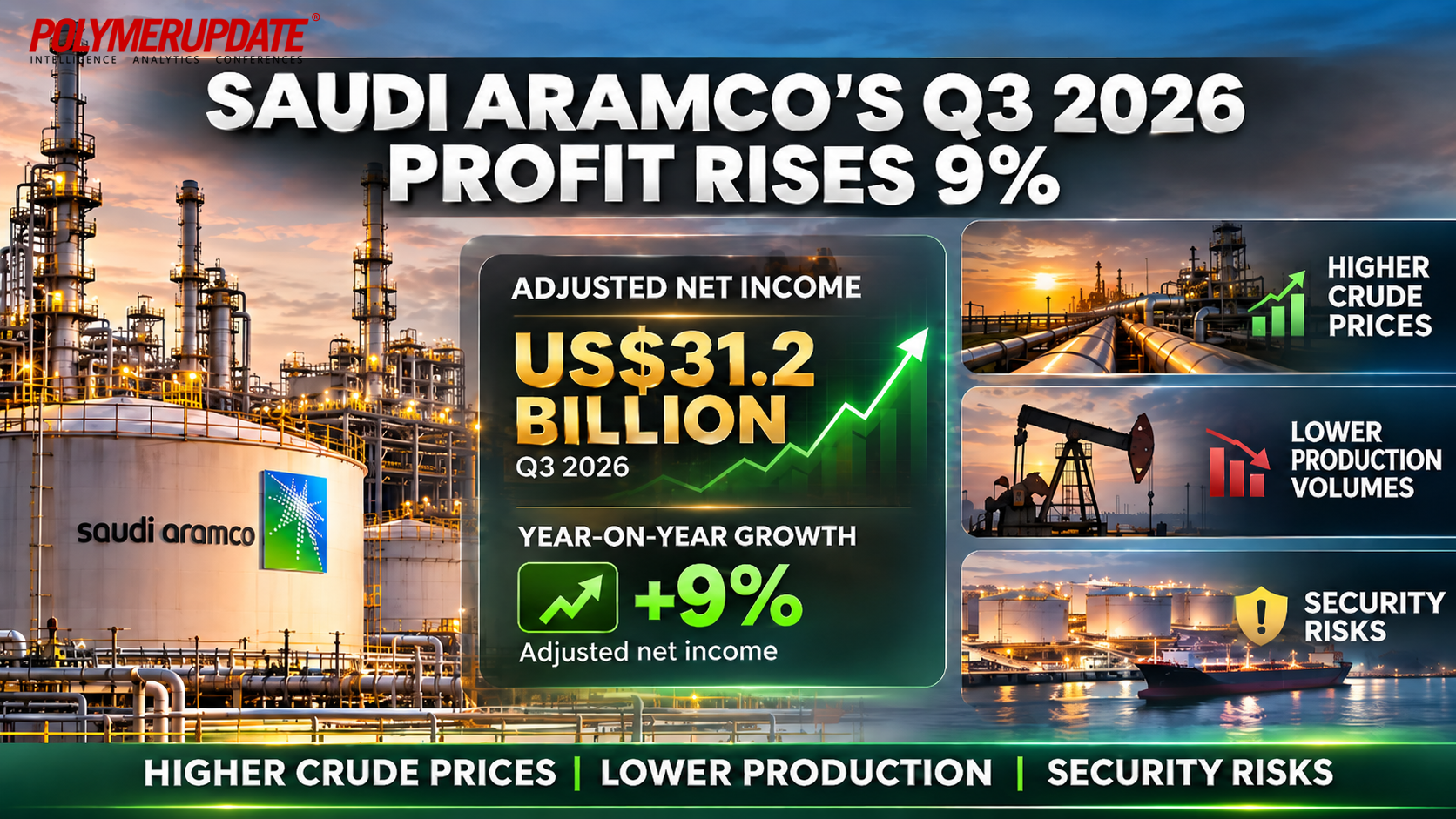
State-owned Saudi Arabian Oil Company (Aramco) posted an increase in its adjusted net income to the tune of 9 percent for the July-September 2026 quarter due to a substantial increase in realisation from crude oil and its derivatives following a sudden spike in their prices on geopolitical instability. Despite increase, Aramco management felt concerned as its net income registered a decline when compared with the sequential previous quarter amid rising missile strikes on the company’s oil infrastructure including refineries, pipeline, and transport facilities by multiple rebel groups during the period under consideration.
Data unveiled by the company reported its adjusted net income rose 9 percent to US$ 31.2 billion during the July-September 2026 (third) quarter from US$ 28.6 billion posted during the corresponding quarter of the previous year, but declined from US$ 33.4 billion in the second (April-June) quarter of 2026. Although the Saudi state-owned oil giant reported a 34.5 percent year-on-year increase in its third-quarter net profit, higher crude prices and stronger refining margins helped offset the impact of lower production, operational disruptions and mounting security risks.
 Growing cost
The third-quarter 2026 financial performance highlighted growing cost of geopolitical instability and attacks on critical energy infrastructure, as Yemen's Iran-aligned Houthi rebels intensified their campaign against Saudi Arabia's oil facilities during the July-September period. Saudi Aramco's operating costs and expenses have risen significantly, driven by higher purchasing costs, elevated selling and administrative expenses (including freight and derivative losses), and increased royalties and taxes.
The company said that its third-Quarter 2026 operating costs reached SAR 330,482 million (US$ 88,128 million) in Q3 2026, compared to SAR 224,640 million (US$ 59,904 million) in Q3 2025. Operating costs for the first nine months of 2026 rose to SAR 880,828 million (US$ 234,887 million), compared to SAR 702,941 million (US$ 187,451 million) during the same period in 2025. The overall cost increase was attributed to higher prices and volumes for crude oil, refined products, and chemical products purchased by the company; escalating freight costs and losses associated with derivative instruments amid regional supply disruptions; and increased due to higher average effective royalty rates and higher realized crude oil prices.
Notably, frequent attacks have added another layer of uncertainty to an already strained global energy market following the US-Iran war, which began in late February and disrupted crude production, shipping and exports across the Middle East. With traditional shipping routes through the Strait of Hormuz facing severe constraints, Saudi Arabia has increasingly relied on its East-West Pipeline to transport crude from its eastern production centres to the Red Sea export terminal at Yanbu. However, repeated attacks on Saudi energy infrastructure, including facilities in Jizan and other southern regions, have exposed the vulnerabilities of this alternative export corridor and complicated Aramco's efforts to maintain uninterrupted supplies to international customers.
Houthi’s offensive since JulyThe Houthi campaign gathered momentum in July, when the group announced a blockade of Saudi Arabia's oil industry and threatened to extend the disruption to the Red Sea, another critical artery for international energy trade. On July 27, the group claimed to have targeted several sensitive crude oil supply and transportation facilities connecting eastern Saudi Arabia with Yanbu. The attacks were intended to undermine the kingdom's efforts to bypass the Strait of Hormuz by redirecting crude exports through the East-West Pipeline.
The campaign escalated further in August. On August 9, the Houthis claimed responsibility for a drone attack on Aramco's Jazan refinery in southwestern Saudi Arabia. The Saudi Energy Ministry confirmed that a fire had broken out at the facility but said it had been extinguished without injuries. The refinery has a processing capacity of 400,000 barrels per day, although it had reportedly been shut since late July. Consequently, the incident raised concerns over the security of the facility rather than establishing an additional production loss of 400,000 bpd.
The attacks also extended beyond individual refining facilities to the wider oil transportation and export network. The Houthis' threats against Saudi-linked vessels and infrastructure increased concerns about the security of crude shipments through the Red Sea and the strategic Bab el-Mandeb Strait, which connects the Red Sea with the Gulf of Aden and the Indian Ocean. In September, the confrontation intensified considerably as group, on September 8, announced a broad operation targeting Saudi energy installations, including facilities belonging to Aramco in the country's southern region. Saudi authorities confirmed attacks on several energy-related facilities and installations and reported that the strikes had injured at least 73 people.
Vulnerability of East-West PipelineThe attacks have assumed greater significance because Saudi Arabia's ability to maintain crude exports has become increasingly dependent on alternative transportation infrastructure. The East-West Pipeline, which connects the kingdom's eastern oil-producing regions with its western Red Sea coast, has played a crucial role in maintaining exports following disruptions to shipping through the Strait of Hormuz. Its importance has increased as Saudi Arabia seeks to preserve international deliveries despite restrictions affecting traditional Gulf export routes.
However, the pipeline's vulnerability became particularly evident in September, when a drone attack launched from Iraq on September 11 temporarily shut the system for 11 days. The attack was attributed to an Iraqi-origin drone and should be distinguished from the Houthi strikes. Nevertheless, it demonstrated how attacks from different regional actors could simultaneously threaten Saudi Arabia's alternative export infrastructure. The interruption highlighted the vulnerability of the kingdom's western export corridor at a time when the Red Sea route had become increasingly important to global energy security.
The Houthis also intensified their maritime campaign against Saudi-linked shipping, attacking on 10 commercial vessels between July 13 and September 25, most of those tankers, with at least six successfully struck. Seven of the targeted vessels either flew the Saudi flag or belonged to Saudi companies. The attacks increased the risks associated with transporting crude and petroleum products through the Red Sea, Bab el-Mandeb and the Gulf of Aden.
Lower production, higher prices support earningsThe impact of the wider regional conflict is reflected in Aramco's third-quarter production figures. Total hydrocarbon production averaged 11.05 million barrels of oil equivalent per day (boepd), compared with 13.3 million boepd in the year-earlier quarter. Total liquids production declined to 8.7 million bpd from 10.8 million bpd. Saudi Arabia's crude oil production stood at approximately 8 million bpd in September, according to secondary sources cited by OPEC in its latest monthly report, down from slightly more than 10 million bpd before the war.
However, these reductions cannot be attributed solely to Houthi attacks. The wider US-Iran conflict, restrictions on shipping through the Strait of Hormuz, regional production disruptions and operational constraints have collectively affected Saudi output and export flows. Higher crude prices provided an important cushion against lower production volumes. Aramco's average realised crude price increased to US$ 95.20 a barrel in the third quarter from US$ 70.10 a barrel in the corresponding period last year, although it was lower than the US$ 108.10 a barrel recorded in the second quarter.
The company's reported net profit reached US$ 36.25 billion, compared with US$ 26.9 billion a year earlier and US$ 32.7 billion in the previous quarter. The reported increase also benefited from the September completion of the sale of Aramco's 50 percent equity interest in the PRefChem refining and petrochemical joint ventures in Malaysia to partner Petronas. Downstream adjusted earnings before interest and tax increased 234 percent year-on-year, supported by stronger refining margins, providing another cushion against upstream disruptions.
Despite the operational challenges, Aramco maintained its third-quarter base dividend at US$ 21.9 billion, up 3.5 percent year-on-year. Its free cash flow increased to US$ 28.2 billion from $23.6 billion a year earlier, while cash flow from operating activities reached US 38.7 billion.
Supply reliabilityAramco's supply reliability declined to 97.8 percent in the third quarter from 99.9 percent in the year-earlier period and 98.4 percent in the second quarter. The company attributed its ability to maintain relatively high reliability to operational flexibility and the rapid restoration of export loadings following disruptions to the East-West Pipeline.
Aramco President and CEO Amin Nasser said geopolitical uncertainty and attacks on key energy facilities had continued to amplify the global energy supply crisis during the quarter, with serious implications for energy security. He said the company had continued delivering reliably to customers despite the extraordinary operating environment and was exploring additional overseas storage capacity and alternative export routes to strengthen its supply network.
The company is also progressing with projects intended to strengthen its longer-term production capacity. Production has commenced at the Zuluf crude oil increment, which is expected to process up to 600,000 bpd by the end of 2026. Meanwhile, the second phase of the Jafurah unconventional gas project remains on track for completion in 2027, with the project expected to reach 2 billion standard cubic feet per day of gas production by 2030.
DILIP KUMAR JHA
Editor
dilip.jha@polymerupdate.com