GAIL Mangalore Petrochemicals Limited (GMPL), a wholly owned subsidiary of GAIL (India) Limited, has successfully commissioned its 1.25 million tonnes per annum (MTPA) Purified Terephthalic Acid (PTA) manufacturing plant at the Mangalore Special Economic Zone (MSEZ) in Karnataka, marking a significant milestone in the company's downstream petrochemical expansion strategy. The commissioning of the facility is expected to strengthen India's domestic PTA manufacturing capacity, improve the availability of a critical raw material for the polyester industry and reduce the country's dependence on imports.
The development also marks the revival of a major petrochemical asset that had remained distressed following financial difficulties at its original owner, JBF Petrochemicals Limited (JBPL). GAIL acquired JBPL in 2023 through the Corporate Insolvency Resolution Process (CIRP), following approval of its resolution plan by the National Company Law Tribunal (NCLT). Subsequently, the state-owned natural gas major undertook an extensive revival, refurbishment and modernisation exercise to restore the facility to operational condition.
The successful commissioning follows considerable engineering, technological and operational challenges associated with reviving the plant. The project involved extensive efforts by GAIL's management and the GMPL team, alongside technology partners, consultants, contractors and other stakeholders. The commissioning represents an important step in GAIL's strategy to expand its presence beyond natural gas transmission and marketing into downstream petrochemicals, while strengthening its position across India's integrated energy and chemicals value chain.
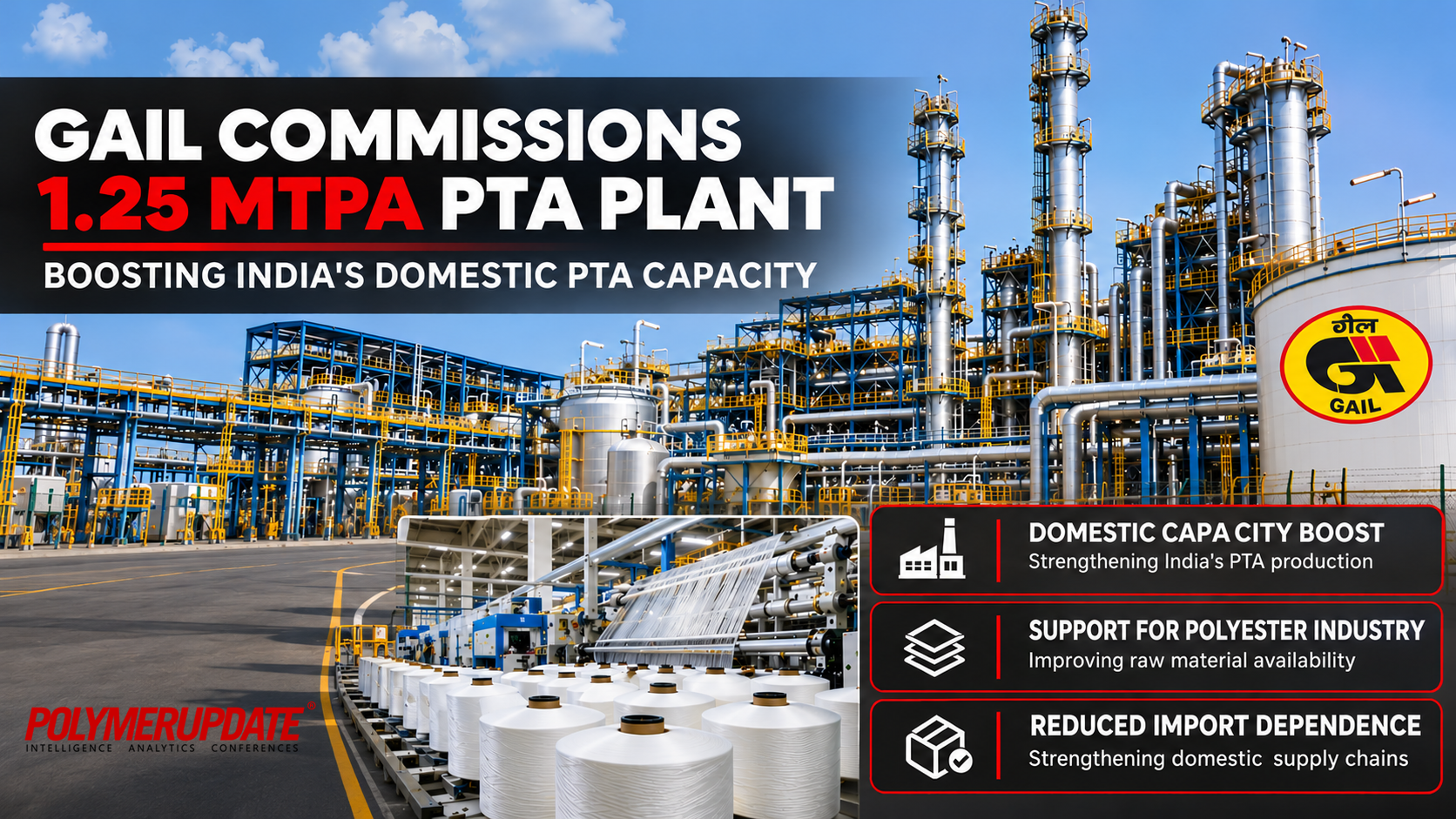 Strengthening India's PTA capacity
PTA is a key intermediate petrochemical used in the manufacture of polyester fibre, polyester filament yarn, polyethylene terephthalate (PET) resin and other polyester-based products. These materials are widely used in textiles, apparel, packaging, bottles, films and several industrial applications. The 1.25-MTPA facility represents a substantial addition to India's domestic PTA manufacturing infrastructure. Its commissioning is expected to improve the availability of domestically produced PTA for polyester manufacturers, potentially reducing their exposure to imported material and international supply-chain disruptions.
India's polyester industry is an important component of the country's textile and apparel manufacturing ecosystem. PTA, together with monoethylene glycol (MEG), constitutes the principal raw material for polyester production. Consequently, the availability and pricing of PTA have a direct bearing on the cost competitiveness and operating economics of downstream polyester producers. The commissioning of GMPL's facility is therefore expected to benefit textile manufacturers, polyester fibre and yarn producers, PET resin manufacturers and other downstream consumers by providing an additional domestic source of supply.
The development assumes particular significance at a time when the Indian petrochemical industry is seeking to strengthen domestic manufacturing capabilities, improve supply-chain resilience and reduce reliance on imported intermediates. Increased domestic PTA availability could also help downstream manufacturers manage procurement risks arising from fluctuations in international freight rates, exchange rates and feedstock prices.
Strategic location and marketing networkStrategically located in the Mangalore Special Economic Zone, the facility benefits from its proximity to New Mangalore Port, providing logistical advantages for the movement of imported raw materials and finished products. The plant is also supported by dedicated logistics infrastructure designed to facilitate efficient transportation and handling of feedstocks and finished PTA. Its coastal location offers access to maritime infrastructure and could provide operational flexibility in sourcing raw materials and serving customers across domestic and export markets.
GAIL will market the PTA produced at the facility under the brand name 'G-Tex', leveraging its established marketing network, customer relationships and distribution capabilities. The introduction of the G-Tex brand will provide GAIL with an opportunity to establish a presence in the PTA market and develop long-term relationships with polyester manufacturers and other industrial consumers. The plant's 1.25-MTPA capacity also provides GAIL with a significant platform to expand its downstream petrochemical business and participate more actively in India's growing polyester and packaging markets.
Financial performance provides growth backingThe commissioning comes at a time when GAIL has reported a substantial improvement in its financial performance during the first half of the financial year 2026-27 (H1 FY27), providing a stronger financial foundation for its capital-intensive expansion plans. According to the company's financial results, GAIL reported standalone revenue from operations of Rs 84,905 crore during April-September 2026, compared with Rs 69,824 crore in the corresponding period of the previous financial year, representing an increase of approximately 21.6 percent.
The company's standalone profit before tax (PBT) more than doubled to Rs 11,611 crore during H1 FY27, compared with Rs 5,357 crore in the corresponding period of FY26. Profit after tax (PAT) increased to Rs 8,943 crore from Rs 4,104 crore, registering year-on-year growth of approximately 118 percent. On a consolidated basis, GAIL reported revenue from operations of Rs 88,651 crore during H1 FY27, compared with Rs 71,086 crore in the corresponding period of the previous financial year.
Consolidated PBT stood at Rs 12,368 crore, against Rs 5,594 crore, while consolidated PAT attributable to the owners of the company, excluding minority interest, increased to Rs 9,385 crore from Rs 4,342 crore. GAIL's capital expenditure during the first half of FY27 stood at Rs 7,600 crore, including Rs 1,425 crore incurred during the second quarter, against its annual planned capital expenditure of approximately Rs 12,900 crore. The company's improving profitability and continued capital investment underscore its focus on strengthening infrastructure, expanding its natural gas business and developing downstream petrochemical capabilities.
Expanding downstream petrochemical ambitionsThe commissioning of the Mangalore PTA facility is strategically important for GAIL as it provides an opportunity to capture greater value from the downstream petrochemical segment rather than remaining predominantly focused on natural gas transmission, marketing and associated infrastructure. The project also complements the company's existing petrochemical operations, including its polymer manufacturing business, and offers potential opportunities to strengthen its participation across multiple segments of the petrochemical value chain.
For India's polyester industry, the additional PTA capacity could contribute towards a more diversified domestic supply base. However, the extent of import substitution will depend on the plant's operating rates, production economics, raw material availability, product quality, customer acceptance and competitiveness against imported PTA. The company's ability to maintain consistent production and secure long-term offtake arrangements with major polyester manufacturers will be important in determining the commercial success of the facility.
The project also demonstrates the potential of the insolvency resolution mechanism to revive distressed industrial assets and return significant manufacturing capacity to productive use. GAIL's acquisition of the former JBF Petrochemicals facility and its subsequent refurbishment have brought a large-scale petrochemical manufacturing asset back into operation. With the successful commissioning of the 1.25 MTPA plant, GMPL has entered a new phase of operations, while GAIL has taken another significant step towards strengthening its downstream petrochemical portfolio.
The facility is expected to play an important role in supporting India's domestic polyester manufacturing ecosystem, improving the availability of a critical petrochemical intermediate and advancing the country's broader objective of building a more resilient and self-reliant chemicals and petrochemicals industry.
DILIP KUMAR JHA
Editor
dilip.jha@polymerupdate.com