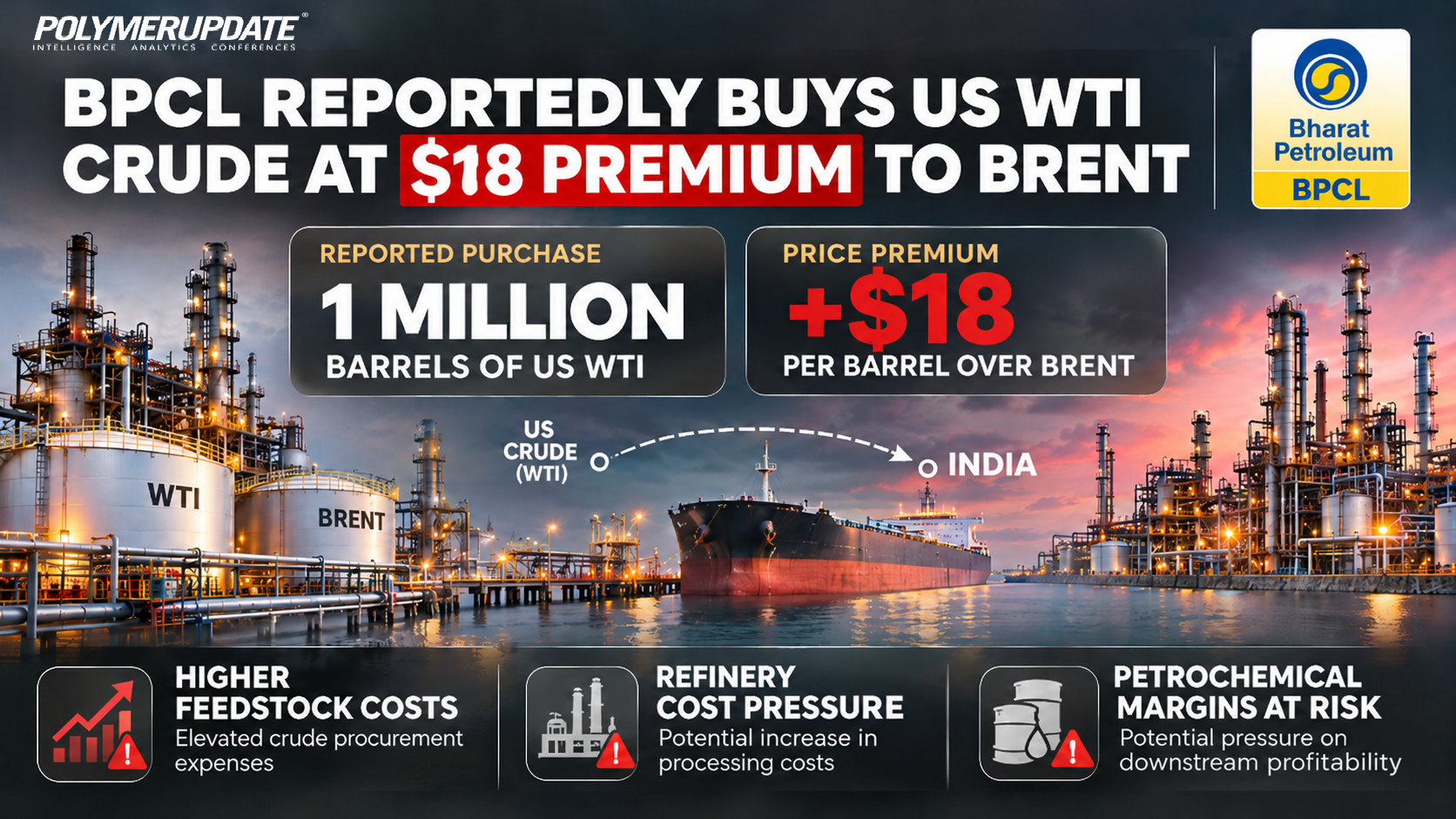
Bharat Petroleum Corporation Ltd (BPCL), one of India's leading state-owned refiners, has reportedly purchased 1 million barrels of US West Texas Intermediate (WTI) crude for delivery to Mumbai, highlighting the continued diversification of India's crude procurement sources amid volatile global oil markets. The cargo, scheduled to arrive between late December 2026 and early January 2027, was reportedly bought at a premium of around US$ 18 a barrel to dated Brent, according to trade sources.
The transaction assumes significance not only for India's refining industry but also for the domestic chemical and petrochemical sector, as higher crude procurement costs could translate into increased feedstock expenses for manufacturers of polymers, solvents, synthetic materials and other downstream chemical products.
Although BPCL has not publicly commented on the reported purchase, the decision to secure a sizeable US crude cargo at a substantial premium suggests that considerations beyond benchmark prices may have influenced the transaction. Refinery configuration, crude quality, expected product yields, freight economics and delivery schedules are among the factors that typically determine the commercial attractiveness of imported crude.
 Changing crude procurement economics
The reported premium of approximately US$ 18 a barrel to dated Brent indicates that BPCL was prepared to pay more for the specific grade and delivery window. Such pricing is noteworthy because US WTI has traditionally attracted Asian refiners when favourable Brent-WTI differentials and freight economics make American crude competitive against Middle Eastern alternatives.
However, crude procurement decisions are rarely determined by benchmark prices alone. Refiners evaluate the delivered cost of individual grades, including transportation expenses, insurance, quality differentials and the potential value of refined products obtained from processing them. WTI's characteristics, including its relatively light and low-sulphur composition, can offer operational flexibility to refineries configured to process different crude grades. Depending on the refinery's processing capabilities and product requirements, such crude can support the production of transportation fuels and other valuable petroleum products.
For BPCL, the 1-million-barrel purchase could provide flexibility in managing its crude slate and planning refinery operations during the year-end period. The late-December to early-January delivery window also suggests that the company is planning its crude requirements in advance rather than responding solely to immediate market conditions. The transaction further demonstrates that Indian refiners continue to consider Atlantic Basin supplies despite potentially less favourable pricing, particularly when specific grades or delivery schedules suit their operational requirements.
Implications for petrochemical industryThe more significant implication of the reported purchase lies in the potential transmission of higher crude prices through India's petroleum refining and petrochemical value chains. Crude oil is an important feedstock for several petrochemical building blocks, either directly or through intermediate refining products such as naphtha and liquefied petroleum gas (LPG). Naphtha is widely used in steam crackers to manufacture ethylene, propylene and other basic petrochemicals, which subsequently serve as feedstocks for polymers, synthetic fibres, solvents and speciality chemicals.
An increase in crude procurement costs can therefore raise the cost of producing several petrochemical intermediates, particularly when higher crude prices are reflected in naphtha and other feedstock benchmarks. For Indian petrochemical manufacturers, sustained increases in feedstock prices could create additional pressure on operating margins, especially if downstream demand remains subdued and producers are unable to pass on the entire cost escalation to customers.
The impact could extend across major polymer categories, including polyethylene (PE), polypropylene (PP) and polyvinyl chloride (PVC), although the extent of the effect would depend on individual production routes, feedstock availability, import parity and prevailing international price movements. Manufacturers of solvents, synthetic resins, industrial chemicals and other petroleum-derived intermediates could also face higher input costs. Downstream industries such as packaging, automotive components, construction materials, textiles and consumer goods may subsequently experience higher procurement expenses.
However, the relationship between crude prices and petrochemical production costs is not always immediate or uniform. Naphtha-based producers are generally more directly exposed to crude price movements, while manufacturers using ethane, propane or other feedstocks may experience different cost dynamics. Consequently, the competitive position of Indian petrochemical producers will depend increasingly on their feedstock mix, access to competitively priced raw materials and ability to pass higher costs through the value chain.
Intensifying margin pressuresThe reported BPCL purchase comes at a time when the global petrochemical industry is navigating a challenging combination of supply-demand imbalances, elevated operating costs and geopolitical uncertainties. Producers in several regions continue to face pressure from capacity additions, uneven downstream consumption and competition from low-cost manufacturing centres. Under these circumstances, a sustained increase in crude and naphtha prices could further squeeze margins for producers operating with relatively expensive feedstock.
Indian manufacturers may find it particularly challenging to absorb additional costs if international polymer prices do not increase proportionately. In such a scenario, the gap between raw material expenses and selling prices could narrow, affecting profitability across the petrochemical and downstream chemical industries. Import-dependent manufacturers could also face higher landed costs for petrochemical intermediates and finished products if elevated crude prices coincide with increased freight rates and currency-related pressures.
Nevertheless, higher international feedstock prices could offer some pricing advantages to domestic producers. If global supply remains constrained and imported material becomes more expensive, Indian manufacturers may gain greater pricing power in the domestic market. The extent of this benefit, however, will depend on demand conditions, inventory levels, import availability and the ability of downstream consumers to absorb higher prices.
Crude diversification and energy securityThe BPCL transaction also highlights India's continuing efforts to diversify crude procurement sources and maintain flexibility in its energy supply arrangements. India imports the bulk of its crude oil requirements, making its refining industry particularly sensitive to international price movements, geopolitical developments and changes in shipping economics. Refiners therefore regularly evaluate supplies from the Middle East, the United States and other producing regions to optimise procurement costs and reduce dependence on individual suppliers.
US crude has emerged as an important alternative for Asian refiners, supported by established export infrastructure and growing availability of seaborne supplies. However, the attractiveness of American barrels depends heavily on the Brent-WTI price differential, freight costs, insurance premiums and the compatibility of individual crude grades with refinery configurations. The latest reported purchase suggests that Indian refiners remain willing to secure US supplies even at a substantial premium when operational and commercial considerations justify the decision.
For BPCL, spot purchases also complement longer-term supply arrangements by providing flexibility to adjust crude intake according to changing market conditions. A 1-million-barrel cargo is sufficiently large to contribute meaningfully to monthly procurement planning while avoiding a longer-term commitment to a particular grade.
OutlookGoing forward, the impact of higher crude procurement costs on India's petrochemical industry will depend on the direction of global crude prices, naphtha availability, refining margins and downstream demand. If crude prices remain elevated, feedstock expenses could rise further, increasing cost pressures on polymer and chemical manufacturers. Producers with diversified feedstock sources, integrated operations and efficient production facilities may be better positioned to manage the volatility.
Conversely, any correction in crude prices or improvement in feedstock availability could provide relief to manufacturers, particularly those operating on naphtha-based production routes. Ultimately, BPCL's reported purchase of US WTI crude at an US$ 18 a barrel premium to dated Brent is more than a routine procurement transaction. It highlights the increasingly complex economics of crude sourcing and the potential implications of higher raw material costs for India's chemical and petrochemical value chains.
For domestic manufacturers, the key challenge will be balancing rising feedstock expenses against competitive selling prices in an industry where cost efficiency and access to affordable raw materials remain critical determinants of profitability.
DILIP KUMAR JHA
Editor
dilip.jha@polymerupdate.com