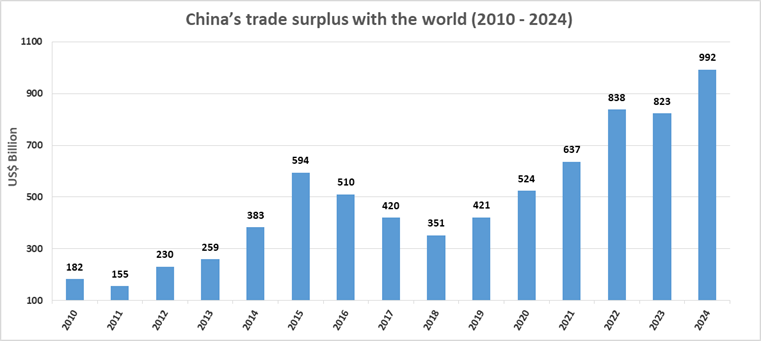
Just a week before U.S. President-elect Donald Trump assumes office, China surprised the world with a trade surplus of approximately US$ 1 trillion (US$ 992 billion, to be precise) in the calendar year 2024. This record trade surplus for the world’s second-largest economy comes at a time when other major economies continue to face challenges in sustaining trade and economic growth.
The surge in Chinese exports has been attributed to a strong push to accelerate shipments to the United States ahead of Donald Trump’s presidency. China’s export rush drove its total shipments to the U.S. to an impressive US$ 525 billion. In 2024, China recorded a trade surplus with the United States equivalent to only a third of the total U.S. trade deficit. This dynamic explains why President-elect Trump, during his election campaign rallies, threatened to impose customs duties of up to 60 percent on Chinese goods. President-elect Donald Trump is scheduled to assume the White House Presidential office on January 20, 2025.
Sources: General Administration of Customs, People’s Republic of China; and Polymerupdate Research
Madan Sabnavis, Chief Economist, Bank of Baroda, commented, “This is indicative of strong push to exports which has been successful. China will get more aggressive with the United States policies possibly being restrictive. India needs to be way of such imports and gave systems to identify dumping and have policies to counter them.”
Steady increaseChina last reported a trade deficit 31 years ago, in 1993. Since then, Chinese policymakers have redrafted their economic policies, making them more business-friendly. A sustained focus on manufacturing, supported by tax holidays and a strong push for exports, steadily transitioned the country toward achieving a trade surplus. Approximately 20 years ago, in 2005, China recorded a trade surplus of US$ 102 billion, which gradually grew to US$ 155 billion in 2011, despite several fluctuations. Favourable economic policies further propelled the country’s trade surplus to US$ 594 billion in 2015.
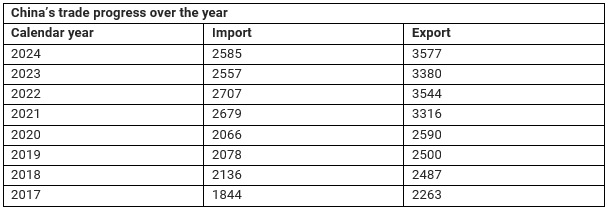
Following a significant decline to US$ 351 billion in 2018, China rebounded with a surge in exports. Over the last decade, the country’s trade surplus nearly tripled. From a surplus of just US$ 102 billion in 2005—when imports of goods and services were valued at US$ 660 billion and exports at US$ 762 billion—China advanced to outward and inward shipments valued at US$ 3,577 billion and US$ 2,585 billion, respectively, in 2024.
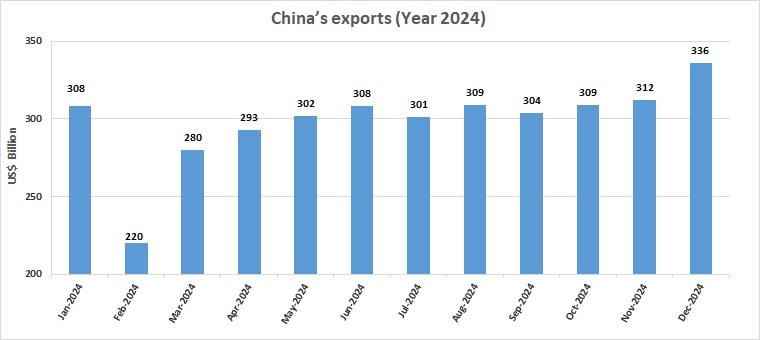
Chinese exports grew by nearly 11 percent in December 2024 to US$ 336 billion, marking the second-highest monthly record, surpassed only by December 2021 when pandemic-driven global demand peaked. Over the years, China’s imports, as a percentage of gross domestic product (GDP), have declined significantly, while exports have continued to grow consistently.
China’s trade surplus in 2024 is roughly equivalent to the entire U.S. trade deficit, estimated at approximately US$ 1 trillion for the year. In the Indian context, China’s trade surplus is nearly equal to India’s total trade volume, encompassing both exports and imports. Despite ongoing geopolitical conflicts, China’s export value rose almost every month in 2024, surpassing the highs of 2022 during the pandemic. While the Chinese economy faced domestic challenges, including a continuing housing crisis and weak consumption, robust external demand provided critical support to exports.
Sources: General Administration of Customs, People’s Republic of China; and Polymerupdate Research
Producing a third of manufactured goodsAccording to the United Nations Industrial Development Organization, China presently produces about a third of the world's all types of manufactured goods. With focus on manufacturing, the Chinese government incentivises manufacturers to set up units in specified locations which supports captive raw material consumptions and generates employment. The Chinese manufactured goods now works out to more than the United States, Japan, Germany, South Korea and Britain combined.
The world’s second biggest economy has built up its exports through huge investments in education, factories and infrastructure, while maintaining fairly high tariffs and other barriers to imports. Universities churn out more graduates in engineering and related subjects each year than the combined number of developed countries in the west.
Sources: General Administration of Customs, People’s Republic of China; and Polymerupdate Research
India eyes opportunityThe United States President-elect Donald Trump’s threat to impose up to 60 percent import tariff on Chinese goods is likely to benefit Indian exporters by up to US$ 25 billion across sectors such as electronics and electricals, automotive parts and components, organic chemicals, apparel and textiles, footwear, furniture and home décor, toys, and more. The U.S. intention to impose higher tariffs on China presents a significant opportunity for Indian exports, particularly in sectors where China has traditionally been a dominant supplier.
The need of the hour is to proactively seize this opportunity rather than react to the situation. The government should collaborate with the industry in this endeavour by engaging with key U.S. organizations such as the Office of the United States Trade Representative (USTR). India, with its growing manufacturing capacity, further bolstered by the Production Linked Incentive (PLI) Scheme and competitive advantages in various sectors, can capitalize on these changes by targeting the U.S. market with alternative products. With better marketing strategies and stronger partnerships, India can effectively position itself to take full advantage of this opportunity.
While submitting a pre-budget representation to the Union Finance Minister Nirmala Sitharaman, Ashwani Kumar, President of the Federation of Indian Export Organization (FIEO), said, “As per our study, we can get an additional export to the tune of around US$ 25 billion to the United States due to tariff war in sectors such as electronics & electricals, automotive parts & components, organic chemicals, apparel & textiles, footwear, furniture & home decor, toys etc.”
For that, India requires to increase its presence in the United States by showcasing in a large number of exhibitions, buyer-seller meetings and tie up with large local associations of retailers and distributors in the United States with proactive support of the Government. There is an immediate need to launch a marketing scheme to focus specifically on the United States of America with a corpus of Rs 250 crore per year accumulating to Rs 750 crore overall for three years. This is expected to help an additional export revenue of Rs 200,000 crore (US$ 25 billion) by the end of three years.
DILIP KUMAR JHAEditor
dilip.jha@polymerupdate.com