Crude oil prices rose by more than 1 percent last week, marking their fourth consecutive weekly gain, driven by persistent supply concerns stemming from additional United States sanctions on Russian energy transport and seasonal demand. Supply issues were further exacerbated by the ongoing voluntary output cuts of 5.5 million barrels per day (bpd) by the Organization of the Petroleum Exporting Countries and its allies (OPEC+), which are expected to be extended until the end of the year, beyond the current mandate of March 2025.
Data compiled by Polymerupdate Research revealed that benchmark Brent crude futures for near-month delivery on the Intercontinental Exchange (ICE) gained 1.29 percent, or US$ 1.03 a barrel, closing the week at US$ 80.79 a barrel compared to US$ 79.76 a barrel at the end of the previous week. Similarly, West Texas Intermediate (WTI) Cushing futures for near-month delivery on the New York Mercantile Exchange (NYMEX) recorded a weekly gain of 1.71 percent, or US$ 1.31 a barrel, to settle at US$ 77.88 a barrel on Friday, up from US$ 76.57 a barrel the previous week.
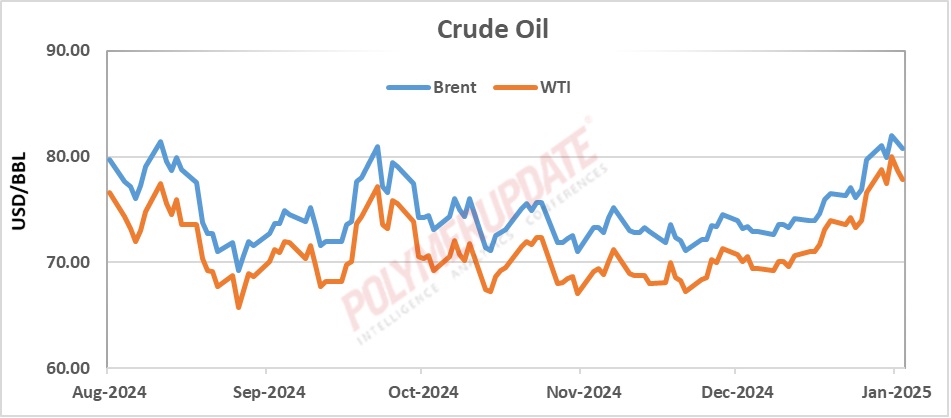
It was an extraordinary week for the crude oil sector, leaving traders and speculators perplexed. While overproduction from non-OPEC+ nations is projected to keep energy prices under pressure, outgoing United States President Joe Biden’s decision to impose additional sanctions on Russian energy supplies triggered a mid-week surge in energy prices to their highest level since August 12, 2024. However, this uptrend proved unsustainable as profit-booking by traders pulled energy prices lower toward the end of the week. Crude oil, a geopolitically sensitive commodity, was also influenced by Israel’s ceasefire agreement with Hamas, the Gaza-centric militant organization.
Rahul Kalantri, Vice President (Commodities) at Mehta Equities Ltd, stated, “Crude oil prices showed very high volatility and slipped from five-month highs amid rebound in the dollar index and Israel-Hamas ceasefire deals. The dollar index closed at multi-month highs and pushed oil prices lower. However, crude oil gained fourth straight week amid decline in the U.S. crude oil stocks at 2022 lows and U.S. sanctions on Russian oil. Chinese economic data released last week was also better than expected and supported crude oil prices. Heating demand in the U.S. is also supporting crude oil prices. We expect crude oil prices to remain volatile in today’s session.”
United States sanctionsOutgoing U.S. President Joe Biden has imposed the most severe sanctions yet on Russia’s oil industry, aiming to restrict the country’s energy supplies. The new sanctions target two major Russian oil companies, Gazprom Neft and Surgutneftegas, along with 183 vessels, numerous oil traders, oilfield service providers, insurance companies, and energy officials. Despite these measures, Russia has pledged to proceed with its major oil and gas projects, asserting that it remains a key and reliable player in the global energy market. President-elect Donald Trump is set to assume office on January 20, 2025.
This marks the first time the United States has directly sanctioned Russian oil companies Gazprom Neft and Surgutneftegas, along with their officials. Following the U.S. action, the United Kingdom also imposed sanctions on these entities, their affiliated services, and officials. The UK stated, “The profits from these two companies are fuelling Putin’s war chest and facilitating the war.” The latest sanctions also prohibit Russian companies and government officials from accessing U.S. services related to the extraction and production of crude oil and petroleum products.
 Bullish market sentiment
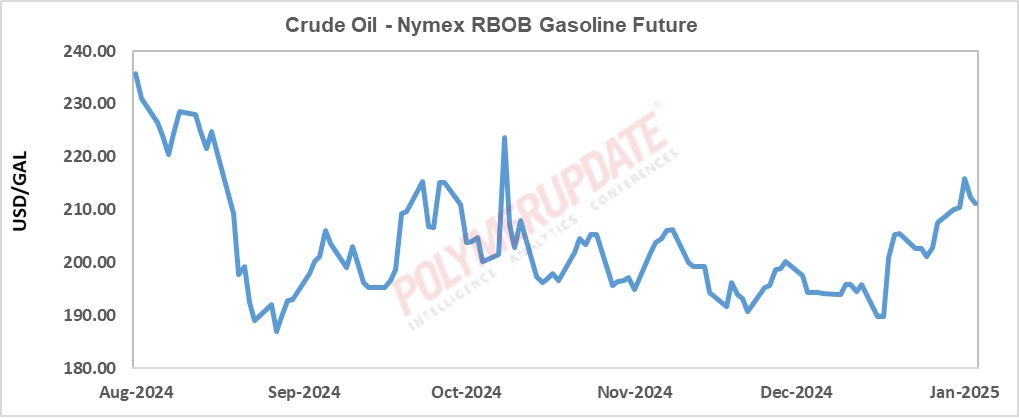
These sanctions are expected to impact Russian energy supplies to China and India due to anticipated disruptions in seaborne transportation. This comes at a time when colder-than-expected weather in the U.S. and Europe has increased demand for heating oil. U.S. stockpiles recorded their eighth consecutive weekly draw, driven by seasonal demand and strong exports. This lifted market sentiment, although gains were later tempered by disappointing refining data from China and the progress of a ceasefire deal easing Red Sea disruptions.
The Gaza ceasefire has eased Red Sea shipping disruptions, while China's disappointing refining output has limited sharp price increases. A ceasefire agreement in Gaza has resulted in an expected halt to attacks on ships in the Red Sea by Yemen's Houthi militia. Israel's security cabinet approved the deal, which facilitated the return of the first three Israeli hostages from Gaza on Sunday. Meanwhile, China's refinery throughput in 2024 declined for the first time in over two decades (excluding 2022). Although China achieved its 5 percent economic growth target for the year, stagnant fuel demand and low profit margins dampened refinery activities.
Concerns about further supply disruptions persist as Donald Trump assumes office today. The Biden administration's recently announced tough sanctions on Russian oil producers and tankers are expected to disrupt supplies and increase freight costs, potentially impacting 0.5–1 million bpd of Russian exports. Additionally, there is anticipation that President-elect Trump's return to power could lead to tighter sanctions on Iran and Venezuela, further complicating global energy markets.
US EIA’s forecastsThe unwinding of OPEC+ production cuts, combined with strong growth in oil production outside OPEC+, is expected to increase global oil output. Consequently, global liquid fuel production is projected to rise by 1.8 million barrels per day (bpd) in 2025 and by 1.5 million bpd in 2026. According to the U.S. Energy Information Administration’s (EIA) Short-Term Energy Outlook (STEO), a periodic publication, global oil consumption growth continues to trail pre-pandemic trends. The STEO forecasts global liquid fuel consumption to increase by 1.3 million bpd in 2025 and by 1.1 million bpd in 2026.
OPEC+ nations initially introduced voluntary oil output cuts in response to sanctions imposed on Russia by the United States-led Group of Seven (G7) countries following Russia's unprovoked missile attacks on Ukraine in 2022. Although OPEC+ coalition ministers initially planned to restore output cuts gradually, they later decided to deepen the reductions. Currently, the coalition is implementing voluntary output cuts of approximately 5.5 million bpd, with plans to restore at least 2.2 million bpd starting in April 2025.
Weather adversaries in the westMost of the United States is currently experiencing extreme winter weather, with conditions expected to worsen this week as Arctic air pushes south from Canada, snow tracks up the Northeast coast, and a potentially crippling winter storm targets the South. Analysts predict that more than 75 percent of the U.S. will face freezing temperatures, with over 70 million people under winter weather advisories and storm warnings.
Nearly the entire United States is likely to be blanketed in a thick layer of snow this week. Washington, D.C., is expected to receive 1–3 inches of snow, while up to 6 inches is forecast for New York and Boston. Other cities, including Hartford, Connecticut; Portland, Maine; and Philadelphia, are likely to see 4–8 inches of snowfall this week. Authorities have declared snow emergencies in major cities across the country. Europe is also grappling with severe winter weather, increasing heating oil demand across the Western world this season.
OutlookWhile the ceasefire deal and weak refining data from China may temporarily pressure oil prices, a rebound cannot be ruled out this week, driven by supply constraints and seasonal demand. Sanctions on Russian oil, coupled with the potential for additional sanctions on Iran and Venezuela as Donald Trump assumes office today, could further impact the market.
DILIP KUMAR JHA
Editor
dilip.jha@polymerupdate.com