Click the icon to add a specified price to your Dashboard list. This makes it easy to keep track on the prices that matter most to you.

Leading multinational beverage producer, The Coca-Cola Company is projected to increase its plastic usage by 20 percent annually by 2030 from its 2023 baseline if it does not alter its current practices, according to a study by Oceana, the largest international advocacy organization focused solely on ocean conservation. The study also estimates an approximate 40 percent increase in plastic usage compared to the base year of 2018.
The Coca-Cola Company is estimated to have used 3.45 million tonnes of plastic annually in its 2023 baseline year. Alarmingly, this usage is forecasted to rise to 4.1 million tonnes (9.1 billion pounds) annually by 2030 — enough to circle the Earth more than 100 times. The report further estimates that up to 602,000 metric tonnes (1.3 billion pounds) of the plastic packaging Coca-Cola uses annually by 2030 could enter the world’s waterways and oceans if the company continues its current trajectory. This is equivalent to 220 billion 500-ml bottles entering waterways and oceans each year.
The scale of Coca-Cola’s plastic usage is stark: the volume could fill the stomachs of over 18 million blue whales. Oceana’s study found that if Coca-Cola increased its use of reusable packaging to 26.4 percent by 2030 (up from 10.2 percent in 2023), it could “bend the plastic curve,” reducing annual plastic usage below current levels. Reusable bottles, if made of plastic, can be reused up to 25 times, and up to 50 times if made of glass. Each reusable bottle could prevent the production and use of up to 49 additional single-use bottles.
Releasing the study, Oceana’s Senior Vice President Matt Littlejohn said, “Coca-Cola’s future is currently tied, like an albatross around its neck, to single-use plastic. Single-use plastic is bad for the oceans, human health, and business. Recycling can’t solve the company’s out-of-control plastic problem. Reuse can. Single-use plastic bottles made with recycled content can still become marine pollution and harm ocean life, just like bottles made of virgin plastic.”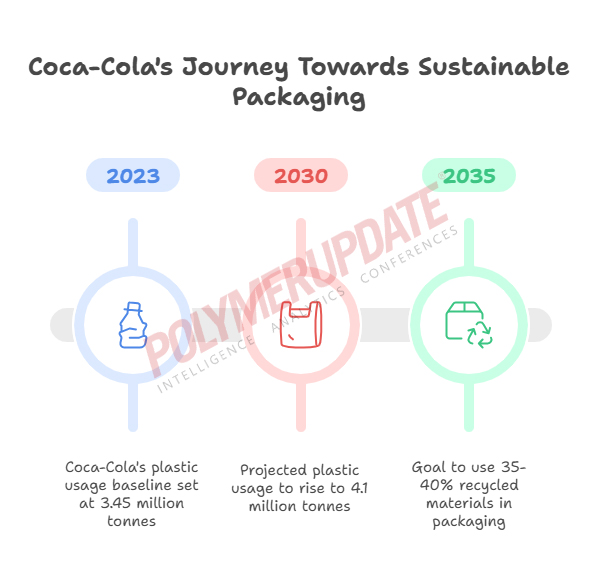 Increasing scrutiny
Coca-Cola is already under increasing scrutiny for its plastic usage. A peer-reviewed study identified Coca-Cola as the leading polluter of branded plastic found in the environment. Unfortunately, in December 2024, the Coca-Cola Company announced that it had abandoned its goal of increasing reusable packaging to 25 percent of its sales.
Instead of pursuing its former goals, Coca-Cola stated that it would focus on increasing the use of recycled content and on collecting its single-use plastic bottles for recycling. The company revealed that it had invested nearly US$1 billion in 2022 to purchase recycled plastic as a substitute for virgin plastic. However, as Oceana’s report highlights, collecting plastic for recycling and selling single-use packaging made from recycled plastic content will not significantly reduce the company’s overall plastic footprint.
Coca-Cola may face intensified criticism due to its rapidly expanding plastic footprint and growing public concern over the health impacts of plastic. Studies increasingly link plastics and the chemicals used in their production to health issues such as cancer, infertility, heart disease, autism, and diabetes.
“The Coca-Cola Company’s plastic use and its status as one of the world’s most infamous plastic polluters is a liability for the company’s future, the oceans, and the planet. Coca-Cola needs to take real action to address its plastic problem now, rather than focusing on measures that fail to meaningfully reduce its single-use plastic footprint,” said Matt Littlejohn, Senior Vice President of Oceana.
Voluntary environmental goals
On December 2, 2024, The Coca-Cola Company announced updated voluntary environmental goals aimed at delivering on the company’s purpose of “Refresh the World and Make a Difference.” This evolution is informed by decades of sustainability efforts, periodic progress assessments, and the identification of ongoing challenges. Achieving these ambitions will require continued investment in innovative and infrastructural solutions, enabling legislation, and enhanced collaboration with bottling partners, industry peers, local governments, and civil society.
“We remain committed to building long-term business resilience and earning our social license to operate through our evolved voluntary environmental goals. These challenges are complex and require us to drive more effective and efficient resource allocation and work collaboratively with partners to deliver lasting positive impact,” said Bea Perez, Executive Vice President and Global Chief Communications, Sustainability & Strategic Partnerships Officer.
The company is prioritizing goals and actions aimed at improving water security in high-risk areas, reducing packaging waste, and decreasing emissions, while extending its timeframe to 2035. Coca-Cola has set a goal to return more than 100 percent of the water used in finished products globally, on an aggregate level, to nature and communities. Since 2015, the company has consistently met or exceeded this goal. Additionally, Coca-Cola seeks to return 100 percent of the total water used in each of the more than 200 high-risk locations across its system.
Use of recycled materials
By 2035, The Coca-Cola Company aims to use 35–40 percent recycled materials in its primary packaging (plastic, glass, and aluminium), including increasing the use of recycled plastic to 30–35 percent globally. Additionally, it plans to ensure the collection of 70–75 percent of the equivalent number of bottles and cans introduced into the market annually.
The Coca-Cola Company offers beverages in a variety of packaging formats, including glass and plastic bottles, aluminium cans, and refillable packaging. Each option has the potential to contribute to reducing packaging waste and emissions. The company is focusing its efforts on increasing the use of recycled materials in primary packaging and enhancing collection rates. Achieving these goals requires supportive policies and the development of robust collection infrastructure. The company also intends to continue investing in refillable packaging in regions where the necessary infrastructure is already in place.
DILIP KUMAR JHA
Editor
dilip.jha@polymerupdate.com