Click the icon to add a specified price to your Dashboard list. This makes it easy to keep track on the prices that matter most to you.

India's retail inflation, as measured by the Consumer Price Index (CPI), eased in April 2025 to its lowest level in six years, driven by declining prices of food and vegetable products, according to data released by the Ministry of Statistics & Programme Implementation (MoSPI) on Tuesday. The easing retail inflation provides much-needed relief to consumers and may prompt the Reserve Bank of India (RBI) to consider cutting interest rates in its upcoming Monetary Policy Committee (MPC) meeting, scheduled from June 4–6, 2025.
“Year-on-year inflation based on the All India Consumer Price Index (CPI) for April 2025 over April 2024 is 3.16 percent (provisional). This marks a decline of 18 basis points in headline inflation compared to March 2025. It is the lowest year-on-year inflation since July 2019,” stated MoSPI.
Madan Sabnavis, Chief Economist at Bank of Baroda, commented, “CPI inflation for April stood at 3.16 percent, slightly above our forecast of 3 percent. The main driver of this low inflation was subdued food inflation, which was recorded at 1.8 percent. The decline in food inflation was largely due to lower inflation for vegetables, which was (-)11 percent. Excluding this, headline inflation would be approximately 4.1 percent. The miscellaneous category, however, recorded higher-than-average inflation at 5 percent.”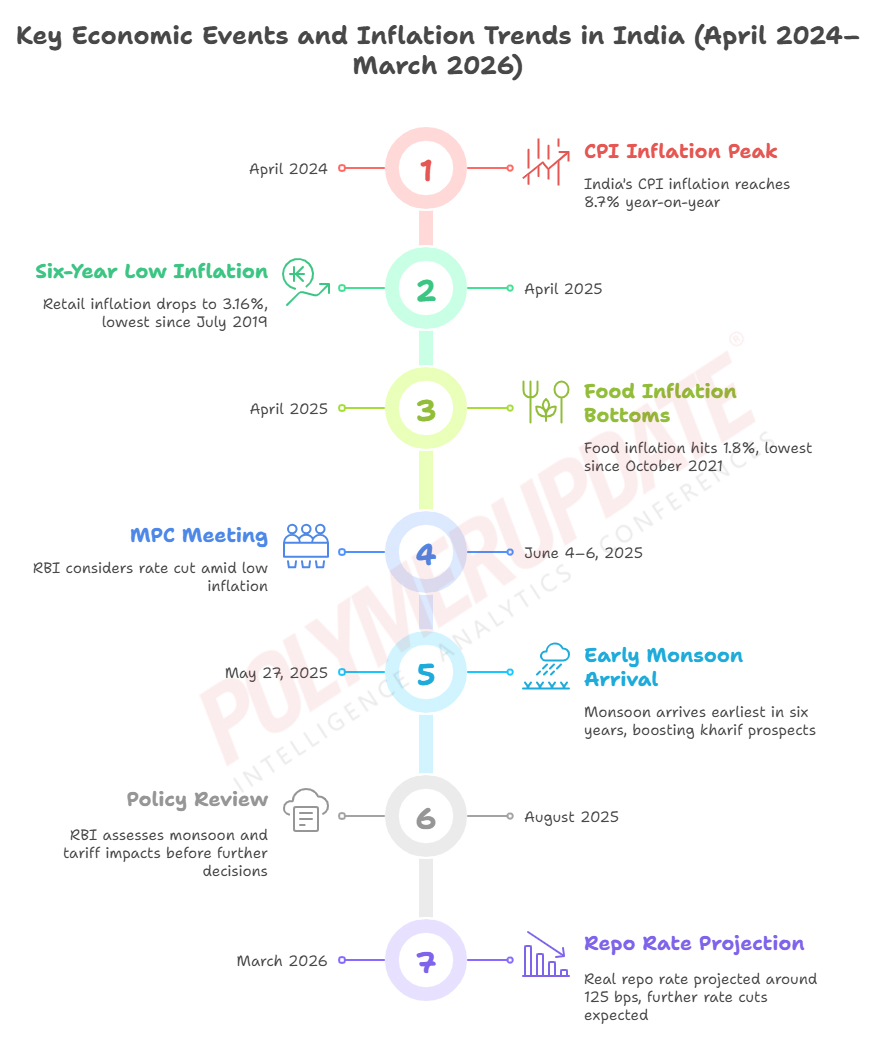 Subdued food inflation
MoSPI reported the year-on-year consumer price inflation rate, based on the All India Consumer Food Price Index (CFPI), at 1.78 percent (provisional) for April 2025 compared to April 2024. The corresponding inflation rates for rural and urban areas were 1.85 percent and 1.64 percent, respectively. Both CPI (general) and CFPI inflation rates have shown substantial declines in recent months, with a sharp 91-basis-point drop in food inflation recorded in April 2025 compared to March 2025. The food inflation rate in April 2025 is the lowest since October 2021.
Paras Jasrai, Associate Director at India Ratings and Research, noted, “India’s food inflation fell to 1.8 percent in April 2025 (April 2024: 8.7 percent; March 2025: 2.7 percent) due to price corrections in vegetables, pulses, cereals, and meat and fish. Vegetable prices declined by 11 percent year-on-year, the sharpest pace of decline since February 2023, significantly contributing to food inflation falling to a 42-month low.”
He added, “Pulses prices dropped by 5.2 percent year-on-year, marking the steepest decline in over six years (January 2019: 5.5 percent). Prices in the meat and fish segment fell by 0.4 percent year-on-year, the first decline in 22 months. Cereals inflation also dropped to a 35-month low of 5.3 percent, driven by improved kharif output. This easing of food inflation is expected to bring relief to households and boost consumption demand as the new fiscal year begins.”
Meanwhile, Dharmakirti Joshi, Chief Economist at Crisil Ltd, stated, “The record rabi harvest and robust pulses output, as reflected in the Second Advance Estimates, coupled with forecasts of a favourable monsoon for the upcoming kharif season, should help keep food inflation in check. On the energy front, Brent crude prices are expected to remain subdued, averaging around US$ 65 a barrel for the current fiscal year, which should help contain non-food inflation. Core inflation inched up by 10 basis points to 4.2 percent in April but remains below its trend level (measured by the decadal average). Based on the current inflation trajectory, a further 25-basis-point rate cut is likely in the June monetary policy review.”
Joshi further emphasized that agricultural performance depends not only on the total volume of rainfall but also on its temporal and spatial distribution. He cautioned that climate change has disrupted traditional monsoon patterns, increasing the frequency of both excessive rainfall and dry spells. Additionally, the growing prevalence of heatwaves poses a significant threat to agricultural productivity and, consequently, to food inflation. These evolving challenges warrant close monitoring.
| India’s retail inflation (Consumer Price Index or CPI) (%) | |||||
| Month | 2020 | 2021 | 2022 | 2023 | 2024 |
| January | 7.50 | 4.06 | 6.01 | 6.52 | 5.10 |
| February | 6.58 | 5.03 | 6.07 | 6.44 | 5.09 |
| March | 5.84 | 5.52 | 6.95 | 5.66 | 3.34 |
| April | 7.22 | 4.23 | 7.79 | 4.70 | 3.16 |
| May | 6.27 | 6.30 | 7.04 | 4.31 |
|
| June | 6.23 | 6.24 | 7.01 | 4.81 |
|
| July | 6.73 | 5.59 | 6.71 | 7.44 |
|
| August | 6.69 | 5.30 | 7.00 | 6.83 |
|
| September | 7.27 | 4.35 | 7.41 | 5.02 |
|
| October | 7.61 | 4.48 | 6.77 | 4.87 |
|
| November | 6.93 | 4.91 | 5.88 | 5.55 |
|
| December | 4.59 | 5.59 | 5.72 | 5.69 |
|
Source: Ministry of Statistics and Programme Implementation (MoSPI)
Rocky start
The fiscal year 2025-26 began on a challenging note with the "Tariff Tantrums" in the first week of April 2025. However, domestically, the new fiscal year has started positively, supported by benign inflation data. Retail inflation stood at 3.16 percent in April 2025, aligning with economists’ expectations of 3.2 percent. The continued decline in food inflation played a key role in keeping retail inflation at its lowest level since July 2019. However, this declining trend was not uniform, as inflation in the fuel and light segments and core inflation registered an upswing during the same period.
Core inflation remained steady at 4.1 percent in April 2025, the highest since November 2023, indicating sustained demand. Interestingly, retail inflation excluding vegetables and pulses rose to an 18-month high of 4.4 percent in April 2025. On a positive note, the decline in retail inflation was more pronounced in rural areas compared to urban areas. This trend is expected to further boost rural demand, which is already showing signs of recovery, supported by sustained positive real rural wage growth.
Challenging areas
Three categories registered inflation above 4 percent. Personal care and effects remained high, primarily due to rising gold prices. In the case of health and education, inflation stood at 4.2 percent and 4.1 percent, respectively. The increase in fees for various educational courses was a key factor driving education inflation, along with annual revisions in healthcare costs. Other components, such as clothing and footwear, housing, and fuel and lighting, continued to record inflation below 3 percent.
While the 3.2 percent inflation rate aligns with the RBI’s forecast of 3.6 percent for the April–June 2025 quarter, the central bank is likely to note that this decrease was primarily driven by vegetables, which have a 6 percent weight in the index. Excluding this component, inflation remains at the target rate. It seems unlikely that this figure alone will prompt a rate cut, as the RBI may prefer to assess both the monsoon's performance and tariff-related issues before making a decision in August. Inflation is expected to remain low in May and June as well, aided by the base effect.
Easing tariffs pressure
The temporary reduction of tariffs by the US and China has helped control heightened uncertainty and volatility in the global economic environment while improving investor sentiment. This has contributed to a correction in precious metal prices and a rise in energy prices. Nevertheless, both remain benign and are expected to stay so throughout the ongoing fiscal year, according to the latest commodity outlook by the World Bank. Domestically, the monsoon is expected to arrive on May 27, the earliest in six years, which bodes well for a favourable kharif season in the financial year (FY) 2025-26. Overall, retail inflation is projected to remain at 3.1 percent for April–March 2025.
The latest data reflects a period of low inflation intensity, marking the third consecutive month where inflation has stayed below the RBI’s target of 4 percent. With retail inflation remaining within the tolerance band of 4 percent (+/- 2 percent), the RBI may consider a 25-basis-point cut in policy rates in light of the fragile global economic and geopolitical environment during the June 2025 policy review. The cumulative rate cuts in FY 2025-26 will depend on the pace of the decline in inflation and the evolving inflation-growth dynamics.
Outlook
Based on current trends, inflation in FY 2025-26 could fall below 4 percent. The real repo rate by the end of March 2026 is projected to be around 125 basis points. Consequently, the central bank may cut policy rates by at least 75 basis points during the remainder of FY 2025-26, with the potential for further reductions depending on incoming data.
DILIP KUMAR JHA
Editor
dilip.jha@polymerupdate.com