Click the icon to add a specified price to your Dashboard list. This makes it easy to keep track on the prices that matter most to you.

Total investment in the global upstream oil and gas sector is likely to decline by 4 percent in calendar year 2025, driven by rising demand for non-fossil fuel-based alternatives aimed at promoting low-carbon products and achieving carbon neutrality. The upstream oil and gas segment is considered a high-emission sector, contributing significantly to greenhouse gas emissions—particularly methane—through activities such as exploration, drilling, flaring, and venting during production.
According to a study by the International Energy Agency (IEA), global upstream oil and gas investment is projected to fall by 4 percent in 2025 to around US$ 565 billion, with U.S. independent shale producers accounting for the bulk of the decline. Oil-focused upstream investment is expected to drop nearly 6 percent to US$ 420 billion, while spending on gas is set to rise by 3 percent to US$ 145 billion. Recent fluctuations in oil prices, financial market volatility, and trade uncertainties could further influence development costs and investment decisions.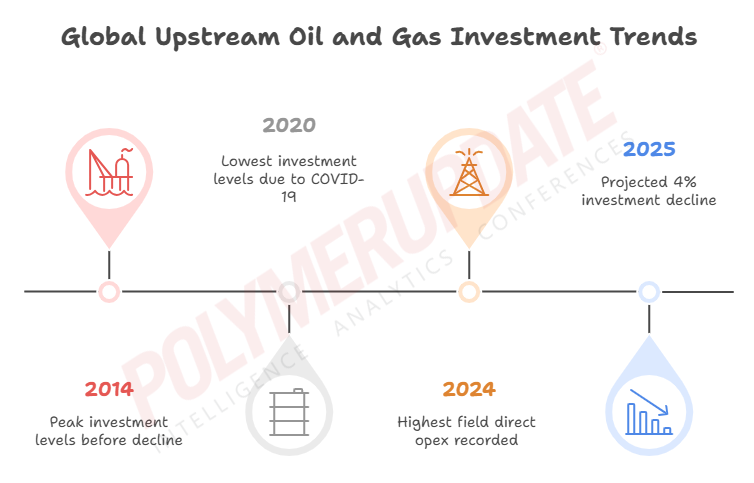 Past trend
In 2024, global upstream oil and gas capital expenditure (capex) remained flat in nominal terms at US$ 590 billion, but declined by US$ 10 billion in real terms compared to 2023 levels. Nominally, capex levels from 2023 to 2025 are at their highest since 2015, but remain below 2019 levels when adjusted for inflation.
Global upstream investment continues to reflect cautious capital deployment across the industry, a trend that has persisted since 2015. Notably, companies are no longer pursuing aggressive growth; instead, they are placing greater emphasis on capital discipline, profitability, and cost optimisation—a shift that has become more pronounced over the past twelve months. Investors are increasingly targeting high-potential, low-cost basins, which offer viable alternatives to capital-intensive oilfields. These options deliver strong returns with minimal downside risk.
Priority sectors
According to a recent IEA report, investment priorities are being directed toward high-potential, low-cost basins such as those in West Africa, deepwater Latin America, and the U.S. federal offshore. In mature offshore basins, exploration activity is increasingly concentrated near existing infrastructure to reduce development expenditures. Despite the broader trend of investment restraint, upstream spending continues to rise in the Middle East and among certain major oil companies, underscoring their strategic focus on long-term resource development.
The increase in upstream investment in 2024 was largely concentrated in projects led by national oil companies (NOCs) in the Middle East, China, and the Americas. Middle Eastern and Asian NOCs accounted for over 60 percent of global capex this decade, a 10 percent increase from a decade ago. Upstream investment by international oil companies (IOCs) remained relatively steady in 2024 and is expected to remain flat in 2025. However, spending levels are still well below those seen a decade ago, partly due to reduced investment in offshore facilities and partly due to cost deflation, with 2024 cost indexes still only at 80 percent of 2014 levels.
Saudi Aramco increased its upstream capex by 19 percent year-on-year (YoY) to US$ 39 billion in 2024, primarily to maintain its 12 million barrels per day (bpd) crude oil production capacity and expand its output of natural gas, NGLs, and condensates. In the UAE, the Abu Dhabi National Oil Co. (ADNOC) plans to raise its crude production capacity to 5 million bpd by 2027, investing US$ 150 billion between 2024 and 2027 to achieve this goal.
Capital expenditures by U.S. independents have recovered since 2020 but remain below pre-COVID levels in both real and nominal terms, as light tight oil (LTO) capex has not fully rebounded. An analysis of well productivity gains in the shale sector shows that since 2014, operational efficiencies have cumulatively saved US$ 220 billion in capex, with US$ 60 billion of that saved in 2024 alone. In other words, if capital efficiency in drilling and completion operations had remained unchanged since 2014, U.S. shale spending in 2024 would have reached US$ 175 billion instead of the actual US$ 115 billion, the report noted.
Projects and resources
Peak production from conventional projects sanctioned during 2021–2024 is expected to average 2.5 million barrels per day (bpd) annually, with the 2024 cohort of sanctioned projects projected to add 2.2 million bpd of annual supply by 2032. This slightly exceeds the previous five-year average peak output of 2.1 million bpd recorded during 2015–2019.
Meanwhile, the results of global exploration efforts over the past decade have been less encouraging. Average annual exploration capital expenditure during 2015–2024 was 30 percent lower than the preceding ten-year average, at US$ 35 billion. Furthermore, the correlation between exploration capex and oil prices weakened significantly, dropping from a coefficient of 0.9 during 2000–2014 to effectively zero during 2015–2024—coinciding with the rise of U.S. light tight oil (LTO). Notably, the share of discovered resources classified as shale or tight oil has increased from 40 percent of the global total in 2015 to nearly 70 percent in 2024.
According to Rystad Energy, just under 5 billion barrels of conventional liquid resources were discovered in 2024—replacing only 19 percent of conventional production from the previous year. Moreover, just four projects accounted for approximately half of the discovered volumes. Namibia saw two major discoveries: Galp Energia’s 900 million barrels of oil equivalent (boe) at Mopane, and TotalEnergies’ 500 million barrels added at the Venus oilfield. ExxonMobil contributed 400 million barrels at its Stabroek Block in Guyana. Rounding out the top five were two Eni discoveries—each estimated at 175 million barrels—at Saasken-Sayulita in Mexico and Calao in Côte d’Ivoire.
Short cycle investment
While volumes of conventionally discovered resources are declining, companies are reallocating capital and operating expenditure (opex) to stem output losses at producing fields. Well capex and field direct opex are key determinants of production decline rates. An analysis of Rystad Energy data shows that 2024 recorded the highest-ever level of field direct opex.
These investments are critical for operators to maintain existing wells and facilities, and to boost short-term supply by increasing incremental recovery from producing reservoirs through side-tracks, major well workovers, and other well interventions. In nominal terms, well capex and field direct opex in 2024 reached nearly 90 percent of their 2014 peak and marked the third-highest level in the industry's history. In contrast, facility capex remained at only 75 percent of its 2014 high, according to the IEA report.
This shift in capital allocation reflects a broader move toward short-cycle investments in shale wells and infrastructure-led offshore expansions—both of which inherently allocate a higher share of spending toward wells. Additionally, facility spending has been reduced through efforts to standardize and “right-size” offshore infrastructure compared to the more capital-intensive approaches of the previous decade.
Revising strategy
Decline rates at mature fields, accounting for both capex and opex, average close to 6 percent globally. This means that approximately 5 million barrels per day (bpd) of supply must be replaced each year just to maintain flat production levels. The increase in opex since near-zero levels in 2020 has helped sustain replacement volumes, even as a growing share of output comes from high-decline shale barrels. In 2024, existing U.S. shale wells saw a production decline of 2.8 million bpd from a base of 8.2 million bpd, while the rest of non-OPEC+ oil output declined by 2 million bpd from a 40 million bpd base.
According to a Wood Mackenzie report, upstream emissions remain closely tied to production, with the world’s largest oil and gas fields also ranking among the highest emitters. Fuel use in production and processing continues to be the largest source of emissions and the most difficult to abate. Rising production volumes could push absolute emissions beyond pre-pandemic levels by 2028.
DILIP KUMAR JHA
Editor
dilip.jha@polymerupdate.com