Click the icon to add a specified price to your Dashboard list. This makes it easy to keep track on the prices that matter most to you.

Vietnam has imposed a 2 percent import duty on high-density polyethylene (HDPE) and linear low-density polyethylene (LLDPE) to protect the interests of its sole domestic producer, Long Son Petrochemical (LSP). Effective July 8, the new tariff is expected to curb the influx of low-cost imports, particularly from Southeast Asian (SEA) markets and East Asia, including China, and support local suppliers in meeting the country’s growing demand.
The decision follows years of investigation and lobbying by LSP, which claimed it was suffering due to an influx of cheap imports. In 2023, LSP had urged the government to revise the prevailing 'nil' import duty, arguing that the absence of tariffs forced the company to slash selling prices to match cheaper landed costs, thereby incurring significant losses.
According to informed sources, LSP had lobbied for a revision of the duty structure since 2023 in anticipation of commencing commercial operations at its new facility. Although the company initially proposed a 3 percent tariff, the suggestion met with strong opposition from downstream processors.
Balancing LSP’s request with the concerns raised by downstream stakeholders, the Vietnamese government ultimately opted to impose a 2 percent import duty. The levy applies to: Polyethylene with a specific gravity of 0.94 or more, in primary forms (HDPE); Linear low-density polyethylene (LLDPE) with a specific gravity of less than 0.94 in ‘Other’ form with alpha-olefin monomer content of 5 percent or less; and Ethylene-alpha-olefin copolymers with a specific gravity of less than 0.94, in primary forms (LLDPE).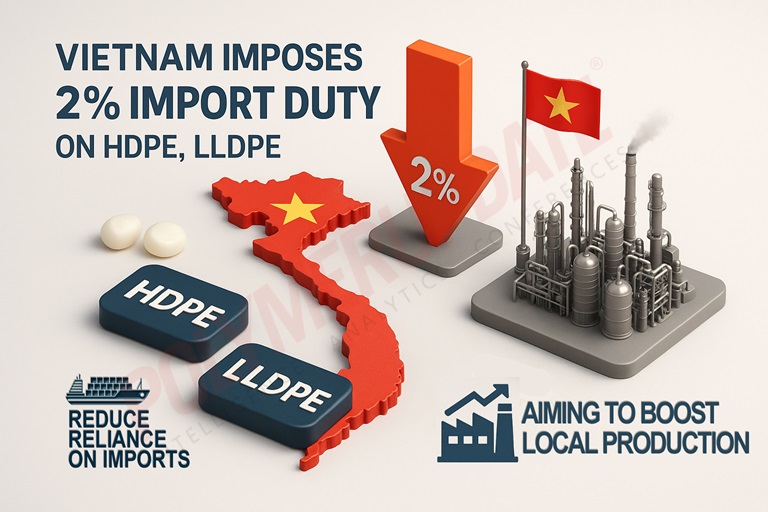 Dependence on local markets
Initially, the government declined LSP’s request for a tariff, citing concerns over supply reliability. However, with the 2 percent import duty now in effect, local buyers may expect more consistent deliveries from the domestic supplier.
Long Son Petrochemical (LSP), Vietnam’s sole polyolefin producer, operates an integrated petrochemical complex invested by SCG Chemicals. The complex has a production capacity of 1.6 million tonnes per year of olefins and 1.4 million tonnes per year of polyolefins. It includes an olefins unit and polyolefin plants producing polyethylene (PE) and polypropylene (PP).
Designed as a fully integrated petrochemical complex, LSP aims to reduce Vietnam’s dependence on imported polyolefins and strengthen the domestic industry. Following a ten-month shutdown due to unprofitable margins, the complex is now likely to restart operations by mid-August. The facility includes: a 950,000 tonnes per annum mixed-feed cracker, a 450,000 tonnes per annum HDPE unit, a 500,000 tonnes per annum LLDPE unit, and a 400,000 tonnes per annum PP unit.
Industry experts believe that while the newly imposed tariff offers temporary relief, its impact may be limited given the ongoing global petrochemical downcycle. In response, LSP has committed to fresh investments in production upgrades and storage infrastructure to enhance its global competitiveness.
To support the existing facility, LSP plans to build new storage infrastructure to accommodate cheaper ethane feedstock. Once completed by 2027, the cracker is expected to run on up to 70 percent ethane, significantly improving cost efficiency compared to naphtha-based peers.
The cracker is designed to utilize a variety of feedstocks, including naphtha, liquefied petroleum gas (LPG), and potentially ethane, offering operational flexibility. According to SCG Chemicals, the LSP project is expected to catalyze Vietnam’s petrochemical industry, reduce reliance on imports, and boost downstream industrial growth. The total investment in the Long Son Petrochemical Complex is estimated at US$ 5.4 billion.
Three-tier tariff on PP
Vietnamese authorities have implemented a three-tier tariff structure on polypropylene. This structure includes: 0 percent under the Special Preferential Import Tariffs for countries with Free Trade Agreements (FTAs) with Vietnam, including ASEAN, China, South Korea, Japan, Australia, and India; 3 percent under the Preferential Import Tariffs for Most-Favoured-Nation (MFN) members; and 5 percent under Ordinary Tariffs for non-MFN countries.
Analysts expect a similar framework to be adopted for HDPE and LLDPE. This means imports from the Middle East—the dominant polyethylene supplier to Vietnam—will now be subject to the new 2 percent duty. However, the treatment of US-origin cargoes remains uncertain. The import duty announcement caught market participants off guard, as they were primarily focused on adjusting to the recent reduction in Value Added Tax (VAT) from 10 percent to 8 percent.
Vietnam-US deal
Business firms in the United States have signed contracts worth over US$ 4 billion with Vietnamese suppliers of merchandise goods, driven by concerns over potential U.S. import tariffs under President Donald Trump’s administration. The move is aimed at safeguarding their business interests amid the President’s ‘America First’ policy, which prioritizes tariffs to protect domestic industries.
“The new projects, including those in oil and gas exploration, petrochemical imports, and aviation, are being planned in Vietnam with assistance from U.S. business houses. These projects are estimated to be worth US$ 4.15 billion,” stated a press release on the official website of PetroVietnam Power Corp (PVPower).
Since Donald Trump assumed office as President of the United States on January 20, 2025, he has announced higher tariffs on key trade partners in an effort to address the U.S. trade deficit (where imports exceed exports). So far, the United States has imposed a 10 percent import duty on Chinese goods, along with an additional 10 percent special tariff. In retaliation, China has implemented a 15 percent import duty, supplemented by a 15 percent special tariff.
Conclusion
In 2025, Vietnam is expected to witness continued growth in both HDPE and LLDPE production and consumption, driven by its expanding economy, rising consumerism, and increasing demand across various sectors. While import duties on these materials have been introduced to support domestic production, the overall market is projected to expand—particularly in rigid plastic packaging—fuelled by the growth of e-commerce and the food and beverage industry.
DILIP KUMAR JHA
Editor
dilip.jha@polymerupdate.com