Click the icon to add a specified price to your Dashboard list. This makes it easy to keep track on the prices that matter most to you.

Reliance Industries Ltd (RIL), a leading Indian multinational conglomerate with diverse business interests, reported a steep 17 percent decline in export revenue from its oil-to-chemicals (O2C) business during the April–June 2025 quarter. The decline was primarily due to a sharp fall in crude oil and derivative prices, along with lower volumes resulting from a planned shutdown. Additionally, the drop in O2C export revenue was attributed to the diversion of downstream products to domestic markets for better realisations.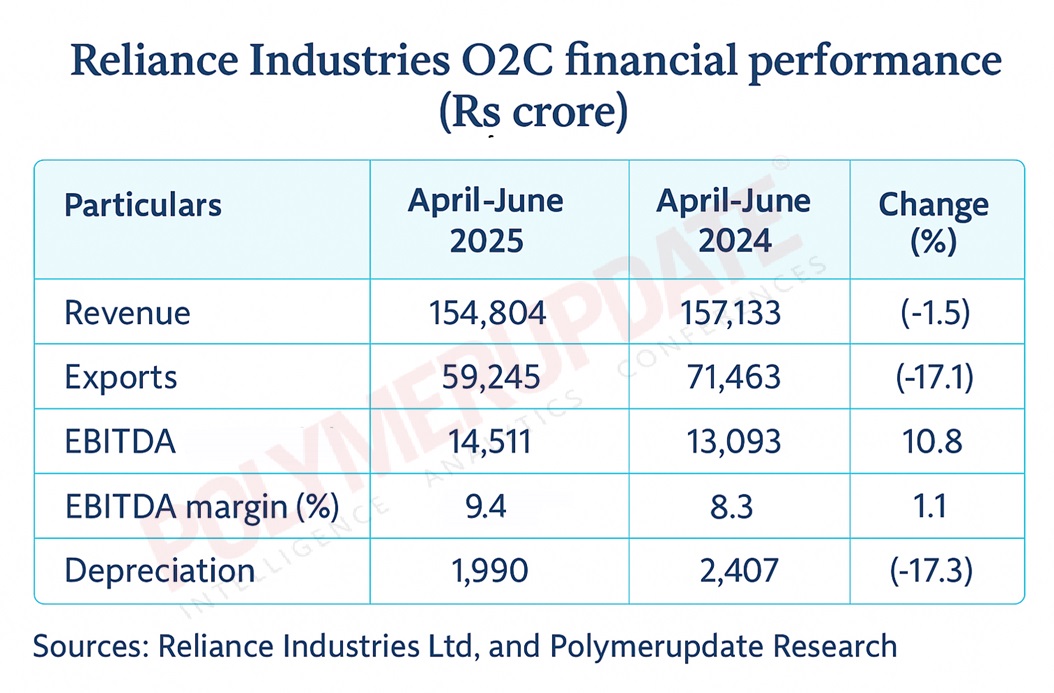 In its consolidated financial results for the April–June 2025 quarter, the company reported that export revenue from its O2C segment fell to Rs 59,245 crore, down from Rs 71,463 crore in the same quarter last year. The figure also declined from Rs 73,749 crore reported in the January–March 2025 quarter.
Commenting on the results, Mukesh D. Ambani, Chairman and Managing Director of RIL, said, “During the quarter, energy markets faced heightened uncertainty, with sharp fluctuations in crude oil prices. Our O2C business delivered strong growth, with a focus on meeting domestic demand and offering value-added solutions through the Jio-bp network. Performance was supported by improved margins in fuels and downstream products. However, a natural decline in KG-D6 gas production led to a marginal reduction in EBITDA for the oil and gas segment.”
The O2C segment includes refining, petrochemicals, aviation fuel, and bulk wholesale marketing. It encompasses a broad portfolio spanning transportation fuels, polymers, polyesters, and elastomers. The deep and integrated nature of the O2C business includes world-class assets such as the refinery off-gas cracker, aromatics, multi-feed and gas crackers, along with downstream manufacturing facilities, logistics, and supply-chain infrastructure. This decline in O2C export revenue was partially offset by growth in the company’s retail and digital businesses.
Decline in O2C turnover
RIL’s overall revenue from the oil-to-chemicals (O2C) segment also registered a marginal decline of 1.5 percent to Rs 1,54,804 crore during the April–June 2025 quarter, down from Rs 1,57,133 crore reported in the corresponding quarter of the previous year. Segment revenue for the January–March 2025 quarter stood at Rs 1,64,613 crore. Thus, compared to the last quarter of the previous financial year (April 2024 – March 2025), the O2C segment revenue reflects a decline of 6 percent. The company’s O2C revenue was supported by higher domestic placement of transportation fuels through the Jio-bp network.
Conversely, both earnings before interest, tax, depreciation, and amortisation (EBITDA), and EBITDA margin reported growth of 10.8 percent and 1.1 percentage points, respectively, during the quarter. Segment EBITDA for the April–June 2025 quarter increased due to favourable margins in domestic fuel retail, improved transportation fuel cracks, and stronger deltas for polypropylene (PP) and polyvinyl chloride (PVC). This was partially offset by lower volumes due to a planned turnaround, and weaker polyester chain margins.
Analysts attributed the segment EBITDA growth to favourable margins in domestic fuel retail, improved transportation fuel cracks, and higher PP and PVC deltas. However, the gains were partially offset by lower volumes from the planned turnaround and a decline in polyester chain margins. Meanwhile, maintenance of one of the crude units and one hydrotreater unit was completed on schedule.
Revenue from the oil and gas segment declined by 1.2 percent year-on-year, primarily due to lower sales volumes of KG-D6 gas resulting from natural production decline, reduced gas prices for coal bed methane (CBM), and lower crude oil price realisation. This was partially offset by improved price realisation for KG-D6 gas.
Additionally, throughput from major secondary units such as the platformer and fluid catalytic cracker (FCC) was maximized through higher supplementary feedstock processing during crude unit maintenance. Aromatics production was optimized in response to low margins, with a focus on maximizing high-value transportation fuel output. Exports of high-octane gasoline grades increased due to attractive premiums. Fuel costs at the Jamnagar Complex were minimized by maintaining high gasifier operating rates and securing cost-effective grid power purchases.
Business environment
During the April–June 2025 quarter, global oil demand rose by 0.6 million barrels per day (bpd) year-on-year (yoy) to 103.4 million bpd. Diesel demand increased by 0.3 million bpd yoy, gasoline demand rose by 0.2 million bpd, and jet/kerosene demand grew by around 0.3 million bpd. Dated Brent crude averaged US$67.8 per barrel during the quarter, down by US$17.1 per barrel (–20 percent) on a yoy basis.
Crude oil benchmarks declined yoy due to persistent tariff uncertainties and the accelerated unwinding of production cuts by the Organization of the Petroleum Exporting Countries and its allies (OPEC+). Global refinery crude throughput rose by 0.19 million bpd to 81.8 million bpd during the April–June 2025 quarter.
Polymer domestic demand increased by 2 percent yoy during the period, with polypropylene (PP) demand rising 7 percent, driven by growth in packaging, furniture, household items, automotive, hygiene, and consumer durables. In contrast, polyethylene (PE) demand declined by 1 percent yoy due to weaker demand from the infrastructure sector. Polyvinyl chloride (PVC) demand remained stable despite the early arrival of the monsoon.
On a yoy basis, domestic polyester demand increased by 3 percent. Demand for polyester filament yarn (PFY) and polyester staple fibre (PSF) rose by 9 percent and 3 percent, respectively, due to improved downstream operations. However, polyethylene terephthalate (PET) demand declined by 10 percent due to reduced beverage sector consumption, also impacted by the early onset of the monsoon.
RIL’s consolidated gross revenue increased by 6 percent yoy to Rs 2,73,252 crore (US$31.9 billion) in the April–June 2025 quarter, compared to Rs 2,57,823 crore in the corresponding period of the previous year. The company’s consolidated net profit surged by 75.8 percent to Rs 30,681 crore during the April–June 2025 quarter, up from Rs 17,448 crore in the same period last year.
DILIP KUMAR JHA
Editor
dilip.jha@polymerupdate.com