Click the icon to add a specified price to your Dashboard list. This makes it easy to keep track on the prices that matter most to you.

Coinciding with US President Donald Trump’s imposition of a 25 percent tariff on Indian goods, the United States on Wednesday imposed sanctions on six Indian companies and five individuals, accusing them of importing and marketing Iranian petroleum and petrochemical products. Announced by the US Department of State, the sanctions are part of a broader global move targeting 20 entities involved in Iran’s oil trade.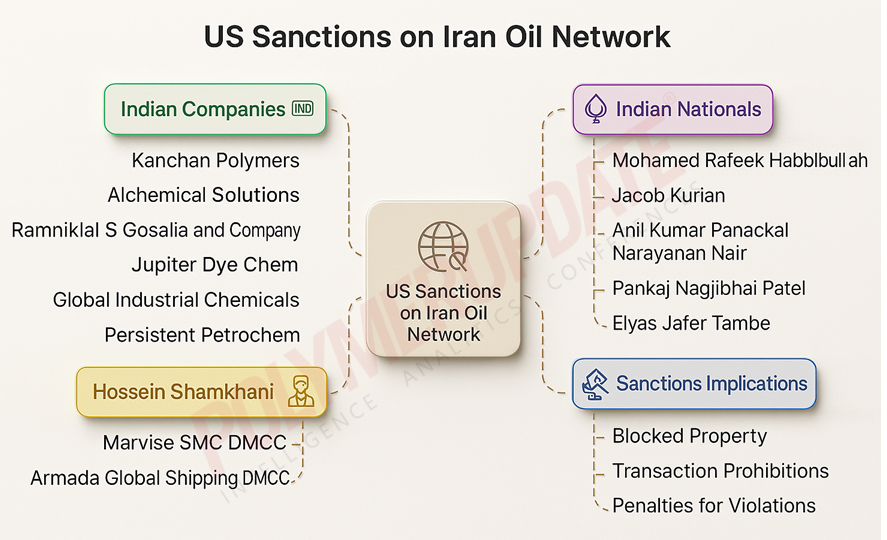 A statement from the US Department of State, reads, “These companies have collectively imported tens of millions of dollars’ worth of Iranian-origin petrochemicals and such transactions generate billions of dollars in illicit funds for Iran's destabilising activities. The Iranian regime continues to fuel conflict in the Middle East to fund its destabilizing activities. Today, the United States is taking action to stem the flow of revenue that the regime uses to support terrorism abroad, as well as to oppress its own people."
Six entities and five individuals
The six Indian companies that are sanctioned by the US Department of State include Chennai-based Kanchan Polymers and five Mumbai-based firms named Alchemical Solutions (also known as Chemform Trading), Ramniklal S Gosalia and Company, Jupiter Dye Chem, Global Industrial Chemicals, and Persistent Petrochem. Two more Indian companies i.e. Mumbai-based Ensa Ship Management and Surat-based Shreeji Gems are featured in the list of sanctioned entities.
The State Department has accused these companies of importing Iranian-origin petrochemicals—which are under US sanctions—worth millions of dollars, and their link with OFAC’s designations over their alleged connections with Hossein Shamkhani’s network. The five Indian nationals designated by the OFAC are Mohamed Rafeek Habibullah, Jacob Kurian, Anil Kumar Panackal Narayanan Nair, Pankaj Nagjibhai Patel, and Elyas Jafer Tambe.
Reports said that Alchemical Solutions Pvt Lie imported more than US$ 84 million worth of Iranian petrochemical goods between January and December 2024. Global Industrial Chemicals Limited is alleged to have acquired Iranian methanol and other substances valued above US$ 51 million from July 2024 to January 2025.
Similarly, Jupiter Dye Chem Pvt Ltd reportedly imported over US$ 49 million worth of Iranian-origin products, including toluene, in the same period. Ramniklal S Gosalia and Company is accused of sourcing methanol and toluene from Iran, amounting to more than US$ 22 million and Persistent Petrochem Pvt Ltd allegedly brought in roughly US$ 14 million worth of methanol between October and December 2024.
Largest Iran-related US action
In its largest Iran-related action since 2018, the Department of the Treasury’s Office of Foreign Assets Control (OFAC) is designating more than 50 individuals and entities and identifying more than 50 vessels that are part of the vast shipping empire controlled by Mohammad Hossein Shamkhani (Hossein).
The US State Department said that Hossein—the son of Ali Shamkhani, a top political advisor to the Supreme Leader of Iran—leverages corruption through his father’s political influence at the highest levels of the Iranian regime to build and operate a massive fleet of tankers and containerships. This network transports oil and petroleum products from Iran and Russia, as well as other cargo, to buyers around the world, generating tens of billions of dollars in profit.
“The Shamkhani family’s shipping empire highlights how the Iranian regime elites leverage their positions to accrue massive wealth and fund the regime’s dangerous behaviour. The over 115 sanctions issued today are the largest to-date since the Trump Administration implemented our campaign of maximum pressure on Iran. These actions put America first by targeting regime elites that profit while Tehran threatens the safety of the United States,” said Secretary of the Treasury Scott Bessent. “
Hossein is intimately involved in the management of the network’s illicit activities through various companies, including United Arab Emirates (UAE)-based Marvise SMC DMCC (Marvise), formerly known as Mairin Ship Management and Consultancy DMCC, which provides management services to many of Hossein’s shipping firms and secretly controls a fleet of dozens of vessels that publicly appear to be owned by multiple other companies transporting crude oil and liquefied petroleum gas for Iran.
Hossein personally oversees Marvise’s operations in Tehran, Iran. Historically, much of Hossein’s tanker fleet fell under the purview of UAE-based Armada Global Shipping DMCC (Armada Global), an umbrella company that managed dozens of vessels used by the network until as recently as early 2025. UAE-based firms Koban Shipping L.L.C, Crios Shipping L.L.C (Crios Shipping), and Fractal Marine DMCC have also played important roles in the management and operation of the network’s fleet of tankers and containerships, the statement said.
Sanctions implications
As a result of today’s action, all property and interests in property of the designated or blocked persons described above that are in the United States or in the possession or control of U.S. persons are blocked and must be reported to OFAC. In addition, any entities that are owned, directly or indirectly, individually or in the aggregate, 50 percent or more by one or more blocked persons are also blocked.
Unless authorized by a general or specific license issued by OFAC, or exempt, OFAC’s regulations generally prohibit all transactions by U.S. persons or within (or transiting) the United States that involve any property or interests in property of blocked persons.
Violations
Violations of U.S. sanctions may result in the imposition of civil or criminal penalties on U.S. and foreign persons. OFAC may impose civil penalties for sanctions violations on a strict liability basis. OFAC’s Economic Enforcement Guidelines provide more information regarding OFAC’s enforcement of U.S. economic sanctions. In addition, financial institutions and other persons may risk exposure to sanctions for engaging in certain transactions or activities involving designated or otherwise blocked persons.
The prohibitions include the making of any contribution or provision of funds, goods, or services by, to, or for the benefit of any designated or blocked person, or the receipt of any contribution or provision of funds, goods, or services from any such person. The power and integrity of OFAC sanctions derive not only from OFAC’s ability to designate and add persons to the Specially Designated Nationals and Blocked Persons List (SDN List), but also from its willingness to remove persons from the SDN List consistent with the law.
Outlook
The ultimate goal of sanctions is not to punish, but to bring about a positive change in behaviour.
DILIP KUMAR JHA
Editor
dilip.jha@polymerupdate.com