Click the icon to add a specified price to your Dashboard list. This makes it easy to keep track on the prices that matter most to you.

South Korean oil refiner and petrochemical producer S-Oil posted a substantial increase in its net losses for the April–June 2025 quarter, as subdued crude oil prices led to lower valuations of refined product inventories and petrochemical by-products. This marked the fifth consecutive quarter of net losses, which widened in Q2 2025, primarily due to a more than six-fold increase in losses from the refining segment.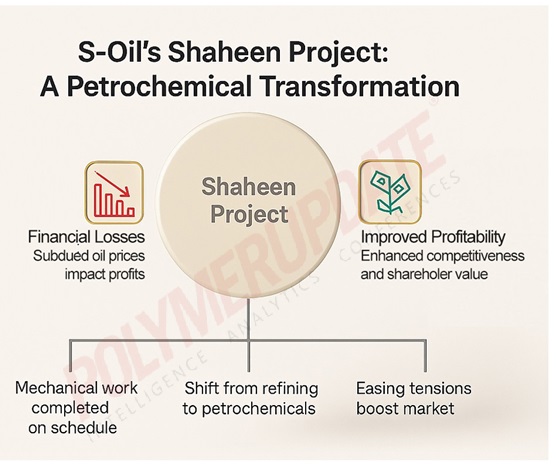 Reports said that Saudi Aramco-controlled S-Oil reported a net loss of Won 441.1 billion for the April–June 2025 quarter, more than three times higher than the Won 121.3 billion loss recorded in the corresponding period of the previous year. The company’s operating income also turned negative, plunging to Won (-)344 billion from a positive Won 160.6 billion in the same quarter of the previous year. Total revenue stood at Won 8,048.5 billion in Q2 2025, down 15.9 percent from Won 9,570.8 billion in the year-ago period.
Operating profit from refining activities slumped to a loss of Won (-)441.1 billion in the April–June 2025 quarter, widening from a loss of Won (-)95 billion in the comparable quarter last year. The petrochemical segment also swung to a loss of Won (-)34.6 billion, compared to a profit of Won 109.9 billion in Q2 2024. In line with the overall trend, lube operating profit declined by 9.6 percent to Won 131.8 billion from Won 145.8 billion in the same quarter of the previous year.
H1’25 performance
For the first half of 2025 (January to June), S-Oil posted a net loss of Won 111.3 billion, compared to a net profit of Won 144.9 billion recorded during the corresponding period of the previous year. The company’s operating income also turned negative, falling to Won (-)365.5 billion in the January–June 2025 period from a positive Won 614.8 billion in the same half of the previous year. Revenue declined by 9.7 percent to Won 17,039 billion in the first half of 2025, down from Won 18,879.3 billion in the year-ago period.
Two major revenue streams—refining and petrochemicals—weighed heavily on the company’s financial performance during January–June 2025. The refining segment posted an operating loss of Won 497.9 billion in the first half of 2025, compared to a profit of Won 155.4 billion in the same period of the previous year. Similarly, the petrochemical segment registered an operating loss of Won 109.2 billion, swinging from a profit of Won 157.9 billion in the first half of the previous year. Operating profit from the lube segment also declined, falling by 20 percent to Won 241.5 billion in January–June 2025 from Won 301.4 billion in the same period of 2024.
Shaheen project on track
Despite incurring losses for the fifth consecutive quarter, S-Oil’s thermal crude-to-chemical project in Ulsan is progressing on track. The mechanical work for the project was completed by the end of June 2025. Major towers have already been installed, and the installation of the cracking heater is advancing well. Installations of the thermal crude-to-chemical reactor and key units, as well as linear low-density polyethylene (LLDPE) and high-density polyethylene (HDPE) reactors and extruders, have all been completed as per schedule.
S-Oil's Shaheen Project, a major petrochemical complex in Ulsan, South Korea, is also progressing as planned and is expected to be completed in the first half of 2026. The project, involving an investment of Won 9.3 trillion, aims to enhance S-Oil's corporate value and strengthen South Korea's industrial competitiveness. Key facilities include a 1.8 million tonne/year mixed-feed cracking unit, an 880,000 tonne/year LLDPE unit, and a 440,000 tonne/year HDPE plant.
Although S-Oil recorded an operating loss in the first quarter of 2025 due to falling oil prices, the company anticipates a gradual improvement in refining margins from the second quarter onwards. The Shaheen Project is expected to support this recovery by supplying feedstock to domestic petrochemical companies and fostering a competitive petrochemical industrial cluster. Refining margins are projected to improve as global uncertainties ease and demand gradually recovers, aided by China's economic stimulus measures and seasonal gasoline blending demand during summer.
With this project, S-Oil is transitioning from traditional oil refining to a more petrochemical-focused business model, with the share of petrochemicals in its portfolio expected to increase from 12 percent to 25 percent. This shift is anticipated to lower costs for domestic petrochemical companies, enhance the competitiveness of the local value chain, and revitalize the regional economy. Additionally, S-Oil plans to boost corporate value through a shareholder return policy, targeting a dividend payout ratio of over 20 percent.
Project initiative
On March 9, 2023, S-Oil held a groundbreaking ceremony at its Ulsan Refinery for the Won 9.258 trillion Shaheen Project (Shaheen: Arabic for "falcon"), Korea’s largest-ever petrochemical project. The event was graced by the presence of President Yoon Suk Yeol and attended by approximately 300 guests, including Chang-Yang Lee, Minister of Trade, Industry and Energy (MOTIE); Doo-kyum Kim, Mayor of Ulsan City; Amin H. Nasser, President & CEO of Aramco; along with members of central and local government and representatives from construction companies. The ceremony marked the beginning of a new chapter in S-Oil’s history.
Shaheen embodies S-Oil’s ambitious plan to strengthen its position as a clean energy and petrochemicals company, aligning with broader carbon neutrality goals. The project is located at the Onsan Industrial Complex in Ulsan City and is expected to be completed in 2026. Key facilities include the world’s largest steam cracker with a production capacity of 1,800 KTA (kilotonnes per annum) of ethylene; a TC2C (Thermal Crude-to-Chemical) facility that converts crude oil directly into petrochemical feedstocks such as LPG and naphtha; a polymer facility producing high-value petrochemical feedstocks for plastics and synthetic resins; as well as storage tanks and other supporting infrastructure.
Current market trend
The polypropylene (PP) and propylene oxide (PO) markets recovered amid tighter supply due to regional maintenance activities and easing tensions between the US and China. For the July–September 2025 quarter, the company expects paraxylene (PX) prices to remain firm, supported by plant turnarounds and the start-up of new downstream purified terephthalic acid (PTA) facilities. The benzene market is also likely to remain resilient, as demand from new downstream facilities offsets the decline in US imports.
DILIP KUMAR JHA
Editor
dilip.jha@polymerupdate.com