Click the icon to add a specified price to your Dashboard list. This makes it easy to keep track on the prices that matter most to you.

Four months after imposing anti-dumping duty (ADD) on PVC (polyvinyl chloride) paste resins, India has recommended a similar measure—ranging from US$ 22 to US$ 284 a tonne—on PVC suspension resins to curb cheap imports and encourage domestic producers to operate more freely. This move is also expected to spur local manufacturers to draw up new investment plans for setting up production facilities in response to rising demand from the infrastructure and construction sectors.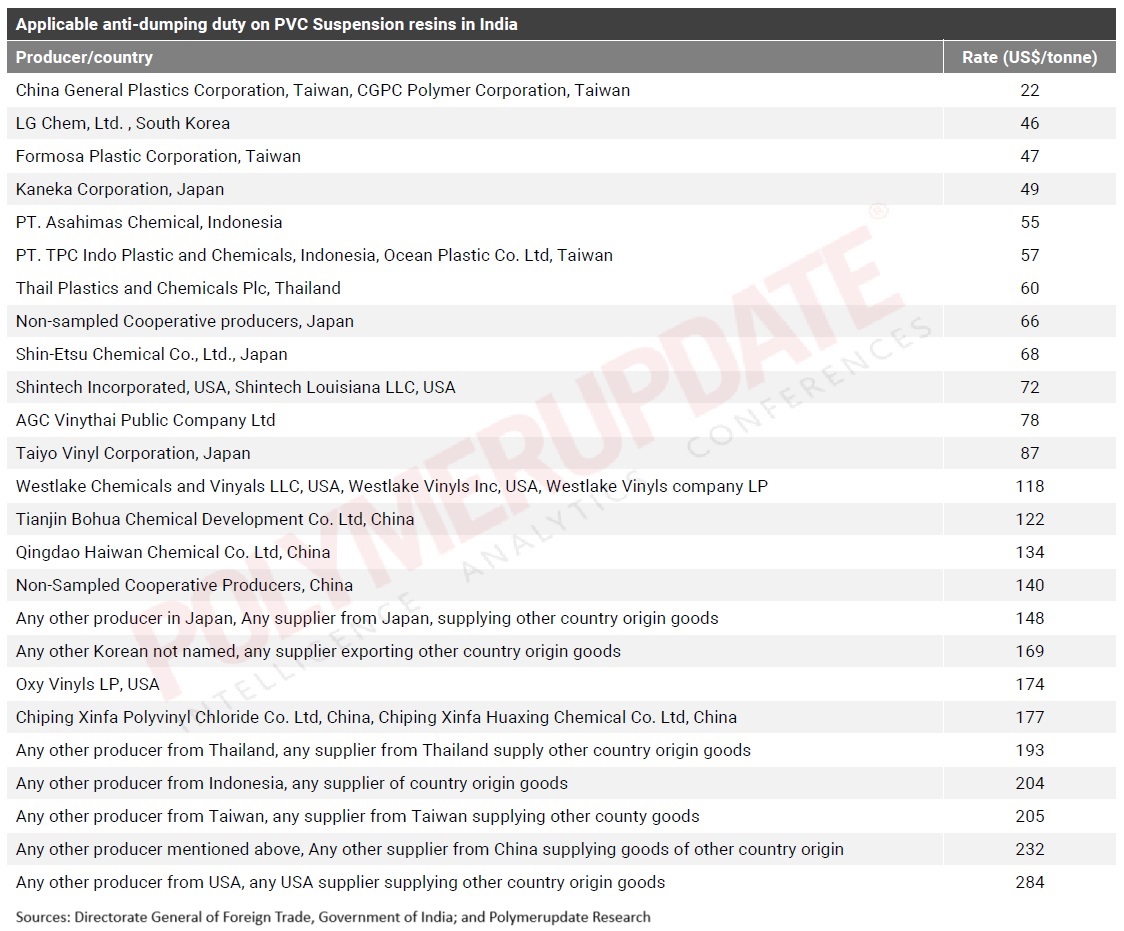 The ADD recommendation was made by the Directorate General of Foreign Trade (DGTR) under the Ministry of Commerce and Industry to the Ministry of Finance for final notification. If implemented, the ADD on PVC suspension resins will remain in effect for five years on imports from China, Indonesia, South Korea, Japan, Taiwan, and the United States of America (USA). It applies both to primary producers in these countries as well as exporters from any other country shipping goods originating from them. The measure has been effective since August 14, 2025, the date of notification.
A notification from the Directorate General of Trade Remedies (DGTR), the Indian authority regulating merchandise imports and safeguarding domestic industries against unfair trade practices, stated, “Having regard to the lesser duty rule followed by the DGTR, the Authority recommends imposition of anti-dumping duty equal to the lesser of the margin of dumping and the margin of injury, so as to remove the injury to the domestic industry. Accordingly, the Authority recommends imposition of anti-dumping duty on the imports of PVC suspension resins, originating in or exported from China, Indonesia, Korea, Japan, Taiwan, and the United States of America (USA).”
India’s PVC production remains significantly below domestic consumption, resulting in heavy reliance on imports. Current local production capacity is estimated at 1.6–1.8 million tonnes per annum (MTPA), against a demand of around 4.1 MTPA, leaving a sizeable demand-supply gap that is largely met through imports, primarily from China, Japan, Taiwan, South Korea, and the USA.
Background of the case
The three Indian primary producers—Chemplast Cuddalore Pvt Ltd, DCM Shriram Ltd, and DCW Ltd—filed an application before the Designated Authority, DGTR, seeking initiation of an anti-dumping investigation concerning imports of Polyvinyl Chloride (PVC) Suspension resins originating in, or exported from, China PR, Indonesia, Japan, Korea RP, Taiwan, Thailand, and the United States of America. The period considered for injury assessment covers October 1, 2022, to September 30, 2023.
On the basis of prima facie evidence submitted by the applicants, the Authority issued a public notice dated March 26, 2024, initiating an investigation to determine the existence, degree, and effect of the alleged dumping of PVC Suspension resins originating in or exported from the aforementioned countries, and to recommend the amount of anti-dumping duty (ADD) which, if imposed, would be adequate to remove the alleged injury to the domestic industry. Through the respective embassies in India, DGTR circulated questionnaires and sought responses from approximately 225 overseas exporters across these countries within a stipulated time frame.
Following the initiation of the investigation, and after providing due opportunity to all interested parties to submit relevant information and defend their positions, the DGTR issued a preliminary finding dated October 30, 2024, provisionally concluding that PVC Suspension resins had been exported from China PR, Indonesia, Japan, Korea RP, Taiwan, Thailand, and the USA at prices below the associated normal value. This amounted to dumping of PVC Suspension resins, causing material injury to the domestic industry. Accordingly, the Authority recommended imposition of provisional anti-dumping duty on imports of PVC Suspension resins from exporters in the above-mentioned countries.
Subsequent to the preliminary findings, and in compliance with directions of the Hon’ble Gujarat High Court, the DGTR conducted an oral hearing on December 11, 2024, regarding product scope issues raised by Epigral Ltd. After considering submissions from all interested parties and conducting the oral hearing, the Authority issued an addendum to the preliminary findings dated December 16, 2024, excluding specialty grades of S-PVC resins imported by Epigral Ltd from the scope of PVC Suspension resins.
Thereafter, the domestic industry filed a Special Leave Petition (SLP) before the Hon’ble Supreme Court of India on May 3, 2025, challenging the Gujarat High Court order dated April 25, 2025. On May 23, 2025, the Hon’ble Supreme Court stayed the operation of the Gujarat High Court judgment.
Arguments from domestic producers
The product under consideration is Homopolymer of Vinyl Chloride Monomer (VCM) of suspension grade, also known as PVC Suspension Resins, which is produced through the suspension polymerization process. The emulsion polymerization process, bulk mass polymerization process, and micro-suspension polymerization process are excluded from the scope of the product under consideration. Additionally, PVC, CPVC, VC-Vac, PVC Paste Resins, Mass Polymerization PVC, and PVC Blending Resins have been kept outside the purview of this investigation.
PVC Suspension Resins is manufactured using vinyl chloride monomer (VCM), which is polymerized through the suspension process. VCM can be obtained either via the EDC (ethylene) route or the carbide route; in both cases, the final product is identical. The DGTR clarified that there is no such category as “specialty grade” of PVC Suspension Resins, contrary to submissions made by certain interested parties. If an exclusion were granted for “specialty grades,” exporters could classify nearly all variants under this category to circumvent the duty.
ADD on PVC Paste resins
In March 2025, India imposed an anti-dumping duty (ADD) of up to US$ 707 a tonne on imports of PVC Paste resins from China and five other countries—Korea, Malaysia, Norway, Taiwan, and Thailand. The measure is aimed at protecting the interests of domestic producers and preventing the use of substandard plastic raw materials in downstream industries. The ADD, initially imposed for five years unless revoked earlier, is intended to shield Indian manufacturers from injury as determined by the investigating authority and claimed by local producers.
A notification issued by India’s Finance Ministry on March 21, 2025, stated, “The Central Government has imposed provisional anti-dumping duty on Polyvinyl Chloride Paste Resins falling under the relevant tariff items of the Customs Tariff Act, originating in or exported from China PR, Korea RP, Malaysia, Norway, Taiwan, and Thailand, and imported into India. The Designated Authority confirmed that PVC paste resin exported to India from these countries is being dumped at below-market prices, causing material injury to the domestic industry.”
DILIP KUMAR JHA
Editor
dilip.jha@polymerupdate.com