Click the icon to add a specified price to your Dashboard list. This makes it easy to keep track on the prices that matter most to you.

India has proposed a sharp cut in the Goods and Services Tax (GST) rates to unlock an estimated ₹1.8 lakh crore potential in recycling and the circular economy, with plastic waste emerging as one of the key drivers. If accepted, the proposal could transform material recycling industries, boost sales of secondary materials, reduce energy consumption in manufacturing, and help tackle the menace of plastic pollution caused by irresponsible post-use dumping and incineration that threatens marine life.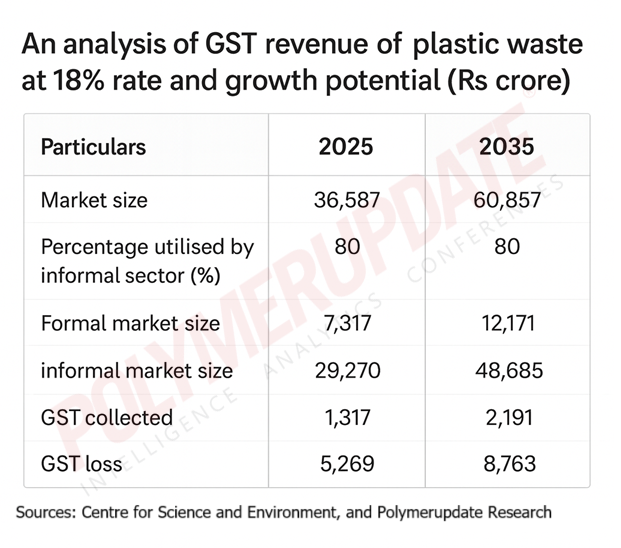 According to informed sources, the government has proposed abolishing the 12 percent and 28 percent GST slabs, consolidating them into two main rates — 5 percent (merit) and 18 percent (standard). The highest slab of 28 percent has been scrapped, with all goods and services under it shifted to 18 percent. Further, about 99 percent of items in the 12 percent bracket would move to 5 percent, while the remaining 1 percent would fall under 18 percent. Scrap of nearly all materials, including plastics, would now be taxed at 5 percent instead of 18 percent earlier.
The proposal will be taken up at the 54th GST Council meeting scheduled for September 9, 2025, and, if approved, could be implemented from October 1, 2025. Apart from supporting recycling industries, the move may also stimulate domestic consumption and serve as a countermeasure to the additional 25 percent tariff recently imposed by the United States on Indian exports as a penalty for buying Russian crude oil.
“While India is advocating reuse and recycling of waste and promoting a circular economy, the current GST regime risks undermining those efforts. The regime does not differentiate between virgin and recycled materials, taxing them equally. This puts recycled products at a severe cost disadvantage despite their lower environmental impact,” said Nivit K Yadav, Programme Director, Industrial Pollution Unit, Centre for Science and Environment (CSE).
The trigger
The recommendation for a sharp cut in the GST rate was triggered by a CSE research report titled ‘Relax the Tax’, which estimated a hidden circular economy potential worth Rs 1.8 lakh crore across sectors such as plastics, metals, glass, paper, and others. Calling for tax relaxation, the study highlighted India’s transition toward a circular economy, which requires reforms in the GST framework. At the current 18 percent rate, the system favours linear consumption over circular material flows. The absence of a tax differential between virgin and recycled materials puts eco-friendly alternatives at a disadvantage, thereby stifling circularity, the study noted.
The report further demonstrated that GST rationalization for industrial waste materials could shift government finances from an estimated Rs 87,000 crore loss under a business-as-usual scenario to substantial profits ranging between Rs 34,000 crore and Rs 1.8 lakh crore under various reform scenarios. Industry stakeholders have consistently identified such tax restructuring as essential to enabling material circularity.
Beyond financial benefits, the analysis emphasized the need to support millions of informal sector workers, who handle over 80 percent of certain waste streams. Proposed reforms include integrating these workers into formal social security systems while providing access to better technology, safety equipment, and improved working conditions. This comprehensive approach, the study argued, would ensure that fiscal policy aligns with circular economy principles while maximizing government revenue and protecting worker welfare.
Need for transformation
For the successful implementation of the Plastic Waste Management (PWM) Rules and Extended Producer Responsibility (EPR) provisions, it is essential to transition the plastic waste recycling industry from informal to formal operations while improving product quality. The cluster development initiative plays a key role in this transformation by integrating advanced machinery for segregation, cleaning, environmental controls, and refining within common facilities to produce near-virgin quality recycled plastics.
Formalizing this sector will also improve GST compliance and increase tax revenue, as a large portion of waste management operations currently remains outside the formal taxation system. The cluster development project aims to formalize the sector, enhance the quality of recycled plastics, expand production capacity, and boost profitability for recycling units. By bringing informal enterprises into the organized sector, it will ensure proper accounting and tax contributions while supporting India’s efforts toward efficient plastic waste management and circular economy practices. This structured approach will not only strengthen environmental sustainability but also reinforce the economic framework through higher GST collection from the waste management sector.
Tax deduction to improve earnings
Engagement with a medium-sized aggregator has revealed critical challenges in the plastic waste sector. A major concern is the high GST rate on recycled plastics, which disproportionately affects small-scale workers. Under the current system, unregistered sellers supplying to larger GST-compliant buyers face an 18 percent deduction. For example, material worth Rs 10 yields only Rs 8.20 after this deduction. Reducing the GST rate to 5 percent would raise their earnings to Rs 9.50—a significant improvement for operators working with very thin profit margins.
Another challenge lies in the fragmented nature of the informal sector and the lack of common facilities for smaller players. This creates heavy reliance on aggregators and limits bargaining power on pricing. Since 95 percent of the plastic waste sector is managed by informal operators, this dependency further weakens their financial position.
There is also a notable lack of alignment between government bodies—particularly the Ministry of Finance (MoF) and the Ministry of Environment, Forest and Climate Change (MoEFCC). The Extended Producer Responsibility (EPR) framework is not harmonized with GST policies, leading to inconsistencies. The issue of fake EPR certificates in 2024 further underscores a loophole that must be addressed within the GST system to prevent fraud.
Stakeholder discussions highlight that the government should balance business interests with human welfare and environmental sustainability. If financial constraints are a concern, increasing the GST on virgin plastics could be considered. Such a measure would generate additional revenue for the government while making recycled materials more affordable and competitive in the market, the study suggests.
Dual operating system
In India, the waste management sector operates through two parallel systems: the formal sector and the informal sector. The formal sector comprises registered businesses that comply with tax regulations, including GST. In contrast, the informal sector functions outside this framework—without registration, tax compliance, or official oversight.
This dual system has significant implications. The dominance of the informal sector leads to substantial revenue losses for the government under GST. At the same time, while the informal sector plays a crucial role in waste collection, segregation, and recycling, it faces multiple challenges. These include low operational efficiency, unsafe and unhygienic working conditions, poor wages, lack of legal protection, and no access to health or social security benefits.
Workers in this sector often rely on outdated methods and have limited access to modern technology, which further undermines productivity and safety. In some waste streams, more than 80 percent of operations are controlled by informal players. Such a high level of informality not only complicates regulation and monitoring but also prevents the adoption of improved practices and technologies within the sector.
DILIP KUMAR JHA
Editor
dilip.jha@polymerupdate.com