Click the icon to add a specified price to your Dashboard list. This makes it easy to keep track on the prices that matter most to you.

The reciprocal and penal tariffs unilaterally imposed on U.S. trade partners by President Donald Trump immediately after assuming office are facing a litmus test in the United States Supreme Court, with conservative justices sharply questioning their legality. The case came before a nine-judge bench, some of whose members were appointed by President Trump. The bench began hearing the case on Wednesday to determine whether President Trump lawfully invoked his authority under the International Emergency Economic Powers Act to levy sweeping reciprocal and penal tariffs on trade partners, or whether the move constituted a violation of the law.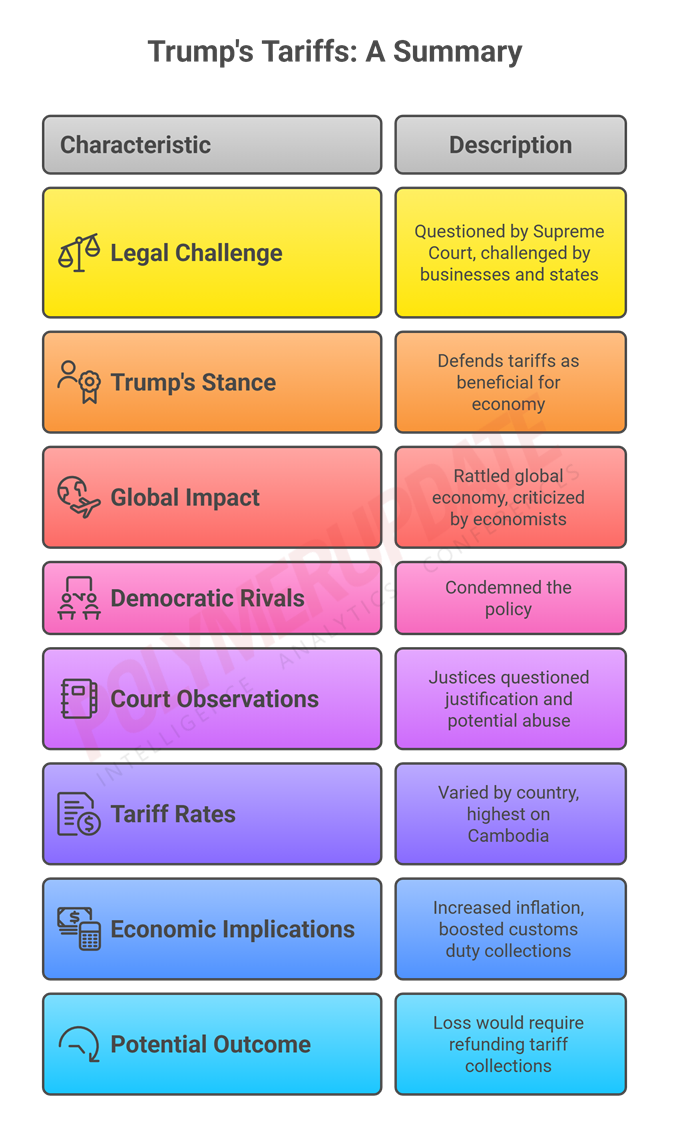 Trump’s tariffs have been challenged on legal grounds by several small businesses and a group of states, which argue that their members faced a substantial rise in the cost of imported raw materials due to these tariffs, thereby increasing production costs for their final products. President Trump has urged the Supreme Court justices to uphold what he calls “friendly reciprocal and penal tariffs,” describing them as beneficial for the U.S. economy and job creation.
The sweeping, unilaterally imposed tariffs have rattled the global economy since their introduction, drawing widespread criticism from economists. Meanwhile, Trump’s Democratic rivals have also condemned the policy, voicing strong disapproval. Small businesses challenging the tariffs’ legality contend that the former president overstepped his authority and misused his powers in imposing these tariffs, which they characterize as a form of taxation.
Court observations
Justices of the U.S. Supreme Court on Wednesday appeared somewhat expeditious in hearing the case on Trump’s tariffs — a departure from the court’s usual practice of taking months to deliberate on major and sensitive cases related to government policy. The apex court, which has a 6–3 conservative majority, began hearing arguments in the tariffs case, widely seen as a litmus test of the Trump administration’s first major exercise of presidential power.
Experts remarked, “Under the Constitution — America’s founding legal document — it is Congress, not the President, that holds the power to tax. The Court has traditionally set limits on how much of that authority can be delegated.”
Justice Amy Coney Barrett, who was appointed to the Court by President Trump, questioned the government’s counsel defending Trump’s tariff order, “Is it your contention that every country — such as Spain and France, among others — needed to be taxed because of threats to the defense and industrial base? I can see the justification with some countries, but explain to me why so many nations had to be subjected to the reciprocal tariff policy as they are today.”
During the hearing, Chief Justice John Roberts observed, as quoted in a report, “The justification for levying sweeping tariffs is being used as a means to impose tariffs on any product, from any country, in any amount, for any length of time.” Another conservative justice, Neil Gorsuch, was quoted as asking, “What would prevent Congress from simply abdicating all responsibility to regulate foreign commerce? I am struggling to find a reason to accept Sauer’s arguments. Could the President, for instance, impose a 50 percent tariff on gas-powered cars and auto parts to address an unusual and extraordinary threat from abroad such as climate change?”
The tariffs
On April 2, the Trump administration in the United States announced a 26 percent duty on Indian goods entering the U.S., including chemicals but excluding pharmaceuticals. The policy aims to mirror tariffs imposed by other countries on U.S. exports and is expected to significantly impact India’s chemical sector, a key export-oriented industry. Announced on the occasion of Liberation Day, the tariffs are likely to provoke similar retaliatory measures from U.S. trade partners, boost regional trade, and create inflationary pressures on the U.S. economy, at least in the short term. A separate 25 percent penal tariff was imposed on India for purchasing Russian oil.
However, Trump’s tariffs on Indian exports are substantially lower than those imposed on neighboring countries, including China and Pakistan. Notably, China — an export-driven economy and the world’s second-largest — faced a 145 percent tariff on goods imported into the U.S. President Donald Trump imposed “extremely high reciprocal tariffs,” effective from April 5 — and in some cases, April 9 — targeting trade partner countries, including both allies and adversaries. The tariff rate on Chinese goods was later reduced to 57 percent and further brought down to 47 percent following a meeting between President Trump and Chinese President Xi Jinping in South Korea in the last week of October.
While President Trump initially proposed a universal 10 percent tariff on all countries, higher reciprocal tariffs were imposed on nations with the largest trade deficits with the U.S. All other countries remain subject to the baseline 10 percent tariff. These tariffs will remain in effect until President Trump determines that the threat posed by trade deficits and underlying non-reciprocal treatment has been resolved, mitigated, or eliminated.
The highest tariffs were imposed on Cambodia at 49 percent, followed by Laos at 48 percent, Madagascar at 47 percent, Vietnam at 46 percent, and Myanmar at 46 percent. Indian goods face a 26 percent import duty upon entry into the U.S. President Trump has defended these measures, asserting that tariffs are necessary to ensure fair trade, protect American workers, and reduce the trade deficit. By deferring implementation for 90 days and maintaining the universal baseline duty of 10 percent, President Trump has left room for negotiations.
Implications
The U.S. Supreme Court justices indicated that they were assessing the broader implications of the sweeping unilateral tariffs imposed by the Trump administration on America’s trade partners — and what might follow if the Court rules in Trump’s favour. A favourable ruling could embolden Trump to deploy tariffs more frequently and against more countries as a tool of geopolitical leverage. President Trump has previously claimed that he had threatened to impose additional tariffs to halt the India-Pakistan war — a claim refuted by Indian Prime Minister Narendra Modi. Despite a temporary ceasefire being announced, President Trump imposed a 25 percent penal tariff on India for purchasing Russian crude oil.
Federal Open Market Committee (FOMC) Chair Jerome Powell has blamed tariffs for the rise in retail inflation. In his September policy statement, Powell said, “Goods prices, after falling last year, are driving the pickup in inflation. Incoming data and surveys suggest that these price increases largely reflect higher tariffs rather than broader price pressures. Near-term measures of inflation expectations have moved up, on balance, over the course of this year on news about tariffs.”
Excluding the volatile food and energy categories, core PCE prices rose 2.9 percent last month — higher than the level a year earlier. However, beyond the next year or so, most measures of longer-term inflation expectations remain consistent with the Federal Reserve’s 2 percent target. Disinflation in services continues, including within the housing segment.
Collections
The Committee for a Responsible Federal Budget (CRFB) estimated that total customs duty collections stood at US$ 195 billion this year, up by more than 250 percent from the previous year’s tally — a clear sign of the fiscal impact generated by heightened trade measures. Despite this boost, along with one-time savings from student loan reforms amounting to US$ 200 billion, the federal deficit still totalled US$ 1.8 trillion (roughly 6 percent of gross domestic product, or GDP). The CRFB warned that lawmakers would need to identify substantially more deficit-reduction measures to place the US$ 38 trillion national debt on a sustainable path.
Customs duty collections, which began the fiscal year under pre-existing rates, rose sharply as the administration introduced new and expanded tariffs throughout the year. Monthly revenues surged from US$ 7 billion in January to US$ 30 billion by September, culminating in a total annual tariff collection of US$ 195 billion — nearly US$ 118 billion (or 150 percent) higher than the US$ 77 billion collected in 2024. Much of this revenue — roughly US$ 150 billion — was generated in the second half of the year, when receipts outpaced those in the same period last year by almost 300 percent.
Conclusion
A loss for President Trump would require refunding all tariff collections — a major setback for the U.S. government.
DILIP KUMAR JHA
Editor
dilip.jha@polymerupdate.com