Click the icon to add a specified price to your Dashboard list. This makes it easy to keep track on the prices that matter most to you.

India has rescinded the mandatory Quality Control Orders (QCOs) on various chemical and petrochemical raw materials to ease the regulatory compliance burden on industries and provide operational flexibility to micro, small, and medium enterprises (MSME) units, four years after their imposition. The withdrawal follows recommendations from NITI Aayog to remove mandatory quality control requirements on about 200 products across multiple categories under the ‘Ease of Doing Business’ initiative, aimed at accelerating India’s industrial growth.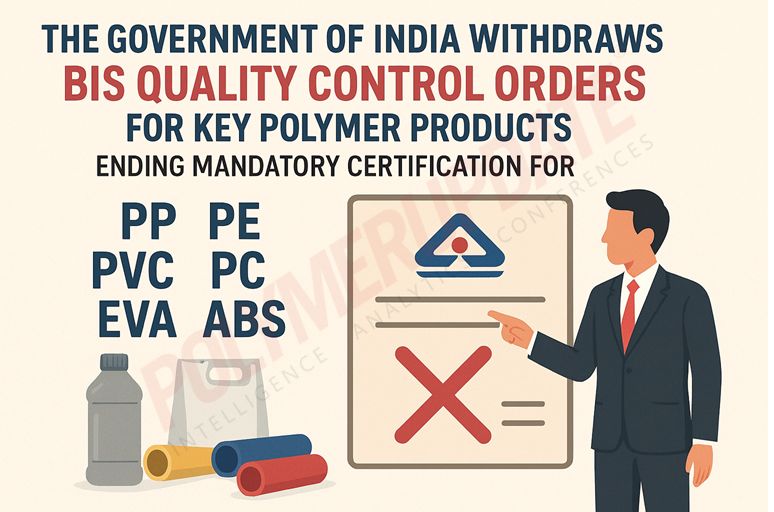 Quality Control Orders (QCOs), issued by various government departments in coordination with the Bureau of Indian Standards (BIS), are mandatory regulations designed to ensure product safety and quality—unlike the voluntary standards also issued by BIS. However, the sharp expansion of QCO coverage—from about 70 products in 2016 to nearly 790 at present—has drawn growing criticism from industry groups and trade partners.
While the government has been gradually withdrawing mandatory Quality Control Orders (QCOs) across different categories for some time, the Department of Chemicals and Petrochemicals under the Union Ministry of Chemicals and Fertilizers issued multiple gazette notifications on Wednesday, informing all value chain participants about the latest rescissions. The new series of notifications cover various chemical and petrochemical raw materials, along with certain finished textile raw materials, that have been excluded from mandatory BIS quality requirements.
Dated November 12, 2025, the notifications formally withdraw the mandatory quality benchmark requirements for several chemical and petrochemical raw materials, including Terephthalic Acid (PTA), Ethylene Glycol, Polyethylene Material for Moulding and Extrusion, Acrylonitrile Butadiene Styrene (ABS), Polypropylene (PP) Materials for Moulding and Extrusion, Polyvinyl Chloride (PVC) Homopolymers, Ethylene Vinyl Acetate (EVA) Copolymers, Polyurethanes, and Polycarbonate.
Countries including the United States and members of the European Union have reportedly raised concerns over these QCOs, viewing them as potential non-tariff barriers in ongoing trade negotiations. In response, the committee constituted three months ago has urged the government to adopt a “balanced approach” that safeguards quality while preserving industrial competitiveness.
Textile raw materials
Finished raw materials such as 100 percent polyester spun grey and white yarn, polyester industrial yarn (IDY), polyester staple fibre (PSF), polyester continuous filament fully drawn yarn, and polyester partially oriented yarn have also been included in the withdrawal of Quality Control Orders (QCOs) with immediate effect. Notably, the mandatory quality requirement orders were first introduced in 2021 to prevent Indian manufacturers from producing substandard goods using inferior raw materials. At the time, policymakers believed that enforcing such quality norms would help Indian exporters expand their presence in overseas markets.
A notification from the Department of Chemicals and Petrochemicals under the Ministry of Chemicals and Fertilizers stated, “The Central Government, being of the opinion that it is necessary so to do in the public interest, after consulting the Bureau of Indian Standards (BIS), hereby rescinds the notification dated December 24, 2021, relating to Terephthalic Acid, with immediate effect, except as respects things done or omitted to be done before such rescission.” Similar but separate notifications were issued for other products as well.
Earlier, on October 24, 2025, the government had withdrawn the QCOs for acrylonitrile, maleic anhydride, and styrene, issued by the Ministry of Chemicals and Fertilizers. The withdrawals, carried out under the Bureau of Indian Standards (BIS) Act, 2016, followed due consultation with the BIS and took effect immediately.
Extensions
These notifications were periodically extended for implementation after the initial effective date was set for June 2022, i.e., six months from the date of the first official Gazette notification. However, inadequate manpower and limited resources at the regulator’s office, coupled with repeated requests from industrial units—particularly those in the MSME sector—prompted the government to withdraw the Orders. The mandatory BIS quality requirement had been extended by six months each time it approached expiry, but the government has now decided to discontinue this practice of issuing repeated extensions through Gazette notifications.
The Government of India has rescinded the QCOs on various chemicals and materials, including polyester fibre and yarn, to ease the regulatory burden on industries, enhance export cost competitiveness, and reduce compliance costs for manufacturers, especially micro, small, and medium enterprises (MSMEs). The QCOs were seen as restricting access to raw materials and creating inefficiencies that adversely affected export-oriented sectors such as textiles and electronics.
Niti Aayog observations
The withdrawal of the mandatory BIS Quality Control Orders (QCOs) was based on recommendations from a government-appointed panel led by NITI Aayog. NITI Aayog member Rajiv Gauba had advised the government to reconsider its approach to QCOs, noting that the sharp rise in mandatory standard requirements has increased compliance costs and disrupted industrial supply chains. The panel also cautioned that the growing compliance burden could delay processes and add costs related to adherence, potentially rendering affected products uncompetitive in overseas markets.
The committee—which includes representatives from the Department for Promotion of Industry and Internal Trade (DPIIT), the Ministry of Micro, Small and Medium Enterprises, and major industry bodies such as the Federation of Indian Chambers of Commerce and Industry (FICCI), the Confederation of Indian Industry (CII), and the Associated Chambers of Commerce and Industry of India (Assocham)—believes that “QCOs should largely apply to finished goods that have a direct bearing on consumer safety, health, and product quality.” The panel has therefore proposed the cancellation, suspension, or deferment of QCOs covering more than 200 products.
Impact
As a result, manufacturers, importers, and traders of the six specified chemicals are no longer required to obtain BIS certification or carry the ISI mark for their production or sale. The withdrawal is expected to ease compliance burdens for small and medium enterprises operating in the oleochemicals and fatty acids sector. However, producers will still be required to uphold product quality and safety standards in line with other applicable industrial and environmental regulations.
Furthermore, the High-Level Committee on Non-Financial Regulatory Reforms has recommended that the government scrap 27 existing QCOs covering key industrial inputs such as base metals, plastics, footwear, polymers, and electronic components. It has also proposed suspending QCOs for 112 products and deferring the implementation of several others that are scheduled to take effect soon. The panel further advised that any decision to defer QCOs should be reviewed by an inter-ministerial committee and implemented by the respective line ministries, including those overseeing textiles, steel, mines, and chemicals.
DILIP KUMAR JHA
Editor
dilip.jha@polymerupdate.com