Click the icon to add a specified price to your Dashboard list. This makes it easy to keep track on the prices that matter most to you.

India has urged developed countries to make climate technology affordable and free from intellectual property barriers to help emerging nations achieve their voluntarily pledged climate goals under the United Nations framework. Additionally, India called for immediate climate finance—running into trillions of dollars—from developed nations to support emissions reduction efforts and help achieve the UN-envisioned target of limiting global temperature rise to 1.5°C by 2050.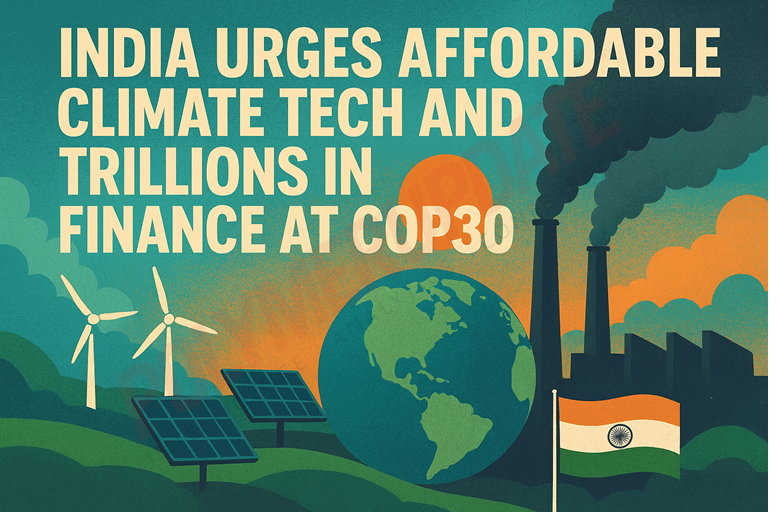 Speaking at the ongoing United Nations Framework Convention on Climate Change’s (UNFCCC’s) 30th Conference of the Parties (COP30) in Belém, Brazil, India’s Union Environment Minister Bhupender Yadav said, “Developed countries must demonstrate greater climate ambition and honour their commitments. They must reach net zero far earlier than their current target dates and deliver new, additional, and concessional climate finance at a scale of trillions of dollars, not billions. There is a need for affordable, accessible climate technology that is free from restrictive intellectual property barriers.”
India has successfully demonstrated that development and environmental stewardship can advance in tandem. The country’s emission intensity has declined by over 36 percent since 2005, even as it has registered robust economic growth. Non-fossil sources now account for more than half of India’s total installed electric power capacity (currently around 256 gigawatts), achieving its NDC target five years ahead of the 2030 deadline. India will soon announce its revised NDCs for 2035 and will also submit its first Biennial Transparency Report on time.
COP30
After 29 unsuccessful attempts in different geographies, negotiators, scientists, and civil society representatives are gathering in Belém, Brazil, from November 6–21, 2025, to discuss priority actions to tackle climate change. COP30 focuses on the efforts needed to limit global temperature rise to 1.5°C, the presentation of new national action plans (NDCs), and progress on the finance pledges made at COP29 in Azerbaijan.
While the gathering of nearly 50,000 delegates has prompted the host country, Brazil, to hail the event as a major success, participants have noted COP30 President André Corrêa do Lago’s dissatisfaction with the negligible progress achieved so far. The divide between rich and poor nations — including the least developed countries — remains a major obstacle.
United Nations Secretary-General António Guterres has already urged world leaders to act swiftly before it becomes too late and the environmental crisis escalates beyond control. Speaking at the World Leaders’ Summit of the Belém Climate Summit — part of the United Nations Climate Conference, or COP30 — Guterres called on leaders to take urgent and decisive action to preserve the 1.5°C target.
U.S. President Donald Trump announced the country’s withdrawal from the United Nations Environment Programme (UNEP) immediately after assuming office in January 2025. Adding to the controversy, President Trump on January 22, 2025, declared the U.S. withdrawal from the global Paris Agreement on climate change, jeopardizing global decarbonization goals. Earlier, during his first term, the U.S. had withdrawn from the Paris Agreement in 2017, only to rejoin under his successor, Joe Biden.
India’s global leadership
India’s global leadership has been demonstrated through initiatives such as the International Solar Alliance (ISA) and the Global Biofuel Alliance (GBA). New Delhi also highlighted the momentum generated by the Nuclear Mission and the Green Hydrogen Mission in advancing the country’s pathway to Net Zero by 2070. In line with the objectives of the Paris Agreement regarding the conservation and development of carbon sinks and reservoirs, more than 2 billion plants have been planted under a community-led initiative in just sixteen months — a testament to the power of collective climate action, Yadav asserted.
According to a report published last week by the Global Carbon Project, an authoritative tracker of global fossil fuel emissions, global carbon emissions are expected to rise to 38 billion tonnes — an increase of 1.1 percent — in 2025. India’s emissions, however, are projected to grow by 1.4 percent, lower than in recent years; in 2024, India’s emissions rose by 4 percent from the previous year.
The slower increase is partly attributed to a favourable monsoon that reduced cooling demand, as well as strong growth in renewable energy, which led to lower coal consumption. China’s emissions in 2025 are projected to increase by 0.4 percent — also slower than in previous years — due to moderate growth in energy consumption coupled with extraordinary growth in renewable energy.
Overall, India is the world’s third-largest emitter of carbon, with annual emissions of 3.2 billion tonnes in 2024, behind the U.S. (4.9 billion tonnes) and China (12 billion tonnes). On a per capita basis, however, India emits just 2.2 tonnes of carbon dioxide per year — the second lowest among the world’s 20 largest economies. Coal remains the major fuel contributing to India’s emissions.
Net-zero pledges
Countries’ pledges to achieve net-zero emissions vary, but many major nations made significant commitments around the 2021 COP26 summit in Glasgow, while the Paris Agreement provides the overarching international framework for climate action. China has pledged to reach net zero by 2060, while the United States, the European Union, and Japan aim for 2050. Several other countries and international organisations, including the United Nations, have also aligned themselves with these long-term goals.
India, for the first time, committed to achieving net-zero emissions by 2070. Net zero, or carbon neutrality, means not adding to the total amount of greenhouse gases in the atmosphere. India has proposed sourcing 50 percent of its energy from renewable resources by 2030 and reducing projected cumulative carbon emissions by one billion tonnes by the same year.
Need strong action
As COP30 negotiations enter the final week, participants are calling for stronger and more decisive action to achieve global climate goals. Speaking at the event, Pope Leo criticised world governments for failing so far to slow global warming and urged a more robust response to the escalating threat. His message reflected growing concern about weakening international ambition and rising greenhouse gas emissions a decade after the historic Paris Agreement — the landmark 2015 accord in which countries committed for the first time to limiting global warming to well below 2°C above pre-industrial levels.
Scientists now warn that the Earth is on track to overshoot that threshold, paving the way for devastating impacts. Delegates in the Amazon city are seeking to reach agreement by Wednesday on several difficult issues, including climate finance and emissions-reduction goals, with the rest of the agenda expected to be resolved by the final scheduled day on Friday, COP30 President André Corrêa do Lago said. Negotiators have frequently worked overtime in previous summits.
DILIP KUMAR JHA
Editor
dilip.jha@polymerupdate.com