Click the icon to add a specified price to your Dashboard list. This makes it easy to keep track on the prices that matter most to you.

India’s energy sector lies at the centre of the country’s aspirations and offers investment opportunities worth US$ 500 billion, Prime Minister Narendra Modi said while inaugurating the latest edition of the flagship energy event, Energy Week, via video conferencing on Tuesday. Modi called upon the global community with the message of Make in India, Innovate in India, Scale with India, and Invest in India.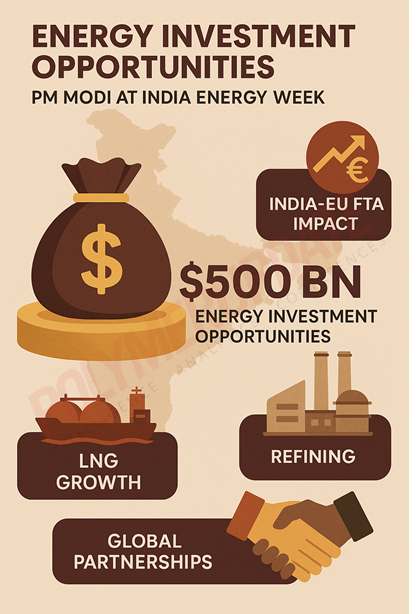 Speaking on the occasion, Modi noted that representatives from nearly 125 countries have gathered in Goa for this edition of Energy Week to discuss an energy-secure and sustainable future, and welcomed all participants. He said India is a land of immense opportunities for the energy sector and the world’s fastest-growing economy, implying that demand for energy products in the country is continuously rising.
India also offers strong opportunities to meet global energy demand. The country is among the world’s top five exporters of petroleum products, with export coverage extending to more than 150 countries. This capacity, Modi said, would be of great benefit to all. He further stressed that Energy Week is an excellent platform to explore partnerships and extended his best wishes to all participants.
India-EU represents 25% world GDP
India signed a significant Free Trade Agreement (FTA) with the European Union, described as the “mother of all deals.” The agreement brings immense opportunities for India’s 1.4 billion people as well as millions across European nations. It stands as a remarkable example of coordination between two of the world’s largest economies. Together, the two sides account for nearly 25 percent of global GDP and about one-third of global trade. Beyond trade, the deal also strengthens the shared commitment to democracy and the rule of law.
The free trade agreement with the EU will complement existing agreements with Britain and the European Free Trade Association (EFTA), thereby reinforcing trade ties and strengthening global supply chains. Modi extended warm congratulations to India’s youth and all citizens on this achievement, and conveyed his best wishes to those engaged in sectors such as textiles, gems and jewellery, leather, and footwear, noting that the agreement would prove highly beneficial for them. The trade deal is expected not only to boost manufacturing in India but also to further expand the services sector. The India–EU free trade agreement will strengthen global business and investor confidence in India.
Global partnerships
India is actively working on building global partnerships across all sectors. In the energy sector alone, there are vast investment opportunities across multiple segments of the energy value chain. India has significantly opened up its exploration sector and has also referred to the deep-sea exploration initiative known as the Samudra Manthan Mission. By the end of this decade, India aims to raise investments in the oil and gas sector to US$ 100 billion, with a target of expanding the exploration area to one million square kilometres.
More than 170 blocks have already been awarded, and the Andaman and Nicobar basin is emerging as the next hydrocarbon frontier. Highlighting that several reforms have been undertaken in the exploration sector, including a reduction in No-Go areas, Modi added that suggestions received during previous editions of India Energy Week have been incorporated into amendments to Acts and Rules. He said companies investing in the exploration sector are likely to see improved profitability.
Distinctive strength
Another distinctive strength that makes investment in India’s energy sector highly attractive is the country’s large refining capacity, where it currently ranks second globally. India is expected to soon become the world’s largest refining hub. At present, the country’s refining capacity stands at around 260 million metric tonnes (MMT) per annum, and sustained efforts are underway to raise it beyond 300 MMT per annum. This represents a significant advantage for investors.
Demand for liquefied natural gas (LNG) in India is steadily rising. The country has set a target to meet 15 percent of its total domestic energy demand through LNG, which will require development across the entire LNG value chain, including large-scale investments in transportation. India is working to build LNG carriers domestically, supported by a recently launched shipbuilding programme worth Rs 70,000 crore. In recent months, numerous investment opportunities have emerged in the construction of LNG terminals at Indian ports, as well as in regasification projects.
Need for a vast pipeline network
There is a need for an extensive pipeline network for LNG transportation. While significant investments have already been made, large-scale opportunities still remain. City gas distribution networks have reached many Indian cities and are rapidly expanding to others, making the sector highly attractive for investment. With India’s large population and steadily growing economy, demand for petrochemical products will continue to rise, necessitating extensive energy infrastructure. Investment in this area is therefore expected to deliver substantial growth. Modi added that there are also abundant opportunities for investors in downstream activities.
“Today’s India is riding on the Reforms Express and undertaking rapid reforms across every sector,” Modi stressed, highlighting the measures being implemented to strengthen the domestic hydrocarbons sector while creating a transparent and investor-friendly environment for global collaborations. He said the country is now moving beyond energy security towards the goal of energy independence. India is developing an energy-sector ecosystem capable of meeting domestic demand and, through affordable refining and transportation solutions, making exports highly competitive globally.
DILIP KUMAR JHA
Editor
dilip.jha@polymerupdate.com