Click the icon to add a specified price to your Dashboard list. This makes it easy to keep track on the prices that matter most to you.

In a major breakthrough, India has reduced import tariffs to zero and committed to a trade package worth US$ 500 billion, in exchange for the United States slashing import duties on Indian goods to a flat rate of 18 percent, US President Donald Trump announced. While India had been levying import duties at various rates—substantially higher on American goods—the United States had been imposing tariffs of up to 50 percent (25 percent as reciprocal duties and an additional 25 percent as a penalty for India’s purchase of crude oil from Russia).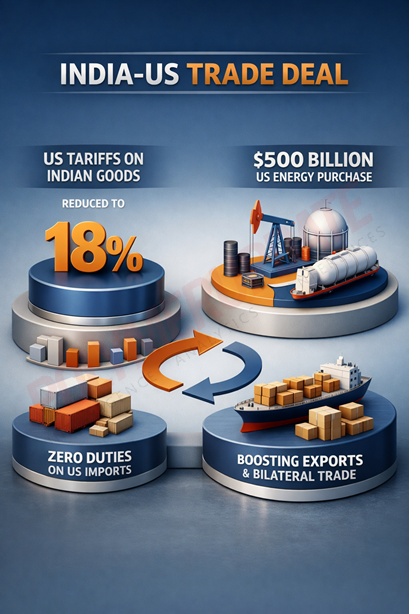 At the time of writing, the draft of the bilateral trade deal had not been officially announced and was not publicly available. However, stakeholders on both sides were attempting to gauge the contours of the agreement based on President Trump’s social media post and a brief comment by Indian Prime Minister Narendra Modi through the Press Information Bureau (PIB). The Indian government is yet to formally announce the trade deal and the conditions laid out in the agreement.
Announcing the deal in a post on the social media platform Truth Social, Trump said: “Out of friendship and respect for India’s Prime Minister Narendra Modi and, at his request, effective immediately, we have agreed to a trade deal between the United States and India, whereby Washington will charge a reduced reciprocal tariff, lowering it from 25 percent to 18 percent. Modi has committed India to buy American oil at a much higher level, in addition to purchasing more than US$ 500 billion worth of US energy, including coal, along with technology, agricultural, and other products. India will also move forward to reduce its tariffs and non-tariff barriers against the United States to zero.”
Acknowledging the significance of the India–US trade deal, Prime Minister Modi thanked President Trump, on behalf of India’s 1.4 billion people, for the decision to reduce tariffs on Indian products to 18 percent. “When two large economies and the world’s largest democracies work together, it benefits our people and unlocks immense opportunities for mutually beneficial cooperation. President Trump’s leadership is vital for global peace, stability, and prosperity. India fully supports his efforts for peace,” Modi said.
Father of all deals: FIEO
The Federation of Indian Export Organisations (FIEO) has wholeheartedly hailed the finalisation of the “Father of All Deals,” the India–US Trade Deal, under which the United States has agreed to reduce tariffs on all Indian-made products to 18 percent. The agreement marks a significant milestone in further boosting and strengthening bilateral trade relations between the two countries. S C Ralhan, President, FIEO, said the agreement would enhance the competitiveness of Indian products in the US market and provide a strong impetus to India’s export growth across sectors.
“The bilateral trade deal will be a historic milestone and a game-changer for Indian exporters. The finalisation of the India–US Trade Deal and the reduction of US tariffs to 18 percent on Indian-made products is a landmark achievement. It reflects the growing strategic and economic partnership between India and the United States and opens up vast opportunities for Indian exporters, particularly MSMEs,” Ralhan said.
Sectors such as engineering goods, textiles and apparel, pharmaceuticals, chemicals, leather products, gems and jewellery, and agricultural products are expected to gain significantly from the tariff rationalisation. Lower tariffs will not only improve price competitiveness but also help Indian exporters integrate more deeply into US supply chains. The agreement is also expected to encourage capacity expansion, attract fresh investments, and support job creation in export-oriented industries.
Trade to begin soon
The reduction in reciprocal tariffs is expected to lead to an immediate and substantial release of orders that were earlier put on hold, particularly in labour-intensive sectors such as apparel, textiles, leather, and footwear, where global buyers typically lock in summer-season sourcing by December. With improved price parity, greater tariff certainty, and strong buyer confidence in Indian suppliers, these sectors are poised for a rapid surge in orders and a strong acceleration in export growth in the coming months.
The agreement sends a strong signal to global markets about India’s commitment to free, fair, and rules-based trade. This development will support India’s long-term export targets and further strengthen its position as a reliable global trading partner. FIEO reiterated its commitment to working closely with exporters and stakeholders to ensure effective utilisation of the benefits arising from the agreement and to address any implementation-related issues in a timely manner.
Bilateral trade
After the United States raised tariffs on Indian products to 50 percent in August, labour-intensive sectors such as textiles, jewellery, and shrimp were the most impacted, particularly in shipments to the United States. However, overall trade remained positive, supported by hefty discounts offered by Indian exporters to US buyers, which helped Indian shippers retain American customers.
Consequently, India’s exports to the United States rose by 16 percent year on year to US$ 85.5 billion, while imports reached US$ 46.1 billion during April–November 2025. India’s bilateral trade in goods and services with the United States stood at US$ 212.3 billion in 2024, with the US recording a goods trade deficit of US$ 45.8 billion and a small surplus in services trade.
DILIP KUMAR JHA
Editor
dilip.jha@polymerupdate.com