Click the icon to add a specified price to your Dashboard list. This makes it easy to keep track on the prices that matter most to you.

The Gross Refining Margins (GRMs) of Indian oil marketing companies (OMCs) rebounded nearly four-fold in the October–December 2025 quarter, as refiners rapidly reconfigured their crude oil sourcing mix — reducing purchases from Russia and increasing imports from Venezuela and the United States, among other major producing nations. A key medium-term development emerged in February 2026: in exchange for a reduction in U.S. tariffs on imports of Indian goods from an effective 50 percent (including penalties) to 18 percent, India is likely to scale back purchases of discounted Russian crude oil.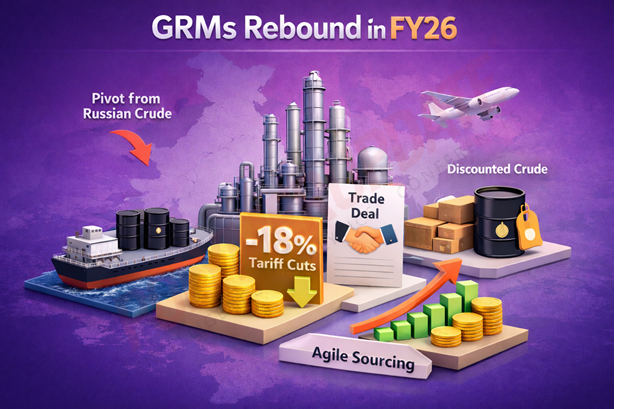 The study states, “Indian OMCs have navigated a highly volatile margin environment over the past three fiscal years, marked by sharp fluctuations in GRMs amid rapidly evolving global market dynamics. Thereafter, GRMs rebounded significantly to US$ 8–10 per barrel in the July–September 2026 quarter and further to US$ 9–13 per barrel in the October–December 2026 quarter, thereby outperforming the Singapore benchmark. GRMs had touched a low of US$ 2–4 per barrel in the January–March 2025 quarter. This improvement was supported by agile inventory management, a decline in crude oil prices, healthy product cracks, and wider discounts on Russian crude due to U.S. restrictions on Russian crude oil trade.”
Strategic change
A defining theme in the latter half of FY26 (i.e., from October 2025 onwards) is the gradual unwinding of the “Russian pivot,” which significantly supported India’s refining margins in FY23 and FY24. India’s crude oil procurement profile has shifted markedly — from a period of elevated dependence in FY24 (around 36 percent) to a noticeable tapering in Q3 FY26 (around 30 percent), and this share is expected to decline further in Q4 FY26. In FY24, Russian crude accounted for nearly 36 percent of India’s total crude oil imports, driven primarily by discounts of US$ 8–10 per barrel.
Although Russian crude oil import volumes remained broadly steady through FY25, the economic attractiveness of Russian crude diminished during the year as discounts narrowed to US$ 3–4 per barrel due to the gradual stabilisation of the global crude oil supply chain. With discounts remaining narrow for much of H1 FY26, India slightly diversified its crude oil imports toward Middle Eastern countries, particularly Saudi Arabia, Iraq, and the UAE.
This shift is likely to accelerate and become more pronounced following the finalisation of the interim India–US trade agreement in February 2026. Under the agreement, the United States reduced tariffs on imports of Indian goods from an effective 50 percent (including penalties) to 18 percent, in return for India’s commitment to reduce imports of Russian crude oil. This geopolitical development carries significant strategic implications for Indian refiners. However, prevailing benign crude oil prices are expected to help refiners navigate this transition smoothly, provided there is no major disruption in global crude oil supplies.
Fluctuations
GRMs of Indian OMCs declined in FY25 to about US$ 4–6 per barrel from US$ 10–12 per barrel in FY24, primarily due to cycle normalisation driven by weaker middle-distillate cracks and a reduction in India’s crude oil discount advantage. In FY26, GRMs remained subdued in the first quarter (April–June 2025), as strong operational performance was offset by accounting volatility arising from inventory losses. However, the second quarter (July–September 2025) saw a pronounced recovery, with margins expanding significantly as inventory losses were reversed and product cracks improved.
The third quarter (October–December 2025) marked the strongest performance of FY26 so far, supported by higher discounts on Russian crude oil and optimal refinery utilisation. Indian GRMs continued to benefit from discounted Russian Urals crude — priced at US$ 3–6 per barrel below Brent on a delivered basis — which constituted approximately 33 percent of India’s crude import basket during April–December 2025.
This sustained cost advantage contributed to a decoupling of Indian GRMs (US$ 7–13 per barrel) from Singapore benchmarks (US$ 4–5 per barrel). Additionally, high yields of middle distillates such as diesel and jet fuel — whose cracks remained elevated due to global supply tightness — further supported margin expansion. Declining crude oil prices also bolstered the profitability of OMCs.
Outlook
Going forward, a compelled shift away from Russian crude toward a blend of Venezuelan, U.S., and Middle Eastern grades is likely to increase the weighted average cost of India’s crude oil sourcing by US$ 1.5–2 per barrel, directly compressing the GRM premium that Indian refiners have enjoyed in recent years.
DILIP KUMAR JHA
Editor
dilip.jha@polymerupdate.com