Click the icon to add a specified price to your Dashboard list. This makes it easy to keep track on the prices that matter most to you.

The Organization of the Petroleum Exporting Countries and allies (OPEC+) has estimated world crude oil demand to rise by 1.3 percent in 2026 due to sustained healthy economic growth. The world liquid fuel demand will be driven largely by a huge spurt in its consumption of its derivatives in China, India, and other Asian countries on a spurt in economic growth in this continent. While other large economies such as United States and Europe are struggling to register a phenomenal growth, nations in Asia are poised for a speedy expansion.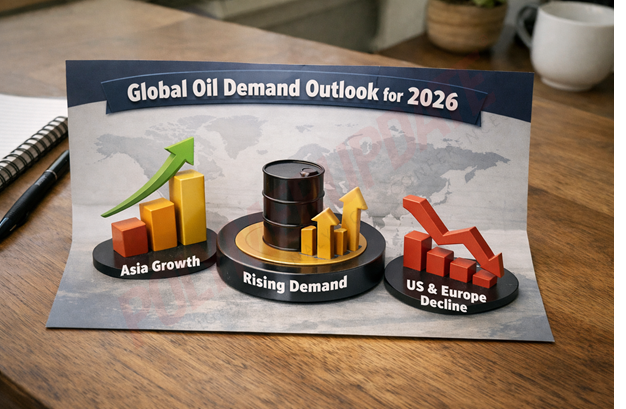 The Middle East-centric oil producers’ body forecasts world crude oil demand growth to remain at 1.38 million barrels per day (bpd) to 106.52 million bpd in 2026, compared to 105.13 million bpd in the previous year. The Monthly report published for February 2026 titled ‘Oil Market Report’ forecasts world crude oil demand at 105.58 million bpd in the January-March quarter, followed by 105.57 million bpd, 107.01 million bpd, and 107.88 million bpd in the next three successive quarters, respectively. The demand acceleration is likely to continue in 2027 as well with an average estimate of 1.34 million bpd to 107.86 million bpd, with the first quarter being at 106.88, followed by 106.81 million bpd, 108.45 million bpd, and 109.27 million bpd in the three successive quarters.
“Oil demand growth is expected to be supported by strong air travel requirement and healthy road mobility, including on-road diesel and trucking, as well as healthy industrial, construction, and agricultural activities in non-OECD (Organisation for Economic Co-operation and Development) countries. Similarly, capacity additions and petrochemical margins are expected to continue to contribute to growth,” the report reads.
Growth in China
The monthly OMR for February edition further estimates average crude oil demand in China to lag behind other Asian countries including India, which eventually drive the world count. While its demand in China is estimated to rise by 200,000 bpd, the figure will go up to 220,000 in India and 270,000 bpd in other Asian countries. China’s oil demand in December increased further by 484,000 bpd, yoy, up from the growth of 420,000 bpd, yoy, observed in November. Strong yoy growth in petrochemical feedstock and gasoline demand more than offset an observed decline in jet/kerosene, diesel and residual fuel oil demand.
Regarding demand for specific products, petrochemical feedstock requirements saw NGLs/LPG leading the increase in demand by 259,000 bpd, yoy, in December, up from an already strong increase of 205,000 bpd, yoy, seen in November. Naphtha demand grew by 237,000 bpd, yoy, slightly below the growth of 283,000 bpd, yoy, seen the previous month. Meanwhile, demand for gasoline increased by 141,000 bpd, yoy, in December, though this is slightly below the increase of 186,000 bpd, yoy, seen in November. Diesel and gasoline demand were affected by severe cold weather and heavy snow, which disrupted road travel, trucking and construction activity in December.
In the near term, China’s economy is projected to continue its growth trajectory in January-March 2026. China’s Lunar New Year holiday, scheduled from 17 February to 3 March, is expected in particular to support consumption and travel. In 2026, China is expected to experience healthy GDP growth, similar to that seen in 2025. The temporary US–China trade truce and a gradually stabilizing housing market are expected to support the growth outlook, in addition to ongoing export diversification amid investment dynamics.
Projections for India
India’s oil demand surged by 308,000 bpd, yoy, in December, following 166,000 bpd, yoy, growth seen the previous month. The increase was driven mostly by NGLs/LPG and diesel. Regarding specific product demand, NGLs/LPG saw the largest increase of 113,000 bpd, yoy, in December, up from growth of 74,000 bpd, yoy, in November. LPG consumption during December grew by 11.2 percent, mostly due to commercial and industrial consumers.
However, domestic consumers still accounted for 86 percent of LPG consumption from April to December 2025, although this is below the 94 percent share seen in the same period in 2024. Demand for diesel increased by 101,000 bpd, yoy, broadly the same growth as seen in the previous month. In transportation fuels, gasoline demand in December increased by 67,000 bpd, yoy, up from an increase of 26,000 bpd, yoy, the previous month.
Looking ahead, the Indian economy remains one of the fastest-growing major economies in the world. This robust economic momentum is expected to continue in the January-March 2026. The composite PMI indicates continued robust private-sector activity in the country, as India’s inflation remains remarkably low, at 1.3 percent in December 2025, well below the Reserve Bank of India’s (RBI) 2-4 percent target range. These factors suggest strong near-term prospects for oil demand in India. Furthermore, strong GDP growth is expected to support internal combustion engine (ICE) vehicle sales amid slow EV penetration. These factors point towards a positive outlook for oil product demand in India in the near term.
US estimates
Oil demand in the United States, the world’s biggest economy, is estimated to have declined by 140,000 bpd, yoy, albeit an improvement from the yoy decline of 403,000 bpd seen the previous month. The largest decline was seen for gasoline and ‘other products’ demand. In terms of transportation fuels, diesel demand saw the largest increase of 116,000 bpd. Jet/kerosene demand inched up by 10,000 bpd, however, this is below the increase of 74,000 bpd, yoy, seen a month earlier. However, gasoline demand contracted by 152,000 bpd, though this was an improvement from a decline of 182,000 bpd seen the previous month.
Economic activity in the region is expected to remain stable during the January-March 2026 quarter. Meanwhile, an extremely cold winter is expected to boost heating fuel demand. Furthermore, ongoing monetary easing and the de-escalation of trade tensions are expected to provide additional support for economic activity in the country. Accordingly, oil demand in the US is forecast to grow by about 30,000 bpd in the January-March 2026 quarter, and in the OECD Americas region, oil demand is projected to increase by 80,000 bpd during this period.
For 2026, the US economy is expected to maintain steady growth, driven by resilient consumer spending, supported by potential tax adjustments that are expected to lead to higher consumer income, combined with potential monetary easing. The easing of trade tensions following major agreements, including a one-year truce with China, is also expected to underpin growth in 2026.
Similarly, within the OECD Americas region, both Canada's and Mexico’s GDPs are expected to improve from 2025. Furthermore, the upcoming FIFA World Cup, to be hosted by the US and Mexico in June, is expected to boost business travel amid stable economic activity in OECD Americas. Oil demand in the region is forecast to grow by about 120,000 bpd to average 25.5 million bpd, and in the US by about 110,000 bpd to average 20.9 million bpd.
DILIP KUMAR JHA
Editor
dilip.jha@polymerupdate.com