Click the icon to add a specified price to your Dashboard list. This makes it easy to keep track on the prices that matter most to you.

India’s trade deficit almost doubled in January 2026 due to an exponential surge in imports following sudden spurt in domestic demand across various sectors and proportionately lower growth in exports on global geopolitical uncertainty and stable economic expansion forecasts. The burgeoning trade deficit marks huge processing activities happening in India, thus adding to value-additions and thereby economic growth and employment additions.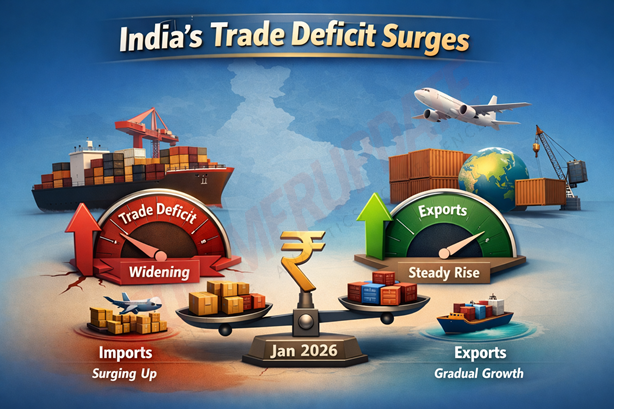 Data compiled by the Union Ministry of Commerce and Industry showed India’s trade deficit at US$ 10.38 billion in January 2026, almost double than US$ 5.39 billion in the corresponding month of the previous year. While overall exports (merchandise + services) jumped to US$ 80.45 billion in January 2026 versus US$ 71.09 billion, total imports swell to US$ 90.83 billion versus US$ 76.48 billion.
A Commerce Ministry statement said, “India’s total exports (merchandise and services combined) for January 2026 is estimated at US$ 80.45 billion, registering a positive growth of 13.17 percent vis-à-vis US$ 71.09 billion in January 2025, underlining a strong recovery in external demand and improving global trade sentiment. Total imports (merchandise and services combined) for January 2026 is estimated at US$ 90.83 billion, registering a positive growth of 18.76 percent vis-à-vis January 2025.”
Trade bifurcation
The Ministry data showed merchandise exports at US$ 36.56 billion in January 2026 versus US$ 36.34 billion in the comparable month of the previous year. Total merchandise imports, however, swell to US$ 71.24 billion in January 2026, compared to US$ 59.77 billion in the same month last year. Interestingly, the country’s services exports jumped to US$ 43.90 billion in January 2026, over 26 percent increase from US$ 34.75 billion registered in January 2025. Imports of services also moved up exponentially by 17.29 percent to US$ 19.60 billion in January 2026 versus US$ 16.71 billion reported in the same month of 2025.
On the import front, overall imports during April-January 2025-26 rose by 6.54 percent to US$ 823.41 billion, compared to US$ 772.85 billion in the same period last year. Merchandise imports grew by 7.21 percent to US$ 649.86 billion from US$ 606.13 billion in April-January 2024-25. Imports in January 2026 stood at US$ 90.83 billion, resulting in a trade deficit of US$ 10.45 billion for the month.
The increase in imports, particularly of petroleum, electronic goods, machinery and industrial raw materials, reflects robust domestic demand and ongoing capacity expansion across sectors. While the trade deficit in January stood at US$ 10.45 billion, the overall trend remains manageable in view of sustained export growth and strengthening economic fundamentals.
Cumulative performance
India’s overall exports during the period rose by 6.15 percent to US$ 720.76 billion, as compared to US$ 679.02 billion in the corresponding period of the previous fiscal. Merchandise exports stood at US$ 366.63 billion, registering a growth of 2.2 percent over US$ 358.75 billion recorded in April-January 2024–25. The Federation of Indian Export Organisations (FIEO) has welcomed the encouraging growth in India’s exports during April-January 2025-26, reflecting the resilience and sustained momentum of the country’s external trade sector amid continuing global uncertainties.
S C Ralhan, President, FIEO, stated that the 6.15 percent growth in overall exports during April-January 2025-26 is a positive and reassuring indicator of the inherent strength and competitiveness of Indian industry. The successful conclusion of Free Trade Agreements with the European Union and the United States marks a transformative milestone in India’s evolving trade architecture.
As the United States continues to be India’s top export destination and Europe remains a major high-value market, these agreements are expected to provide enhanced market access, improved tariff competitiveness and greater regulatory predictability for Indian exporters. With timely implementation and proactive industry preparedness, the FTAs are poised to significantly accelerate India’s export growth trajectory in the coming years.
Sectoral performance
Key sectors such as engineering goods, pharmaceuticals, textiles and garments, leather, gems and jewellery, agriculture and marine products are expected to benefit substantially from these trade agreements. The steady performance of sectors including engineering goods, electronics, pharmaceuticals, textiles, gems and jewellery and agriculture during the current fiscal demonstrates the diversification of India’s export basket and the country’s deeper integration into global value chains.
Pankaj Chadha, Chairman, Engineering Export Promotion Council (EEPC) India, viewed, “Engineering goods exports have demonstrated notable resilience in the last several months despite high US tariffs and persistent global uncertainty. Engineering shipments continued their remarkable growth run in January 2026, too. The provisional quick estimate shows engineering goods exports recorded 10.4 percent year-on-year growth in January 2026 to US$ 10.40 billion as compared to US$ 9.24 billion in January 2025. On a cumulative basis, engineering shipments grew 4.52 percent to US$ 101.13 billion in the April-January period of 2025-26 as compared to US$ 96.76 billion in the corresponding period of the previous year.”
Major export contributors during April-January 2025-26 included engineering goods, petroleum products, electronic goods, drugs and pharmaceuticals, gems and jewellery, organic and inorganic chemicals, ready-made garments of all textiles, cotton yarn and fabrics, handloom products, rice and marine products. India’s leading export destinations continued to be the United States, United Arab Emirates, China, the Netherlands, United Kingdom, Germany, Singapore, Bangladesh, Saudi Arabia and Italy, while major import sources included China, United Arab Emirates, Russia, United States, Saudi Arabia, Iraq, Switzerland, Hong Kong, Singapore and Japan.
FIEO expressed confidence that with sustained policy support, improved market access under the new FTAs and continued industry resilience, India is well-positioned to maintain its export growth momentum and further strengthen its role as a reliable and competitive partner in global trade.
DILIP KUMAR JHA
Editor
dilip.jha@polymerupdate.com