China CPI rises to 1.3% in February on Lunar New Year demand, food and travel costs jump, PPI improves, oil price surge may lift inflation further in March
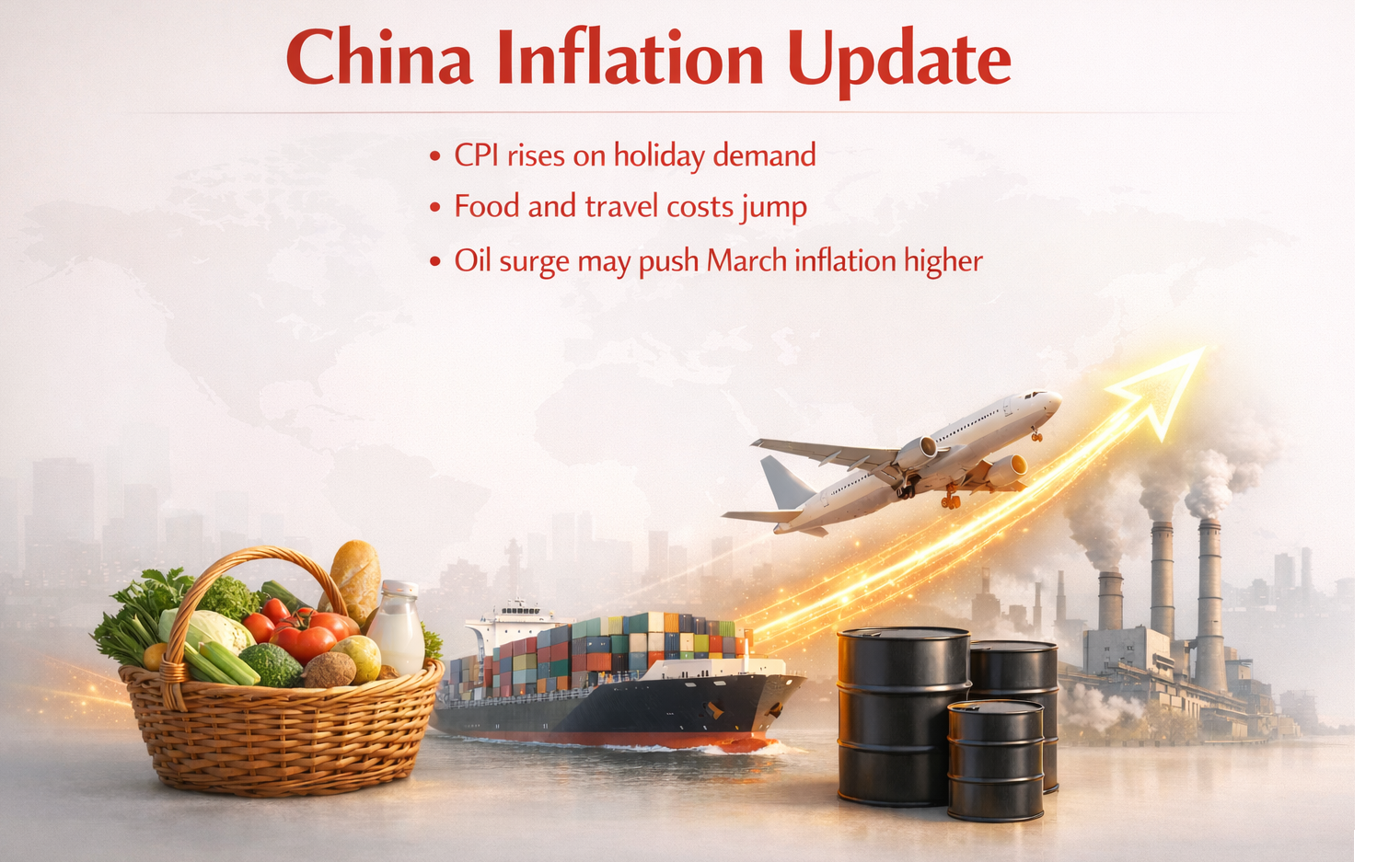
China's consumer price index (CPI) inflation rose to 1.3 percent year-on-year in February, up from 0.2 percent in January, higher than consensus forecasts. February's boost was partly Lunar New Year driven, but there's further inflationary pressure likely ahead in March thanks to the surge in oil prices. Inflation for 2026 as a whole could also be supported by 'anti-involution' efforts.
The usual holiday food categories saw notable month-on-month increases. Aquatic products surged 6.9 percent MoM to hit 6.1 percent YoY, while fresh fruit prices also rose 4.0 percent MoM to reach 5.9 percent YoY. After the Lunar New Year distortions pass, analysts continue to expect food inflation to remain in positive territory this year, driven by the turn in the pork price cycle.
Food inflation reboundsChina’s food prices rose 1.7 percent year on year in February 2026, reversing a 0.7 percent decline in the previous month and marking the fastest increase since October 2024, largely driven by stronger demand during the Spring Festival holiday. Festive consumption typically boosts purchases of fresh produce and meat, leading to a temporary pickup in food inflation. Price growth accelerated notably for fresh vegetables (10.9 percent versus 6.9 percent in January) and fresh fruit (5.9 percent versus 3.2 percent).
At the same time, pork prices, a key household staple in China, fell at a slower pace (-8.6 percent versus -13.7 percent), suggesting easing downward pressure after a prolonged supply-driven slump. China’s producer prices fell 0.9 percent year-on-year in February 2026, easing from a 1.4 percent decline in January and better than market expectations of a 1.1 percent drop. It marked the mildest decline since July 2024, buoyed by stronger prices in advanced and emerging sectors and by capacity management in key industries. Chinese Premier Li Qiang said that Beijing’s aim for “an appropriate rebound” in prices is one of the key considerations for monetary policy.
Tourism and travelThe Lunar New Year also contributed to a spike in inflation for tourism and travel services, which rose 11.7 percent YoY. Miscellaneous services surged 15.4 percent YoY, as households continue to show solid demand for quality services.
Other categories also showed signs of moving out of deflation. Beyond residence (-0.2 percent) and transportation and communications (-0.7 percent), many categories were positive on the month. It's likely to see the transportation subcategory pick up in the coming months, with fresh measures to curb auto price wars and the spike in oil prices likely to bolster inflation.
At the Two Sessions, policymakers set a 2 percent CPI inflation target and vowed to "steer general price levels back into positive territory.” This is a firm commitment to ending deflation. As things stand, they won't need to do much to achieve this.
PPI inflation climbsProducer price index inflation rose to -0.9 percent YoY in February, a 19-month high. PPI inflation has seen positive MoM growth for the past 5 months. With the ongoing oil price surge in March, it can be seen moving into positive territory as early as next month's report. The purchasing managers' index surveys have so far flagged a recovery in PPI inflation.
Similar to January, the highest PPI inflation in February was observed in the non-ferrous metals mining (30.2 percent) and smelting and processing (22.1 percent) industries. Crude oil and natural gas industries saw a 5.1 percent MoM uptick in February but remained in contraction at -12.9 percent YoY. With the price shocks in March, further upside can be seen on this subcategory in next month's report.
PBOC signals room for monetary easingAt the Two Sessions, the People’s Bank of China (PBOC) signalled that this year would continue to feature moderately loose monetary policy, and that there was room for lower lending rates at a suitable time.
Our interpretation is that, while the urgency for monetary easing was not great, there’s still room for further rate cuts. Unless the oil price shock is notably stronger and longer than expected, inflation is unlikely to inhibit PBOC easing this year. Analystse continue to see room for a rate cut in the second quarter as the economy likely got off to a soft start in 2026, though odds are rising for policymakers to choose a more cautious route and push this back, assuming energy disruptions persist, and global inflationary pressures pick up.
DILIP KUMAR JHA
Editor
dilip.jha@polymerupdate.com