Click the icon to add a specified price to your Dashboard list. This makes it easy to keep track on the prices that matter most to you.

The United States Trade Representative (USTR), a Cabinet-level agency within the Executive Office of the President, has launched an investigation under Section 301(b) of the Trade Act of 1974, which deals with unfair trade practices, against 16 countries including China, Japan, and India for the potential imposition of fresh tariffs. The move follows the Supreme Court of the United States striking down President Donald Trump’s previous duty levies imposed under the International Emergency Economic Powers Act (IEEPA). Initiated on March 11, the investigation aims to pave the way for new duties to restrict imports from these countries.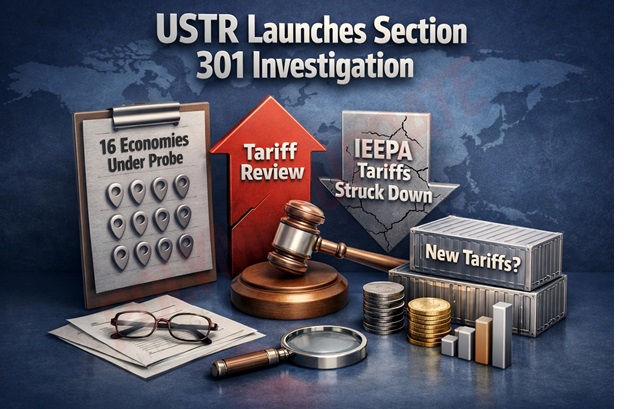 Trump’s move to launch the investigation is seen as a fresh attempt to create additional pressure on these key partner nations to strike trade deals that could favour the United States under the President’s “America First” policy and “Make America Great Again (MAGA)” agenda. Although these trade partners have undergone multiple rounds of negotiations, a final agreement has yet to be signed due to what officials describe as “unfriendly” conditions, including demands prioritising duty-free access for American goods in partner nations.
Announcing the initiation of the investigation, the USTR said it will open dockets for the submission of written comments on March 17, while the Section 301 Committee will convene public hearings on May 5. Experts believe the USTR may impose fresh tariffs on these countries as part of an effort to pressure them into reaching an immediate trade agreement.
USTR views
Announcing the probe initiation, USTR Jamieson Greer commented, “These investigations will focus on economies that appear to exhibit structural excess capacity and production in various manufacturing sectors, such as through large or persistent trade surpluses or underutilised or unused capacity: Bangladesh, Cambodia, China, the European Union, India, Indonesia, Japan, Korea, Malaysia, Mexico, Norway, Singapore, Switzerland, Thailand, Taiwan, and Vietnam. India had a trade surplus of US$ 58 billion with the US in 2025 across the sectors include textiles, health, construction goods, and automotive goods.”
The agency further stated, “For example, evidence suggests the solar module sector is plagued by excess capacity, including that India’s current module manufacturing is nearly triple the annual domestic demand. India also has created significant excess capacity in petrochemicals, steel, and other industries.”
Tough experience
The United States, under the administration of Donald Trump, imposed a 50 percent tariff on a broad range of imports from India, effective August 27, 2025, as a punitive measure in response to India’s continued purchases of discounted crude oil from Russia. The tariff structure comprised a 25 percent “reciprocal” duty, intended to counter what Washington described as higher tariffs and market barriers imposed by India on American goods, along with an additional 25 percent penal levy aimed at discouraging New Delhi’s energy trade with Moscow. The move marked a sharp escalation in trade tensions between the two strategic partners and affected a wide range of Indian exports entering the US market.
However, the steep tariffs were scaled back in February after the two countries reached an interim trade understanding aimed at easing bilateral tensions and stabilising trade flows. The partial rollback was seen as a step toward broader negotiations on market access, tariff reductions, and supply-chain cooperation between the United States and India. While the reduced duty provided some relief to Indian exporters, analysts noted that the remaining tariff burden could still affect the competitiveness of several export-oriented sectors until a comprehensive trade agreement is finalised. However, the India-US Free Trade Agreement finalises 18 percent tariff levy on Indian goods, but the final agreement is yet to be signed.
Trump’s 15% duty levy
The administration of President Donald Trump imposed a 15 percent ad valorem surcharge on certain imports with effect from February 24, 2026, following the U.S. Supreme Court’s ruling that his earlier tariff measures were unconstitutional. The surcharge was initially set at 10 percent for a period of 150 days before being raised to 15 percent. According to the administration, the measure is not a direct replacement for the previous tariffs but a temporary mechanism to continue duty collection, deemed necessary to address the balance-of-payments deficit.
The latest Presidential Action issued by the Trump administration states: “After considering the information, opinions, and recommendations provided by senior officials, I find fundamental international payments problems that significantly harm United States national security and economic interests. Therefore, special measures are required to restrict imports and address those problems. Accordingly, I impose a temporary import surcharge of 10 percent, later raised to 15 percent, ad valorem, for a period of 150 days on certain articles imported into the United States, effective February 24, 2026.”
The Supreme Court’s decision to strike down the reciprocal IEEPA tariffs could materially reshape the trade policy landscape. In response, U.S. President Donald Trump swiftly announced the introduction of a 15 percent across-the-board tariff, following an initial 10 percent surcharge that was raised to 15 percent on February 22. Under the new structure, the surcharge applies broadly to most imports, with several key exceptions. Products already subject to Section 232 duties — such as steel, aluminium, copper, lumber, and automobiles — are excluded to the extent that existing Section 232 tariffs remain in force. Approximately 1,100 product codes are fully exempt from the surcharge.
DILIP KUMAR JHA
Editor
dilip.jha@polymerupdate.com