Click the icon to add a specified price to your Dashboard list. This makes it easy to keep track on the prices that matter most to you.

Indian exporters have begun advancing shipments of merchandise goods, including routing cargo through alternative routes, to avoid the risk of defaults that could potentially lead to the permanent loss of clients. The move is aimed at maintaining trade relationships despite rising global uncertainties, supply chain disruptions and escalating geopolitical tensions. The intensifying conflict in West Asia and the resulting closure of shipping through the Strait of Hormuz—a key maritime corridor connecting the Persian Gulf with the Gulf of Oman and the Arabian Sea, and separating Asia (Iran to the north) from the Arabian Peninsula (Oman and the United Arab Emirates to the south)—has significantly disrupted normal trade flows.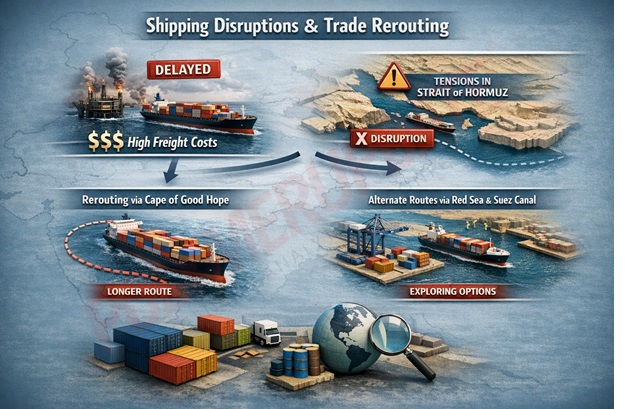 Exporters are also assessing existing inventories, contracts under execution and shipment schedules for flexibility before taking any final call on potential production adjustments, including possible cuts. In the meantime, they have begun issuing regular advisories to overseas clients while maintaining continuous dialogue with shipping, insurance and container companies. In the current scenario, issues such as vessel and container availability, flexibility in compliance timelines, surcharge management and exporters’ ongoing engagement with government representatives are expected to play a key role in managing the shipment crisis.
The ongoing geopolitical tensions in West Asia following joint strikes by Israel and the United States on Iran, and Tehran’s subsequent closure of the Strait of Hormuz, have created uncertainties for India’s exports by disrupting shipping schedules, raising transport costs, limiting tanker and container availability and pushing up insurance premiums. The Federation of Indian Export Organisations (FIEO) has urged shipping lines not to take undue advantage of the situation and make exports more challenging.
Alternate routes
India has been exploring alternative maritime export routes to mitigate the risks associated with disruptions in the Strait of Hormuz, one of the world’s most critical oil and cargo transit chokepoints. In the event of restricted passage through the Gulf, exporters are increasingly considering routes that bypass the Persian Gulf by routing cargo through ports on India’s western and southern coasts and moving shipments via the Bab el-Mandeb Strait and the Suez Canal toward Europe, or via the Cape of Good Hope toward the Atlantic.
Another strategic option under discussion involves leveraging the International North-South Transport Corridor through Iran, the Caspian region and Russia. The corridor combines sea, rail and road networks to reach European markets while reducing dependence on traditional Gulf shipping lanes. However, rerouting cargo through longer maritime corridors typically increases both transit time and freight costs. For shipments to Europe, vessels that bypass the Suez route and instead sail around the Cape of Good Hope may add roughly 10–15 days to the journey.
Cargo destined for the United States and other Atlantic markets could face an additional 7–12 days of transit time depending on the final destination and shipping schedules. These longer voyages raise bunker fuel consumption, insurance premiums and container freight rates, potentially increasing logistics costs for Indian exporters by 15–30 percent in extreme disruption scenarios. Despite the higher costs, these alternative routes provide crucial logistical flexibility and help maintain continuity of trade flows during periods of heightened geopolitical tension in the Gulf region.
Exports weaken
According to government data, India’s merchandise exports stood at US$ 36.61 billion in February 2026, showing a marginal decline of 0.81 percent compared with the same month last year. Merchandise imports rose by 24.11 percent to US$ 63.71 billion, resulting in a trade deficit of US$ 27.1 billion, which moderated compared with January 2026. However, overall exports (merchandise and services combined) grew by about 11 percent year-on-year to US$ 76.13 billion, while overall imports increased by about 22 percent to US$ 80.09 billion, reflecting strong services exports and sustained domestic demand.
During April–February FY2025–26, India’s merchandise exports reached US$ 402.93 billion, registering growth of 1.84 percent, while imports rose by 8.53 percent to US$ 713.53 billion. Cumulative merchandise and services exports during the period are estimated at US$ 790.86 billion, compared with US$ 747.58 billion in the corresponding period last year, reflecting growth of 5.8 percent.
S C Ralhan, President of the Federation of Indian Export Organisations (FIEO), said, “India’s export sector continues to demonstrate resilience despite the escalating conflict in the Middle East involving the United States, Israel and Iran, which has heightened global trade uncertainty. Disruptions in key maritime routes, including the Strait of Hormuz and the Red Sea, have forced vessels to reroute, increasing freight costs, insurance premiums and transit times, thereby adding pressure on exporters. India’s resilient exports have been supported by diversified markets and strong performance in key sectors.”
Sectors that reported growth include engineering goods, petroleum products, electronic goods, pharmaceuticals, gems and jewellery, chemicals, ready-made garments, cotton yarn and fabrics, rice and marine products. Major export destinations continued to include the United States, United Arab Emirates, China, Netherlands, United Kingdom, Germany, Saudi Arabia, Bangladesh, Singapore and Hong Kong.
Widening trade deficit
Data from the Ministry of Commerce and Industry showed that India’s trade deficit for the first 11 months of the financial year (April 2025–February 2026) stood at US$ 311 billion, substantially higher than the US$ 262 billion recorded in the same period last year. Exports of goods were higher by 1.8 percent at US$ 403 billion, supported mainly by strong growth in electronics exports, which rose by 28.1 percent. Positive growth was also seen in marine products, drugs and pharmaceuticals, and engineering goods. However, growth in readymade garments and chemicals remained virtually flat.
Madan Sabnavis, Chief Economist at Bank of Baroda, observed that the impact of tariffs imposed by the United States during the year appeared to have been managed in a stable manner. However, due to lower oil prices, exports of fuel products registered negative growth. Another segment that recorded a decline was gems and jewellery.
Imports grew by 8.3 percent from US$ 658 billion to US$ 714 billion during the period. The main drivers were gold (28.7 percent), silver (143 percent) and electronics (17.6 percent), followed by machinery, which grew by 15 percent. Crude oil imports declined by 3 percent during the period, though this trend could reverse sharply in March due to the impact of the ongoing conflict. The major sources of imports were China (US$ 119 billion), the United Arab Emirates (US$ 61 billion), Russia (US$ 51 billion) and the United States (US$ 48 billion).
On the positive side, exports of goods and services together stood at US$ 791 billion, resulting in a deficit of US$ 109 billion against imports of US$ 901 billion. The picture is likely to become clearer in March, when the full impact of the ongoing conflict may be reflected in trade data. Crude oil prices have remained elevated at over US$ 100 a barrel, while other commodities have been volatile. With disruptions in major maritime trade routes, it remains uncertain how the situation may evolve. While the trade balance will influence the currency, other stronger factors such as remittances and flows from Foreign Portfolio Investors (FPIs) could play a key role in determining the direction of the rupee.
Outlook
Experts believe that close monitoring of geopolitical developments, maintaining smooth logistics connectivity, and providing timely policy support will be essential to sustain export momentum. Continued diversification of markets, strengthening regional trade partnerships, and improving logistics efficiency will also help India mitigate global disruptions and maintain export growth.
DILIP KUMAR JHA
Editor
dilip.jha@polymerupdate.com