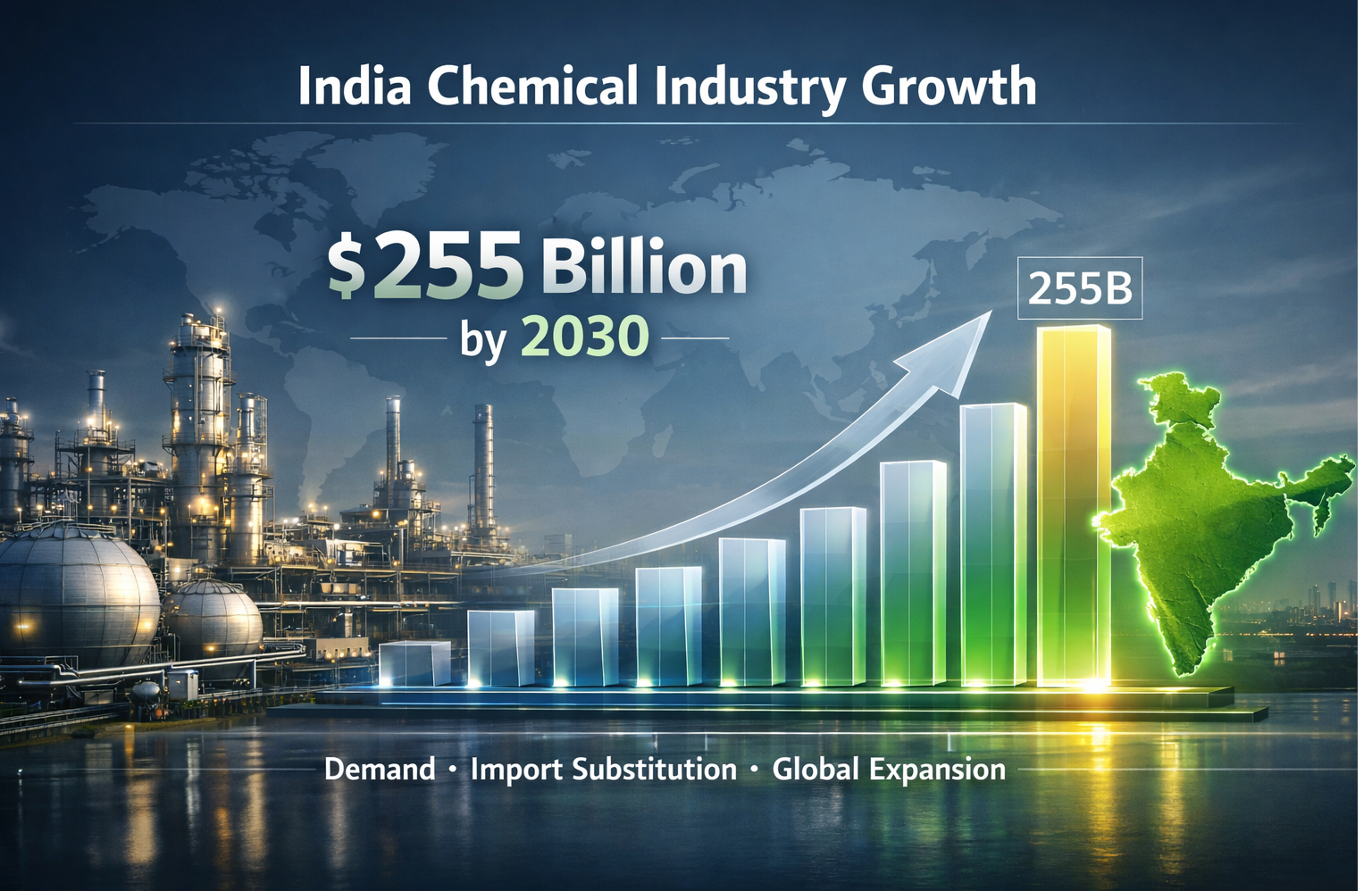
India’s chemical industry is poised to register a compounded annual growth rate (CAGR) of 8–9 percent over the next five to six years, with significant expansion opportunities for companies willing to look beyond domestic demand and scale capabilities to compete as global suppliers. This strong growth, outpacing India’s gross domestic product (GDP) despite global geopolitical challenges, is expected to lift the overall industry to US$ 239–255 billion during the period under consideration, from the current US$ 155–165 billion, global consultancy firm McKinsey & Company said in its latest report.
McKinsey has identified 18 distinctive growth arenas at the macro level that could generate US$ 1.7–2 trillion in revenue for India by 2030, driven by technological advancements and sustained investment. Of these, eight key arenas—including construction, semiconductors, renewables, and automotive—have significant usage of chemical inputs and could add US$ 30–35 billion to chemical revenues by 2030, as downstream capacity expands through government funding, policy incentives, and supply chain localization. In parallel, India’s chemical trade deficit of approximately US$ 31 billion in 2025 highlights a substantial import substitution opportunity, particularly in inorganics and polymers.
Value creationThe consultancy further states that, amid global volatility, overcapacity, margin pressure, and trade fragmentation, profitable growth is likely to depend on sharper choices around portfolios, capabilities, capital allocation, and execution. Focused moves across seven levers could help build resilience and global competitiveness for Indian chemical companies. The report emphasises the need to build domestic platforms with global reach, noting that eight select arenas can now support global-scale chemical operations in India. Even individual segments offer significant near-term opportunities, underscoring the importance of timely investments and strategic partnerships.
It also highlights the need to create global operating capabilities in priority markets. With only an approximately 3 percent share of global trade, Indian companies could strengthen such capabilities to enhance growth and pricing power. Another key area is the institutionalisation of programmatic partnerships. As global deal activity accelerates and asset valuations reset, Indian companies could pursue partnerships to access technology and markets that might otherwise require prolonged organic development.
The report further suggests turning innovation into a growth engine. There is significant scope to transform R&D from a process-focused technical function into a strategic growth driver through technology development, application-led innovation, customer-embedded creation, and accelerated commercialisation—either independently or through partnerships.
AI as operating modelA potential lever could be the integration of artificial intelligence (AI) into the operating model. The report estimates that AI and advanced analytics could deliver EBITDA improvements of 8 to 12 percentage points across procurement, manufacturing, and the supply chain, without heavy capital expenditure. It also highlights the importance of building resilient supply chains. Recent disruptions, including pandemic-related shutdowns and logistics bottlenecks, underscore the need for greater resilience through measures such as distributed warehousing, regional inventory positioning, and vertical and horizontal integration or partnership arrangements.
Alongside this, there is a need to strengthen the balance sheet and profit and loss (P&L). Amid geopolitical turmoil, maintaining balance sheet headroom and actively managing working capital, foreign exchange, and energy exposure are critical—not only as defensive necessities but also as strategic enablers.
While challenges may persist, these seven levers could help Indian chemical companies reignite growth while maintaining profitability amid heightened global volatility. Firms that prioritise structurally attractive markets, develop specialised capabilities, and deploy capital with discipline can lead India’s chemical industry into its next phase of global prominence, with early movers not only achieving superior scale but also shaping competitive dynamics for the decade ahead.
HeadwindsOver the past decade, Indian chemical companies have delivered a total shareholder return (TSR) CAGR of approximately 17 percent—two to three times the returns of most global peers—and have outpaced the Sensex. A changing world order has, however, softened value creation, with base chemicals experiencing sharper declines than specialty chemicals over the past one to two years.
Industry revenue growth from fiscal year 2019 to fiscal year 2025 has tracked nominal GDP growth of 6–7 percent, yet EBITDA margins have compressed across multiple segments. Value creation has become noticeably bifurcated: a limited set of winners combines double-digit growth with margin expansion, while the broader cohort remains mired in modest growth with flat margins. These pressures have slowed capital expenditure momentum, with utilisation rates across specialty chemicals averaging 60–75 percent and new lines operating at just 20–30 percent.
Global perspectiveThe industry has shifted from a phase of broad-based value creation to one of structural capacity imbalance. Following strong TSR during the China-led expansion and the Covid-19 upcycle, the global chemical industry now faces declining returns, with TSR at 1.2 percent over the past two years, as capacity additions—particularly in China—have exceeded demand and depressed global utilisation rates.
Over longer time horizons, commodity and specialty chemicals have delivered similar average returns, while diversified chemical companies have consistently lagged, with average TSR lower by 0.5 to 2 percent. Although specialty chemicals continue to outperform on a relative basis in the current cycle, returns have moderated due to customer destocking, China’s overcapacity, and weakening pricing power. Petrochemicals have been the most affected, as sustained oversupply has pushed utilisation to multi-year lows and delayed margin recovery.
Structural changesAfter two decades of outperformance, the global chemical industry has entered a structurally different operating environment. Since late 2022, global chemicals have trailed the broader market, with TSR turning negative. This shift has been driven by inventory destocking and China’s structural overcapacity, which have put pressure on prices. Global petrochemical operating rates have fallen to approximately 70 percent, considerably below pre-Covid-19 averages of around 80 percent, while rising US tariffs (now averaging 18 percent) are reshaping competitive dynamics and accelerating supply regionalisation.
While these headwinds are compressing near-term margins, they also present opportunities for leaders to reposition for long-term advantage. India’s strong domestic demand, competitive cost base, and expanding role in global value chains offer structural resilience relative to many other markets. Indian companies that act decisively—focusing on high-growth sectors, building differentiated capabilities, and streamlining capital deployment—could be well positioned to drive the next phase of the industry’s evolution.
DILIP KUMAR JHA
Editor
dilip.jha@polymerupdate.com