US President Donald Trump has ordered military personnel to pause missile strikes on Iran’s power plants and energy infrastructure for five days amid constructive talks over the past two days aimed at reopening the Strait of Hormuz. Trump said on Monday that the US and Iran have had “very good and productive” discussions over the last two days regarding a permanent end to the war.
Trump said in a social media post on Truth Social, “I am pleased to report that the United States of America, and the country of Iran, have had, over the last two days, very good and productive conversation regarding a complete and total resolution of our hostilities in the Middle East. Based on the ‘tenor and tone’ of these in depth, detailed and constructive conversations, which will continue throughout the week, I have instructed the Department of War to postpone any and all military strikes against Iranian power plants and energy infrastructure for a five-day period, depending on the success of the ongoing meetings and discussions.”
Previous threatsThe pause comes two days after US President Donald Trump joined Israel’s Prime Minister Benjamin Netanyahu who said that military force will jointly attack Iran’s power plants. Trump said on Saturday, “We are getting very close to meeting our objectives as we consider winding down our great Military efforts in the Middle East with respect to the Terrorist Regime of Iran: (1) Completely degrading Iranian Missile Capability, Launchers, and everything else pertaining to them. (2) Destroying Iran’s Defense Industrial Base. (3) Eliminating their Navy and Air Force, including Anti Aircraft Weaponry. (4) Never allowing Iran to get even close to Nuclear Capability, and always being in a position where the U.S.A. can quickly and powerfully react to such a situation, should it take place. (5) Protecting, at the highest level, our Middle Eastern Allies, including Israel, Saudi Arabia, Qatar, the United Arab Emirates, Bahrain, Kuwait, and others.
Trump further added on Saturday, “The Hormuz Strait will have to be guarded and policed, as necessary, by other Nations who use it — The United States does not! If asked, we will help these Countries in their Hormuz efforts, but it shouldn’t be necessary once Iran’s threat is eradicated. Importantly, it will be an easy Military Operation for them.”
Energy infrastructure on targetsIran’s retaliatory strategy has increasingly focused on targeting critical energy infrastructure across the Middle East following Israeli strikes on its own oil and gas assets. After Israel hit the South Pars gas field—one of the world’s largest—Tehran launched coordinated missile and drone attacks on key facilities in Qatar, Saudi Arabia, Kuwait, and the UAE, including the vital Ras Laffan LNG hub and major refineries. These strikes have caused significant disruptions, including damage to LNG export capacity and refinery operations, raising fears of prolonged supply outages and sharp spikes in global energy prices. The widening scope of the attacks underscores a shift toward “energy warfare,” where both production and export infrastructure are being used as strategic pressure points in the conflict.
At the same time, Israel has systematically targeted Iran’s energy backbone, striking fuel depots, refineries, and gas processing facilities, including those in Tehran and the South Pars region. These attacks aim to weaken Iran’s economic resilience and disrupt its ability to fund military operations, but they have also triggered a dangerous cycle of escalation. Iran has warned of “zero restraint” if its energy infrastructure continues to be hit, signalling the potential for further large-scale retaliation. As both sides expand their focus to high-value energy assets, the conflict is increasingly threatening regional stability, global oil and gas flows, and critical chokepoints such as the Strait of Hormuz.
Of late, Iran also threatened to attack Israel’s power plants and those supplying US bases across the Gulf region if the US targets Iran’s power network. Notably, the Israel-US war with Iran intensified with Tehran targeting Israeli nuclear sites in its latest bid to hit Tel Aviv harsh. The full restoration of some of the attacked oilfields, refineries, and energy infrastructure would take several years.
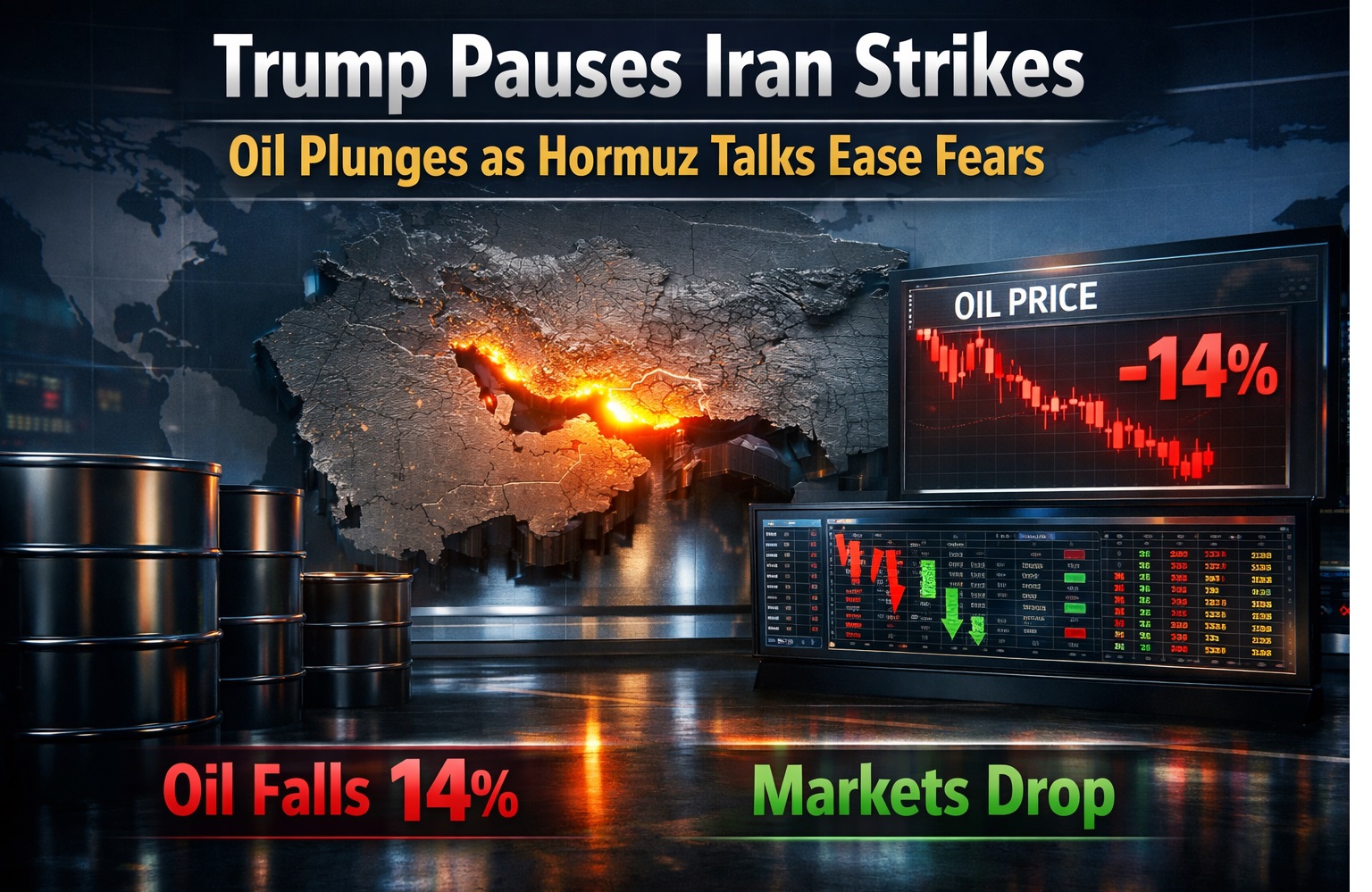
Crude oil tumblesCrude oil prices tumbled 14 percent to trade at US$ 96 a barrel following Trump’s announcement of a pause in military strikes on Iran’s power plants and energy infrastructure. Gold prices slumped by more than 9 percent, while silver followed suit, falling over 12 percent. Other asset classes, including equities worldwide, also declined.
In India, the benchmark BSE Sensex fell 2.61 percent, or 1,836.37 points, to close at 72,696.39 on Monday. The Nifty 50 also declined, ending 2.60 percent, or 601.85 points lower, at 22,512.65. Major stocks on both exchanges fell in a similar proportion.
DILIP KUMAR JHA
Editor
dilip.jha@polymerupdate.com