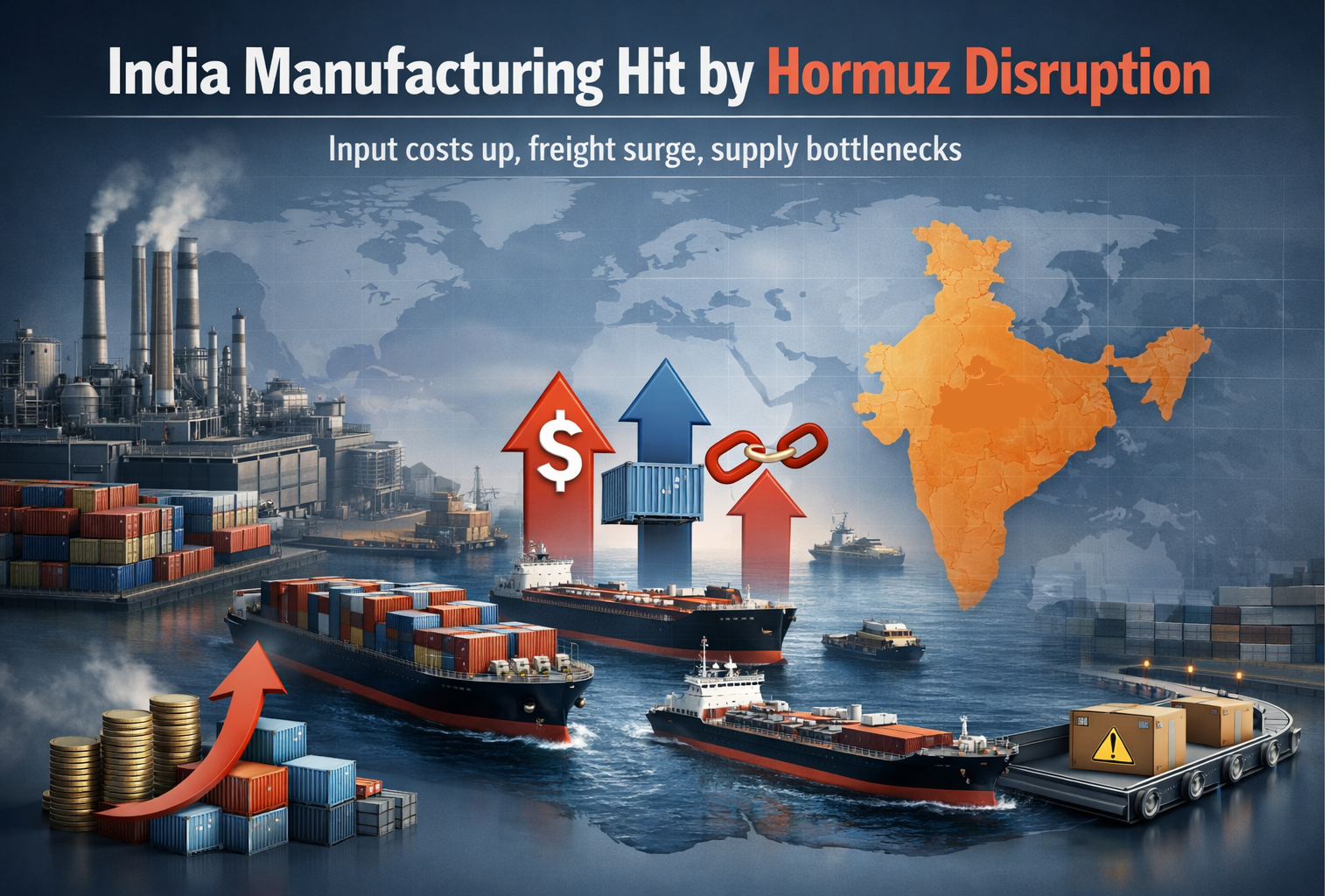
India’s manufacturing sector is navigating one of its most severe external shocks in recent years, as the ongoing West Asia conflict and the disruption of the Strait of Hormuz have triggered a cascade of challenges—ranging from surging raw material costs and freight rates to acute supply bottlenecks. The Strait, which handles nearly 20 percent of global oil flows and a significant share of global merchandise exports, has witnessed a sharp decline in shipping activity, severely impacting global trade logistics and energy supply chains.
While addressing the Lok Sabha, India’s Prime Minister, Narendra Modi, said, “Now that the crisis has lasted for more than three weeks, its adverse impact on the global economy and on people’s lives is evident. This war has created unexpected challenges for India, including economic, national security-related, and humanitarian concerns. India imports large quantities of crude oil, gas, and fertilizers through the Strait of Hormuz. Since the war began, shipping through the Strait has become highly challenging.”
Modi termed the current crisis worse than the Covid-19 the world experienced for two years from the calendar year 2020-2021, adding, “Efforts are being made to ensure the supply of oil and gas from wherever possible. Our aim is to ensure that ships carrying oil, gas, fertilizers, and other essential goods reach India safely.”
The Reserve Bank of India (RBI) has also raised serious concerns about the ongoing Israel-US conflict with Iran. In its latest Bulletin released on Wednesday, the central bank stated, “The conflict in the Middle East and fresh trade (Section 301) investigations by the US (against India, China and 14 other nations) have resulted in increased volatility in global markets. The second advance estimates of gross domestic product (GDP) for 2025–26 indicate sustained resilience of the Indian economy. High-frequency indicators signal that economic activity gained momentum in February. The Consumer Price Index (CPI)-based headline inflation picked up in February on account of rising prices of food and beverages. India’s foreign exchange reserves remain adequate to provide a cushion against external shocks.”
Input cost pressureThe most immediate impact on Indian manufacturing has come through a sharp rise in input costs. Crude oil prices have surged past US$112 a barrel amid supply disruptions, increasing energy and feedstock costs across sectors such as petrochemicals, plastics, fertilizers, and metals. This marks a staggering 55 percent increase in benchmark crude oil prices since the Israel-US war with Iran began on February 28. This has resulted in a proportionate rise in the prices of derivatives, including naphtha, polymers, and plastics, among others.
Additionally, the disruption has extended beyond oil. Key industrial inputs such as sulphur—a critical raw material for chemicals and fertilizers—have witnessed steep price increases due to constrained supplies moving through the Gulf. For energy-intensive industries, including steel, cement, and chemicals, higher fuel and feedstock costs are compressing margins, forcing companies to either absorb losses or pass on costs to end-users, thereby fuelling inflationary pressures.
Chemical prices have surged significantly, with some polyethylene terephthalate (PET) grades doubling, as the ongoing Iran conflict (since late February 2026) has caused severe disruptions to Middle East raw material supplies, higher shipping costs, and a sharp rise in energy prices. Major producers such as BASF and Lanxess have initiated steep price hikes in Europe and India. Simultaneously, methanol prices in India rose by 65 percent in March. European firms like Wacker Chemie have also announced widespread price increases, with some inputs for tyres rising by as much as 50 percent. Pesticide manufacturers in India have warned of a 20–25 percent increase due to supply chain disruptions.
A veteran plastic industry executive, speaking on condition of anonymity, said, “The ongoing Israel-US war with Iran has created havoc in the Indian plastics industry. The sharp spike in crude oil prices has created challenges for the sector due to the proportionate surge in polymer prices. The most critical issue is that polymer prices are rising rapidly—often on a daily basis—which is extremely difficult for the small-scale downstream plastics industry to absorb. As a small-scale industry, we usually manage opportunistic and periodic fluctuations. However, the abnormal and frequent increases in polymer prices under the current uncertain market conditions are making sustainability increasingly difficult.”
Freight rate painsThe closure of, or heightened risk in, the Strait has, by some estimates, caused over 700 ships to experience congestion or delays. Many of these vessels have been stranded or rerouted, while insurers have raised war-risk premiums, further escalating logistics costs. Shipping companies are increasingly opting for longer alternative routes, such as around the Cape of Good Hope, adding weeks to transit times and significantly increasing freight expenses. Meanwhile, major shipping lines are avoiding the Red Sea and Gulf region, leading to higher fuel costs and reduced available capacity. These rising costs are translating into higher cargo prices, affecting pharmaceuticals, electronics, and food, among others.
Congestion at major trans-shipment hubs and stranded cargo in the Gulf have compounded the problem, disrupting supply schedules for manufacturers dependent on just-in-time inventory systems. Container rates have surged due to emergency surcharges—some as high as US$ 4,000 per container—and longer routes around Africa, which add 10–14 days to transit times. Rates for oil tankers (VLCCs) have soared, at times exceeding US$ 400,000 per day, as the Strait of Hormuz has effectively been closed to many carriers. War-risk insurance premiums have also risen sharply for vessels transiting the region.
Supply chain bottlenecksThe near-closure of the Strait has led to widespread supply chain bottlenecks. Tankers and cargo vessels carrying crude oil, LNG, LPG, and petrochemical feedstocks have faced delays or cancellations, affecting downstream industries. India, which relies heavily on the Gulf for energy imports, has been particularly exposed. Around 40 percent of its crude imports typically pass through the Strait, making such disruptions highly consequential for industrial activity.
Shortages of LPG and natural gas have already forced supply prioritisation toward households, impacting industrial consumption and potentially slowing production in sectors such as ceramics, glass, and small-scale manufacturing. Several major oil refining companies in the Middle East have declared force majeure to their overseas clients following the shutdown of manufacturing units due to Iranian missile attacks. Both the government and industry are adopting a multi-pronged strategy to mitigate risks and minimise the impact on Indian consumers and downstream manufacturing units.
OutlookWhile India’s manufacturing sector has demonstrated resilience through diversification and policy support, the situation remains highly fluid. Prolonged disruption in the Strait of Hormuz could keep input costs elevated, disrupt production cycles, and weaken export competitiveness. However, the crisis is also accelerating structural shifts—such as supply chain diversification, energy transition, and logistics resilience—which could strengthen India’s manufacturing ecosystem over the long term. In the near term, the sector is likely to remain under pressure, with its performance closely tied to geopolitical developments and the restoration of normal shipping flows through one of the world’s most critical trade arteries.
DILIP KUMAR JHA
Editor
dilip.jha@polymerupdate.com