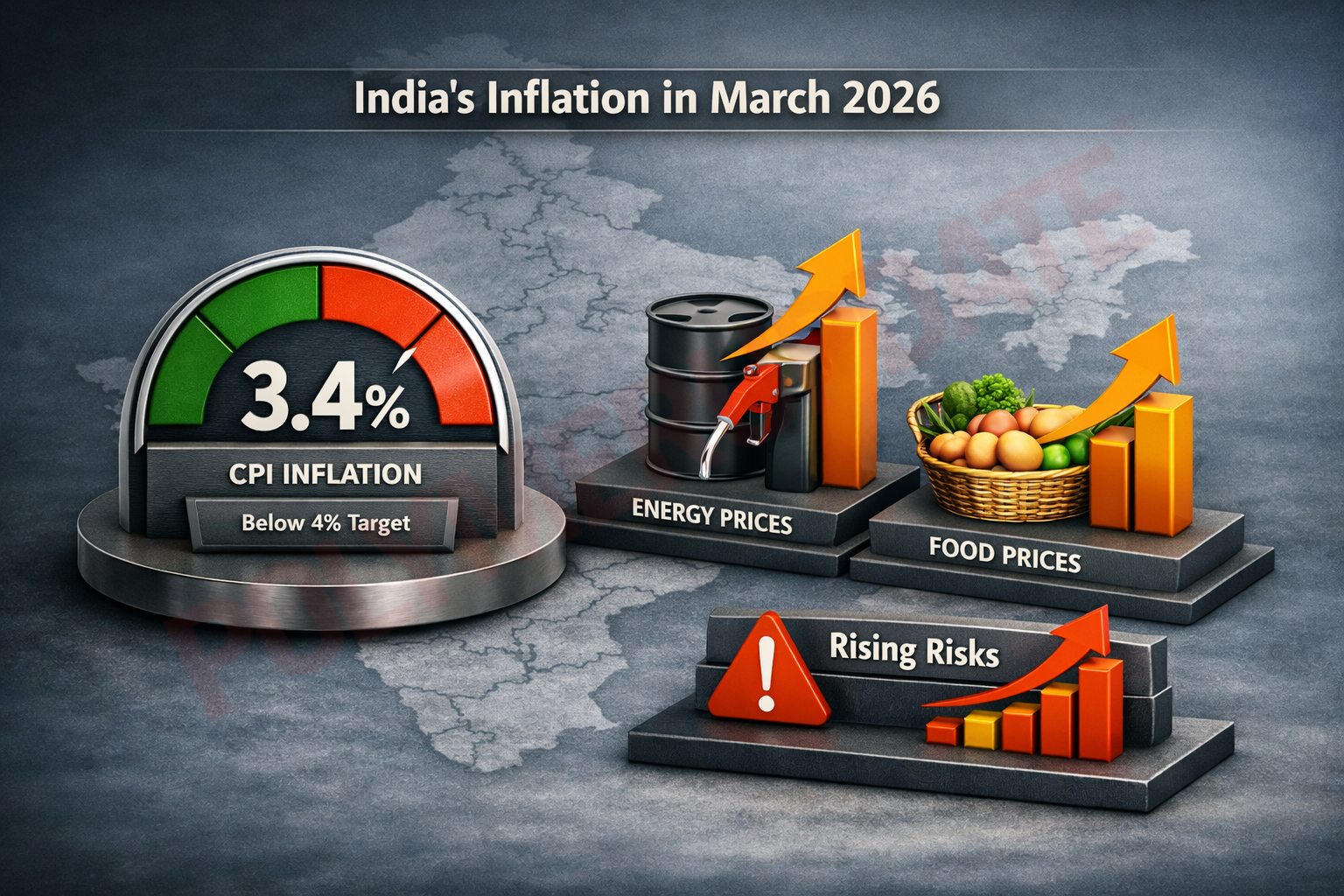
India’s retail inflation, measured by the Consumer Price Index (CPI), edged marginally higher to 3.4 percent in March under the new series (2024=100), driven by a slight increase in energy prices, which in turn pushed up the cost of other items, including food. However, CPI-based inflation remained below expectations of 3.7 percent, though it was higher than 3.21 percent in February and 3.34 percent in March 2025.
The retail inflation print remained within the comfort range of 4 percent, as envisaged by the Reserve Bank of India (RBI). Rural inflation stood at 3.63 percent in March 2026, while urban inflation was lower at 3.11 percent, according to data released by the Ministry of Statistics and Programme Implementation (MoSPI). The uptick in March was primarily driven by unfavourable base effects, even as underlying momentum remained muted. The pass-through of higher global energy prices led to increases in select fuels such as premium petrol, liquefied petroleum gas (LPG), and diesel for industrial use.
Madan Sabnavis, Chief Economist at Bank of Baroda, said, “CPI inflation for March stood at 3.4 percent, as against our expectation of 3.7 percent. Inflation was higher in rural areas at 3.6 percent, compared to 3.1 percent in urban regions. Given the West Asia crisis, it is instructive to examine the month-on-month inflation for March, which registered an increase of 0.3 percent. The major drivers were pan and tobacco at 0.9 percent, housing, water, gas, etc. at 0.6 percent, and restaurants at 0.4 percent. For the latter two categories, there was a clear impact of higher crude prices, which led to an increase in LPG prices.”
 Food inflation up
Food inflation, based on the All India Consumer Food Price Index (CFPI), rose to 3.87 percent (provisional) in March 2026 on a year-on-year basis, up from 3.47 percent in February, indicating stronger price pressures in household essentials. While rural food inflation stood at 3.96 percent, urban food inflation came in at 3.71 percent. At the headline level, rural inflation continued to outpace urban inflation. Overall CPI inflation in rural areas was recorded at 3.63 percent in March, compared with 3.11 percent in urban centres.
Retail inflation in vegetables helped pull down the overall food inflation print in March. According to the Ministry of Statistics and Programme Implementation (MoSPI), onion prices declined by a sharp 27.76 percent, followed by potatoes at 18.98 percent, garlic at 10.18 percent, arhar/tur at 9.56 percent, and peas and chickpeas by 7.87 percent.
Megha Arora, Director at India Ratings & Research, commented, “In March 2026, CPI inflation accelerated to a 13-month high of 3.4 percent year-on-year, driven by a rise in fuel prices—reflecting the transmission of higher liquefied petroleum gas (LPG), industrial diesel, and premium petrol prices—as well as food inflation. The impact of the LPG price hike is reflected in higher inflation in the fuel category, which was recorded at 1.65 percent in March 2026. Consequently, inflation in LPG-sensitive segments such as restaurants and accommodation services also increased to 2.88 percent in March, compared with 2.73 percent and 2.87 percent in February and January, respectively.”
Sector-wise figuresHousing inflation for March was estimated at 2.11 percent (provisional), with rural housing inflation at 2.54 percent, while urban housing inflation was lower at 1.95 percent. Personal care recorded the highest inflation on a year-on-year basis at 18.7 percent; however, it declined by 0.3 percent on a month-on-month basis due to a correction in gold and silver prices. On a year-on-year basis, the highest inflation was observed in food and beverages (3.7 percent) and pan and tobacco (4.2 percent). Education and restaurants recorded inflation of 3.3 percent and 2.9 percent, respectively.
Overall, the food category as well as essential services registered relatively high inflation rates. Clothing and footwear followed, with inflation at 2.8 percent under discretionary consumption goods. Housing inflation remained moderate at around 2 percent, but it is expected to rise over time as the base effect diminishes. At the state level, higher inflation was observed in Telangana, Andhra Pradesh, Karnataka, Tamil Nadu, and Rajasthan, while Kerala recorded only a marginally lower rate than Rajasthan.
OutlookGoing ahead, inflation is expected to gradually rise towards the 4 percent mark projected by the RBI for the April–June 2026 quarter. The current upward trend in inflation will be closely monitored by the RBI, particularly in the context of the ongoing war and monsoon prospects, when taking a decision on interest rates. A prolonged pause, for now, appears highly likely.
Upside risks to inflation persist from a potential re-escalation of the West Asia conflict, which could push crude prices higher, as well as from possible El Niño conditions that may lead to a deficient monsoon and elevated food prices—the latter risk being more pronounced during July–September 2026. Higher inflation, coupled with supply chain disruptions, cannot be ruled out in the coming months.
While the direct pass-through of higher energy prices to retail consumers, in the form of petrol and diesel price hikes, may remain limited, indirect effects through rising input costs are expected to persist, said Rajani Sinha, Chief Economist at Care Ratings.
DILIP KUMAR JHA
Editor
dilip.jha@polymerupdate.com