Click the icon to add a specified price to your Dashboard list. This makes it easy to keep track on the prices that matter most to you.

By Professor Dr. Sajjid Mitha
CEO & Founder, Polymerupdate | Polymerupdate Academy | RACE Expos and Conferences
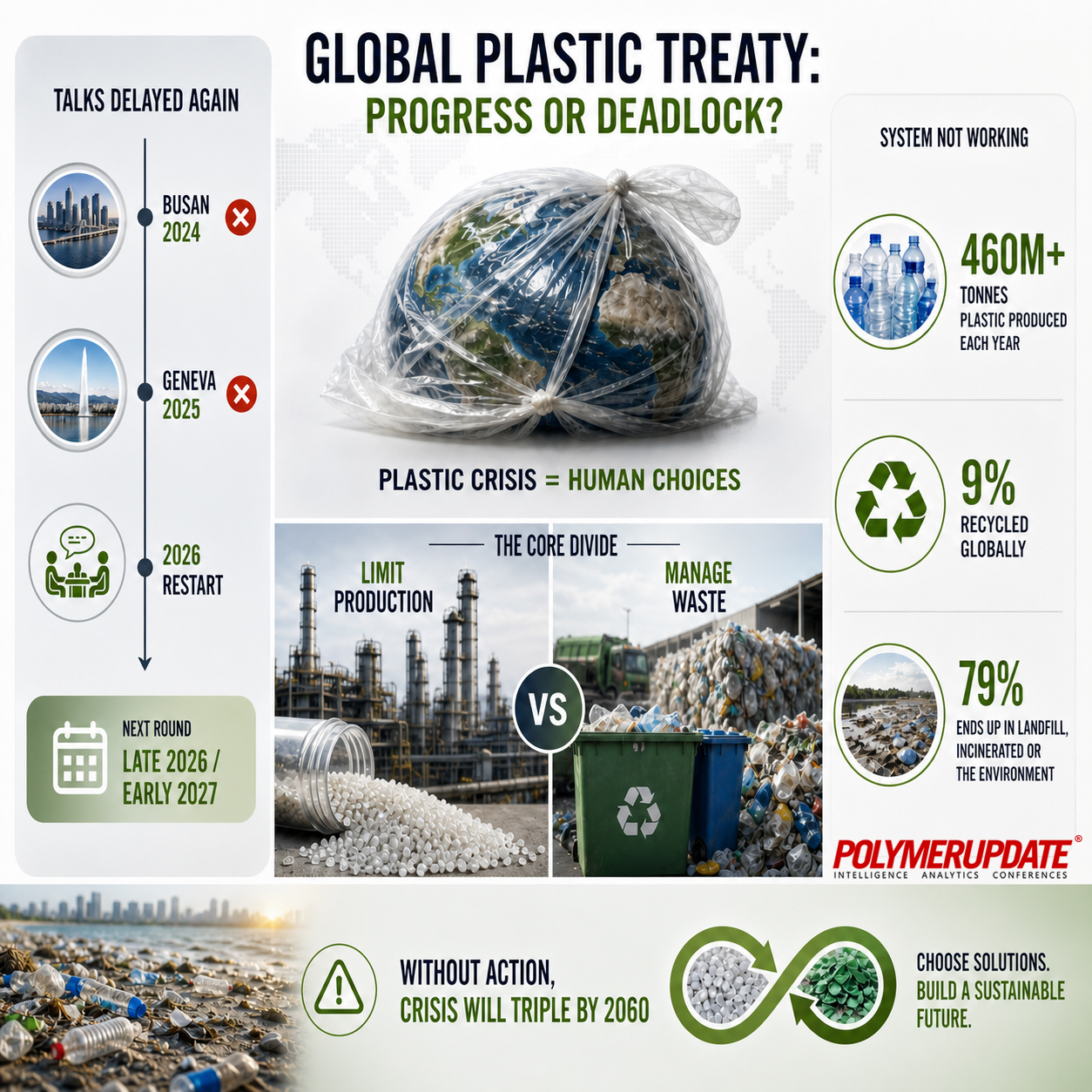
After two failed attempts to finalise a global treaty on plastic pollution — first in Busan, South Korea in December 2024, and again in Geneva in August 2025 — the United Nations Intergovernmental Negotiating Committee (INC) is attempting, once more, to find its footing. A new Chair has been elected. A roadmap has been issued. Informal consultations are underway. The world is watching.
But before we dissect the politics of treaty-making, let us be honest about something that rarely gets said plainly: Plastic is not the enemy. We are.
A Material Betrayed by Its Makers
Plastic is one of the most versatile, durable, and transformative materials humanity has ever produced. It has saved millions of lives in medicine, made clean water accessible, enabled food preservation, and reduced the weight — and therefore the fuel consumption — of virtually every vehicle on earth. The material itself is not the problem.
The problem is what we chose to do with it. We engineered a near-indestructible substance and then decided it was disposable. We designed systems of single-use convenience and built entire economies around planned obsolescence. We created the infrastructure for mass production with no credible plan for what happens at the end of life. Every piece of plastic choking a river, embedded in a seabird’s stomach, or detected in human blood was put there — directly or indirectly — by a human decision. Industrial, political, or personal.
If we are serious about solving the plastic crisis, we must begin by accepting that responsibility unambiguously. A treaty that simply shuffles the problem downstream — from production to waste management — without confronting the choices that created it will not succeed.
Where the Negotiations Stand: The Unvarnished Truth
Let us be precise about the current state of affairs, because public discourse on this issue has at times been muddled by outdated reporting.
The INC process was launched in March 2022, when the UN Environment Assembly passed a historic resolution to develop a legally binding global instrument on plastic pollution, covering its full lifecycle. Five negotiating sessions were planned, with a target of concluding by late 2024.
That target was missed — twice.
- INC-5.1 (Busan, November–December 2024): No agreement reached. A “Chair’s Text” was produced as a basis for further work.
- INC-5.2 (Geneva, August 2025): Ten days of negotiations concluded without consensus. The chair issued successive draft texts, neither of which secured sufficient support. The session adjourned amid deep divisions, and former Chair Luis Vayas Valdivieso of Ecuador subsequently resigned in October 2025, citing the weight of the impasse.
- INC-5.3 (Geneva, 7 February 2026): A one-day administrative session was convened solely to elect a new chair. No substantive negotiations were held. Chilean Ambassador Julio Cordano — diplomat and Director of Environment, Climate Change and Oceans at Chile’s Ministry of Foreign Affairs — was elected as the new INC Chair.
- In March 2026, Ambassador Cordano released a formal roadmap for the path to INC-5.4, the next substantive round of negotiations, now expected to take place at the end of 2026 or in early 2027. The venue has not yet been confirmed; Brazil, Azerbaijan, and Kenya have been put forward as potential hosts.
The Roadmap: Cautious Steps Toward a Broken Finish Line
Cordano’s roadmap — issued by letter on 16 March 2026 — is built on three guiding principles: *transparency, inclusivity, and predictability*. These are welcome words after a process that many observers criticised as opaque and procedurally chaotic.
The roadmap’s key elements are:
- Informal virtual “Heads of Delegation” (HOD) consultations convening every four to six weeks. The first was held on 12 March 2026 to consult on the roadmap and modes of work.
- An informal in-person HOD meeting in Nairobi, Kenya, from 30 June to 3 July 2026, intended to review all components of the negotiations, including the most contentious issues such as production limits.
- A possible second in-person meeting in early October 2026, subject to the availability of funding.
- The development, following Nairobi, of “an informal reference document” — not a draft treaty text, but a working document that maps options and reflects the level of progress to date, without proposing bridging solutions prematurely.
- INC-5.4, the next formal session, expected at the end of 2026 or early 2027.
Importantly, an informal gathering of approximately 20 countries was hosted by Japan in early March 2026. While participants described the meeting as useful for “testing ideas,” a source present at the discussions told Climate Home News that progress remained “challenging” and national positions had largely not shifted. To resume formal negotiations on any useful basis, a significant change in those positions will need to occur before INC-5.4 convenes.
The Core Divide: Production vs. Waste
The central fault line in these negotiations has not changed. It comes down to a single, consequential question: Does this treaty regulate the making of plastic, or only the throwing away of it ?
On one side stands what is loosely called the High-Ambition Coalition — a group of over 100 nations that supports a treaty covering the full lifecycle of plastic: mandatory caps on virgin plastic production, elimination of harmful chemicals of concern, product design standards to reduce waste at source, and binding national action plans with transparent reporting.
On the other side is a bloc led by petrochemical-producing states — including Saudi Arabia, Russia, and, until recently, the United States — which has argued for voluntary, nationally determined measures focused primarily on downstream waste management, recycling, and collection infrastructure.
This is not merely a technical disagreement about policy instruments. It is a structural conflict of interest. The production of plastics is overwhelmingly derived from fossil fuels — polyethylene, polypropylene, PET, and most other common plastics are petrochemical products. Nations and corporations with the most to lose from production caps have the most incentive to keep the treaty’s scope confined to waste.
As a government advisor, I have said this directly in negotiating rooms and I will say it here: voluntary measures on waste management, in the absence of supply-side constraints, will not bend the curve. The evidence is unequivocal. More than 460 million metric tonnes of plastic are produced every year. On current trajectories, the OECD projects global plastic waste reaching 1.7 billion metric tonnes by 2060. Recycling alone — even optimistically scaled — cannot absorb that volume.
The Numbers: What the Data Actually Shows
It is worth grounding this discussion in verified, current data:
Production: Since 1950, cumulative plastic production has exceeded 9 billion metric tonnes. The world now produces over 460 million metric tonnes annually. Without a binding reduction mechanism, production is projected to roughly triple by mid-century.
Recycling: Only approximately 9% of all plastic ever produced has been recycled. Roughly 12% has been incinerated. The remaining 79% persists in landfills or the open environment — soils, waterways, oceans, and air.
Ocean pollution: According to the Pew Charitable Trusts’ “Breaking the Plastic Wave” report, approximately 11 million metric tonnes of plastic enter the ocean annually. Without intervention, this figure is projected to reach 29 million metric tonnes by 2040 — a near-tripling that would be catastrophic for marine ecosystems, fisheries, and coastal communities.
Current ocean stock: Estimates for the total volume of plastic already present in the world’s oceans range from 75 to 199 million metric tonnes. These figures are likely conservative, given the difficulty of measuring deep-sea and microplastic concentrations.
Human health: Microplastics have now been detected in human blood, lungs, placentas, and brain tissue. The long-term implications are not yet fully understood, but the trajectory of discovery is deeply concerning.
Economic cost: Some analyses estimate the cumulative economic cost of plastic pollution could reach $281 trillion by 2060 — a figure that dwarfs the investment required to prevent it.
What a Credible Treaty Must Do
Based on the science, the economics, and the geopolitical reality of these negotiations, a treaty that is worth the paper it is printed on must accomplish the following:
1. Address the full lifecycle. From design and feedstock to use, collection, recycling, and end-of-life. A treaty confined to waste is a treaty that accepts the premise of the problem rather than addressing its cause.
2. Include binding production reduction targets. Not aspirational language — measurable, time-bound caps on the production of virgin plastics, with phase-out schedules for the most harmful and unnecessary categories (single-use, non-recyclable, chemically hazardous).
3. Eliminate chemicals of concern. Many plastics contain additives — flame retardants, plasticisers, colourants — that are toxic, persistent, and endocrine-disrupting. A lifecycle treaty must address these explicitly.
4. Establish a meaningful finance mechanism. Developing nations produce a fraction of the plastic that high-income nations do, yet bear a disproportionate burden of its environmental consequences. Any treaty that asks them to implement binding measures without providing the financial and technical capacity to do so will fail in practice, regardless of what it says on paper.
5. Mandate transparency and independent verification. National action plans without credible reporting requirements and third-party verification are not plans — they are announcements. The Paris Agreement’s architecture offers instructive lessons here, including its limitations.
6. Ensure civil society and frontline community inclusion. The communities most affected by plastic pollution — coastal communities, informal waste workers, low-income urban populations — must have meaningful input into the process, not merely observer status. Their knowledge is not supplementary; it is essential.
The Human Reckoning
We have produced 9 billion tonnes of a substance we call disposable, built a global economy dependent on its continuous manufacture, and are now surprised to find it everywhere we look — including inside ourselves.
The plastic treaty matters. It matters enormously. But no treaty, however ambitious, can substitute for a fundamental shift in the relationship between human consumption, industrial production, and environmental consequence. That shift requires political will, yes. But it also requires cultural change — in how governments frame responsibility, in how corporations design products, and in how individuals understand their role within a system they have the power to reshape.
Plastic did not pollute the planet. We did. And we are the only ones who can stop it.
A binding, ambitious, lifecycle-covering global plastics treaty — one that holds governments accountable, transitions industry, and protects the communities most at risk — is not just environmentally necessary. It is the minimum credible response to a crisis of our own making.
The Nairobi meetings in July 2026 will be a test of whether the world’s governments have finally understood that.
I, for one, am watching with the exhausted optimism of someone who has sat in too many rooms where the right outcome was visible, and the political will was not.
Professor Dr. Sajjid Mitha is the CEO and Founder of Polymerupdate, Polymerupdate Academy, and RACE Expos and Conferences. A leading voice in the global polymer and plastics industry.