Click the icon to add a specified price to your Dashboard list. This makes it easy to keep track on the prices that matter most to you.

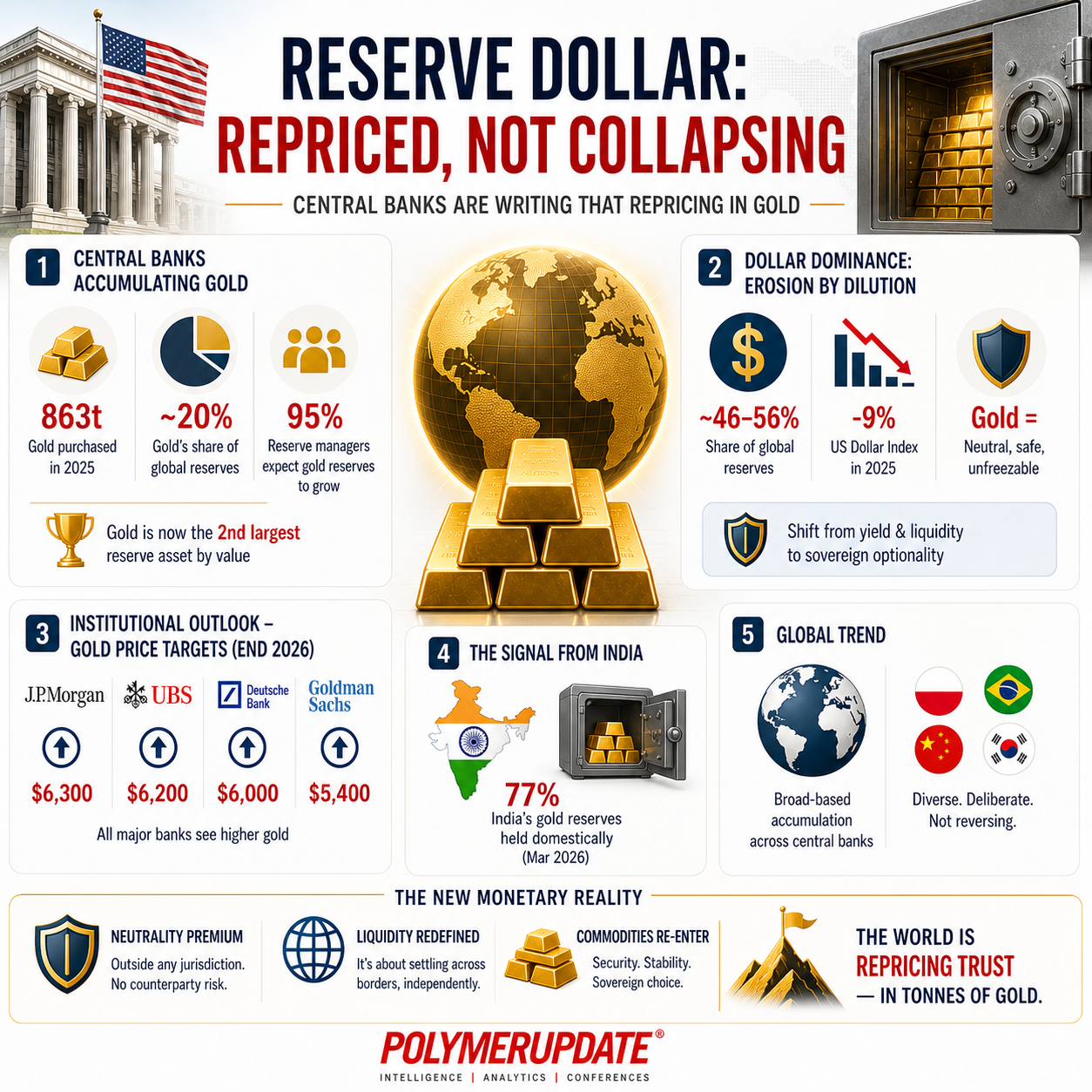
The reserve dollar is not collapsing. It is being repriced — and the world's central banks are writing that repricing in gold.
| Professor Dr. Sajjid Mitha CEO & Founder, PolymerUpdate · PolymerUpdate Academy · RACE Expos and Conferences |
The global monetary order is not facing a sudden, cataclysmic "Minsky moment." What we are witnessing is something more consequential, and more difficult to reverse: a disciplined, multi-year repricing of the world's most foundational asset class. The reserve dollar is not collapsing. It is being diluted — one central bank decision at a time.
For three decades, the prevailing consensus on sovereign reserve management rested on a simple axiom: US Treasury securities offered safety, liquidity, and yield in one instrument. That consensus survived crises, wars, and several emerging-market blow-ups. It ended, in practical terms, in February 2022 — when the United States and its allies froze approximately $300 billion in Russian sovereign reserves held in Western financial institutions. The message received by reserve managers from Beijing to Brasília was unambiguous. What can be frozen is not a reserve asset in any meaningful sense. It is a political instrument.
We are now living with the consequences of that moment. History has re-entered the ledger of money.
Section I
The Re-Monetisation of Bullion
Gold has been reabsorbed into the architecture of sovereign balance sheets — not as a cyclical trade, not as an inflation hedge of last resort, but as a structural first-mover in reserve diversification. This is the defining monetary story of the decade, and the data are no longer ambiguous.
Central banks globally purchased a net 863 tonnes of gold in 2025, according to World Gold Council data. This represented a 21 percent moderation from the record years of 2022 through 2024 — each of which exceeded 1,000 tonnes annually — but the retreat from peak levels tells only part of the story. In historical context, 2025 was the fourth-largest year of central bank gold accumulation on record, comfortably exceeding the 2010–2021 annual average of 473 tonnes. The slowdown was not a change in conviction; it was arithmetic. At gold prices above $4,000 an ounce, central banks no longer need to purchase as many tonnes to shift their allocation percentages meaningfully.
| 863t Central bank gold purchases, 2025 World Gold Council, Feb 2026 | 20% Gold's share of global reserves (value) ECB / World Gold Council, 2025 | 95% Reserve managers expecting gold reserves to grow WGC Central Bank Survey, 2025 |
The most consequential data point of the cycle is not a tonnage figure — it is a ranking. In 2025, for the first time since 1996, the value of central bank gold holdings overtook foreign holdings of US Treasuries. Simultaneously, gold surpassed the euro to become the world's second-largest reserve asset by value, accounting for approximately 20 percent of global reserves against the euro's 16 percent. The dollar retains its dominant position, with roughly a 46–47 percent share — but the composition of what sits alongside it has been fundamentally reordered.
Shaokai Fan, Head of Central Banks at the World Gold Council, has noted that the buyer base is broadening beyond the "usual suspects" of China, Russia, and Turkey. Poland's National Bank was the standout buyer of the 2025 cycle, adding 102 tonnes to bring total holdings to 550 tonnes — now equivalent to 28 percent of its total reserves, with a revised target of 30 percent and stated ambitions to reach 700 tonnes on national security grounds. Brazil returned to the market in the second half of 2025 for its most significant accumulation in four years. The Czech National Bank has purchased gold for over three consecutive years running. Even South Korea signalled interest in resuming purchases after a 12-year hiatus.
Surveys indicate that 95 percent of central bank reserve managers expect global gold reserves to increase over the next twelve months — with zero respondents anticipating a decline. That is not a sentiment reading. It is a structural mandate.
World Gold Council Central Bank Gold Reserves Survey, 2025
A note on opacity: the World Gold Council estimates that approximately 57 percent of total 2025 central bank purchases were not immediately disclosed — a figure consistent with prior years and suggestive of accumulation by institutions unwilling to move markets or signal strategic intent. The headline 863-tonne figure likely understates the true scale of sovereign demand.
Section II
Dollar Dominance: Erosion by Dilution
The "de-dollarisation" thesis has attracted far more hyperbole than its underlying data supports. The dollar remains the undisputed anchor of the international monetary system, accounting for approximately 46–56 percent of global foreign exchange reserves depending on the measurement methodology. No credible analyst is forecasting an imminent collapse of dollar primacy.
What is occurring is more subtle, and in some respects more durable: a structural shift in the objective function of reserve management. For most of the post-Bretton Woods era, reserve managers optimised for yield and liquidity. Today, an increasing number are optimising for what might be termed sovereign optionality — the ability to operate outside the reach of any single jurisdiction's financial infrastructure. Gold, uniquely, satisfies that criterion. It carries no counterparty risk. It cannot default. It cannot be frozen by executive order.
Former Credit Suisse strategist Zoltan Pozsar framed this shift early, describing the emergence of what he termed "Bretton Woods III" — a commodity-backed monetary order taking shape in parallel with the existing dollar system, in which gold functions as the neutral settlement asset of last resort. Whether or not the full edifice of his thesis proves correct, the directionality it identified has proved accurate. Commodity-backed bilateral trade corridors are expanding. Appetite for long-duration US Treasuries among foreign reserve managers has cooled. The surplus value of trade is increasingly being stored in physical assets rather than digital promises.
The US Dollar Index fell more than 9 percent in 2025 — its worst annual performance in eight years. That move is consistent with, though not solely caused by, the reserve diversification underway. The more important signal is not the dollar's price but the slow erosion of the captive demand that once supported it unconditionally.
Section III
The Institutional Verdict: Where the Major Banks Stand
The structural thesis has migrated from the heterodox to the consensus. The major investment banks have, with varying degrees of conviction, repriced their gold outlooks to reflect a regime change rather than a cyclical trade. Gold hit an all-time high of approximately $5,595 per ounce on 29 January 2026, before retreating roughly 15 percent by mid-April as a sharp rise in oil prices — driven by the Hormuz situation — raised inflation expectations and deferred Federal Reserve rate cuts, briefly elevating the opportunity cost of non-yielding assets. The structural buyers — central banks and long-duration institutional allocators — were not, by most accounts, among the sellers.
Institutional Gold Price Targets — Year-End 2026 | |||
|---|---|---|---|
Institution | Target ($/oz) | Relative Conviction | Primary Driver Cited |
| J.P. Morgan Global Research | $6,300 |
| Central bank & investor demand averaging 585t/quarter |
| UBS Global Wealth Management | $6,200 |  | Rotation from bonds & equities; upside scenario $7,200 |
| Deutsche Bank | $6,000 |  | Structural fiscal debasement concerns |
| Goldman Sachs | $5,400 |  | 60t/month EM central bank purchases; debasement trade |
Goldman Sachs — whose $5,400 year-end target is the most conservative among major bank forecasts — reaffirmed its call through the March 2026 correction, with analysts Daan Struyven and Lina Thomas arguing that the institutions which drove gold to its January peak were not among the sellers. J.P. Morgan, whose $6,300 target represents the high end of the institutional range, forecasts that combined central bank and investor demand will average approximately 585 tonnes per quarter through 2026. The analytical departure between the two houses is not directional but conditional — Goldman's base case does not depend on a new wave of private buyers; J.P. Morgan's more bullish scenario does.
What is notable is that even the most conservative institutional forecast now implies a structural floor that would have been dismissed as speculative only three years ago.
Section IV
The Signal from the Subcontinent — and Beyond
Perhaps no single data point captures the scope of this transition more precisely than India's reserve strategy. As of end-March 2026, the Reserve Bank of India held 880.52 metric tonnes of gold — with gold's share of total foreign exchange reserves standing at 16.7 percent, up from 13.9 percent just six months earlier. More telling still is where that gold now physically resides: approximately 77 percent — some 680 tonnes — is held domestically, inside India. As recently as March 2023, less than 37 percent was stored at home. The remainder sat in the vaults of the Bank of England and the Bank for International Settlements.
The repatriation of approximately 274 to 280 tonnes since 2023 is not a logistical exercise. It is a geopolitical statement. The message it sends is the same one being transmitted, in different languages and different quantities, from Warsaw to Brasília to Astana: in a world where financial infrastructure can be weaponised, custody matters as much as ownership.
China's People's Bank reported a comparatively modest 27-tonne increase in officially disclosed gold reserves for 2025, bringing stated holdings to 2,306 tonnes — roughly 9 percent of total reserves. The operative word is "disclosed." Given that the World Gold Council estimates 57 percent of global central bank purchasing in 2025 was unreported, and given China's historical pattern of intermittent disclosure, its true accumulation almost certainly exceeds the official record substantially.
Conclusion
The Return to Tangibility
Over three decades of markets, I have watched many "new era" narratives arrive with great conviction and depart with equally great embarrassment. This one is different — not because the arguments are more eloquent, but because the balance sheets are moving. Central banks do not make structural allocation changes for rhetorical reasons. They make them when their mandate demands it.
Three durable themes are now visible to any honest observer of the data. First, a neutrality premium has emerged — a persistent valuation advantage for assets that sit outside any single jurisdiction's enforcement reach. Gold is the paradigmatic case, but the principle extends to any hard asset free of counterparty or cancellation risk. Second, the definition of liquidity has been quietly rewritten. In the twentieth century, liquidity meant the ability to sell. In the twenty-first, it increasingly means the ability to settle — to transfer value across borders without requiring the goodwill of a third-party payment infrastructure. Gold satisfies that definition in a way that no digital ledger controlled by a sovereign authority currently can. Third, commodities have re-entered the monetary conversation. From India repatriating bullion to domestic vaults, to Poland's central bank governor invoking "national security" as justification for a 700-tonne gold target, to Brazil's quiet return to the gold market after a four-year absence — the accumulation is broad, deliberate, and not reversing.
The global order is not collapsing. It is hardening — fracturing along lines of trust, jurisdiction, and the capacity for financial coercion. In that landscape, gold is no longer simply a commodity. It has become the world's most honest real-time signal of geopolitical risk — a sovereign poll, conducted in tonnes, with no margin of error and no editorial discretion.
The tally, as of today, is unambiguous.
Disclosure & Notes: This editorial represents the independent analysis and views of the author. It does not constitute investment advice. All data cited is sourced from the World Gold Council, European Central Bank, International Monetary Fund, Reserve Bank of India, and publicly available research from Goldman Sachs, J.P. Morgan Global Research, UBS, and Deutsche Bank, as of the date of publication. Price targets and institutional forecasts are subject to revision. Readers should conduct their own due diligence before making any investment decisions. |