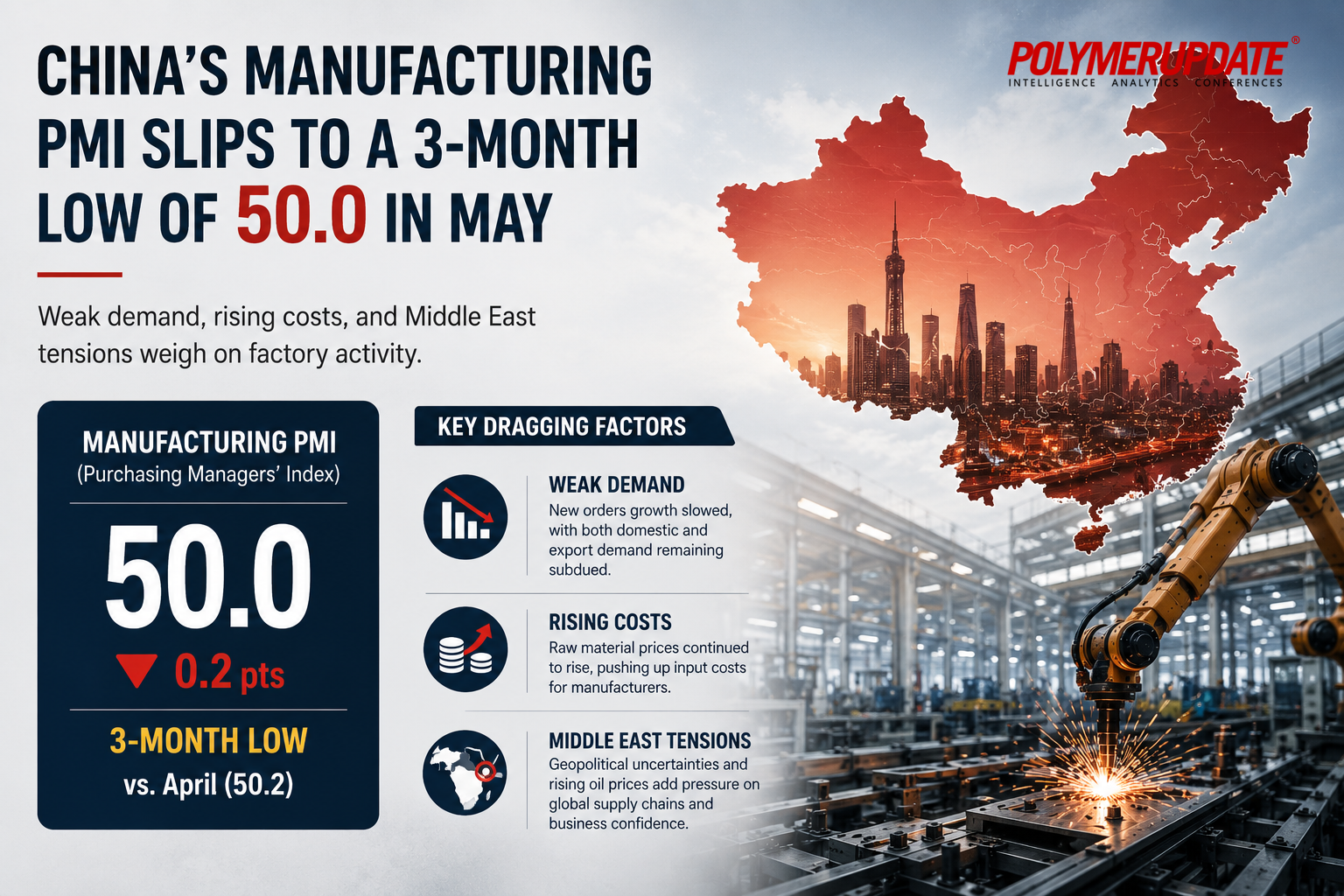
China’s Manufacturing PMI (Purchasing Managers’ Index) declined to its lowest level in three months in May due to softening domestic demand and steadily rising input costs linked to the ongoing US-Iran conflict in the Middle East, the country’s official agency, the National Bureau of Statistics (NBS), said in its latest report published on Monday. The manufacturing PMI of the world’s second-largest economy after the United States indicated that factory activity continued to face headwinds amid sluggish local consumption and weaker price competitiveness in overseas markets.
The manufacturing PMI stood at 50.0 (neutral) in May, marking the lowest level in three months, compared with 50.3 in April and 50.4 in March. The reading had risen to a multi-month high in March from 49.0 in February and 49.3 in January this year. A reading above the 50 threshold indicates expansion, while a reading below this benchmark points to contraction. However, the 50-mark suggests that China’s factory activity remains at a critical juncture and could move in either direction depending on domestic demand conditions and overseas price competitiveness.
A statement from the NBS said, “China’s official NBS Manufacturing PMI edged down to 50.0 in May 2026 from 50.3 in April, in line with market expectations, indicating that the country’s manufacturing sector remained on the threshold between expansion and contraction. The marginal decline highlighted persistent challenges facing manufacturers, particularly weak domestic demand, slower industrial orders, and cautious business sentiment. Although the PMI remained above the critical 50-mark, the softer reading suggested that the pace of industrial activity lost momentum amid an uncertain global economic environment.”
 Headwinds
Manufacturing activity also came under pressure from rising input costs linked to the ongoing conflict in the Middle East, which continued to disrupt energy markets and global supply chains. Elevated crude oil prices increased transportation and production expenses for Chinese factories, while geopolitical uncertainties weighed on export-oriented industries. The data reflected growing concerns that higher raw material costs and subdued consumer demand could further squeeze manufacturers’ profit margins and limit production growth in the coming months.
Lynn Song, Chief Economist, Greater China, ING Economics, believes, “China’s official manufacturing purchasing managers’ index, published by the National Bureau of Statistics, showed activity falling to 50.0 in May, down from 50.3 in April. This 50.0 level represents the threshold between expansion and contraction and marked a 3-month low. There was a broad-based decline in the sub-indices. But we saw the most notable drops in new orders, which fell back into contraction at 49.9 from 50.6, and new export orders, which fell to 48.6 from 50.3.”
Output growthChina’s manufacturing activity showed further signs of moderation in May 2026, with output growth easing to a three-month low of 51.2 from 51.5 in April. The softer production reading reflected weakening demand conditions and cautious business activity amid persistent economic uncertainties. Manufacturers continued to struggle with sluggish domestic consumption and uneven recovery across key industrial sectors, limiting the pace of expansion in factory operations.
New orders contracted slightly to 49.9 in May from 50.6 in the previous month, ending two consecutive months of growth and indicating weaker market demand. Export-oriented manufacturers faced additional pressure as foreign orders dropped to 48.6 from 50.3, highlighting subdued global demand and rising geopolitical uncertainties. Ongoing tensions in the Middle East, elevated freight costs, and concerns over slowing global economic growth continued to weigh on overseas sales and export competitiveness.
Labour market conditions in the manufacturing sector remained weak, with the employment index staying in contraction territory at 48.6, marginally lower than April’s 48.8. Purchasing activity also declined for the first time in three months, falling to 49.8 from 51.1, suggesting that factories turned cautious in procuring raw materials and intermediate goods amid softer order inflows. Meanwhile, supplier delivery times improved slightly to 49.2 from 49.5, indicating modest easing in supply chain disruptions despite continued geopolitical and logistical challenges.
On the pricing front, input cost inflation moderated to 60.5 from 63.7 but remained elevated due to higher energy and raw material costs. At the same time, output price growth slowed sharply to 51.9 from 55.1, reflecting weaker pricing power among manufacturers as demand conditions softened. Despite these challenges, overall business sentiment remained positive at 53.9, although it eased slightly from April’s 54.5, suggesting that firms continued to expect gradual improvement in economic conditions over the coming months.
Sub-indicesChina’s Raw Material Purchasing Price Index fell sharply to 60.5 in May from the previous month, while the Ex-factory Price Index also declined notably to 51.9. Despite the moderation, both indices remained comfortably above the 50-mark, indicating that inflationary pressures within the manufacturing sector persisted and that China’s broader reflation trend remained intact.
Meanwhile, China’s manufacturing activity continued to show resilience, with the production sub-index easing marginally by 0.3 percentage points to 51.2 in May, while remaining firmly in expansion territory. Large enterprises once again outperformed medium- and small-sized firms, extending a long-standing trend in which their PMI readings have surpassed those of smaller manufacturers in 23 of the past 25 months.
RatingDog PMIThe RatingDog PMI fared better, showing a slight moderation from the previous month. The RatingDog China Manufacturing PMI eased to 51.8 in May 2026 from an over five-year high of 52.2 in April, but remained above forecasts of 51.4. Growth in new orders and output moderated, but stayed robust, supported by domestic demand, new customers, and product upgrades, while export orders dipped slightly. Production also increased strongly, remaining among the highest levels since late 2024.
This outperformed market forecasts for a bigger decline. It suggests China's export-focused manufacturing continues to outperform, with external demand remaining solid while domestic demand has been soft. The RatingDog PMI release noted that, aside from employment, the sub-indices all contributed positively in May -- though mostly at lower levels than in April.
In the past several years, the correlation between PMI and industrial production weakened. Last month, PMIs rose, while industrial production plummeted to a multi-year low. This may be explained by China's industrial activity becoming increasingly high-tech focused. Also, many of the more traditional manufacturing sectors, such as cement and steel, are still struggling amid the property market downturn.
A surprise return of non-manufacturing PMIThe official non-manufacturing PMI rebounded from 49.4 to 50.1, beating market expectations for a smaller uptick and edging back into expansionary territory. The non-manufacturing PMI has been softening so far this year amid sluggish domestic demand.
The breakdown of the sub-indices does not suggest a very strong outlook. Three sub-indices were in expansionary territory: business expectations (54.8), suppliers' delivery time (51.2), and input prices (52.2). Aside from business expectations, which have been solidly at expansionary levels for all but one month since data availability began in 2007, longer delivery times and higher input prices are not necessarily encouraging signs.
New orders (45.0) and new export orders (48.1) both picked up on the month but remained well in contractionary territory. Unlike the pickup in ex-factory prices seen in the manufacturing PMI data, sales prices (48.8) for non-manufacturing firms have yet to return to expansion despite rising input prices, remaining below 50 for a 32nd consecutive month.
China’s NBS Composite PMI Output Index rose to 50.5 in May 2026 from 50.1 in April, marking a third straight month of growth in overall business activity. The uptick reflected a modest rebound in the services sector after April’s contraction, while manufacturing activity remained largely stable. However, the outlook remained clouded by external headwinds. The Middle East conflict, which led to the closure of the Strait of Hormuz in late February, has driven energy prices sharply higher, increasing production and transportation costs and squeezing profit margins.
DILIP KUMAR JHA
Editor
dilip.jha@polymerupdate.com