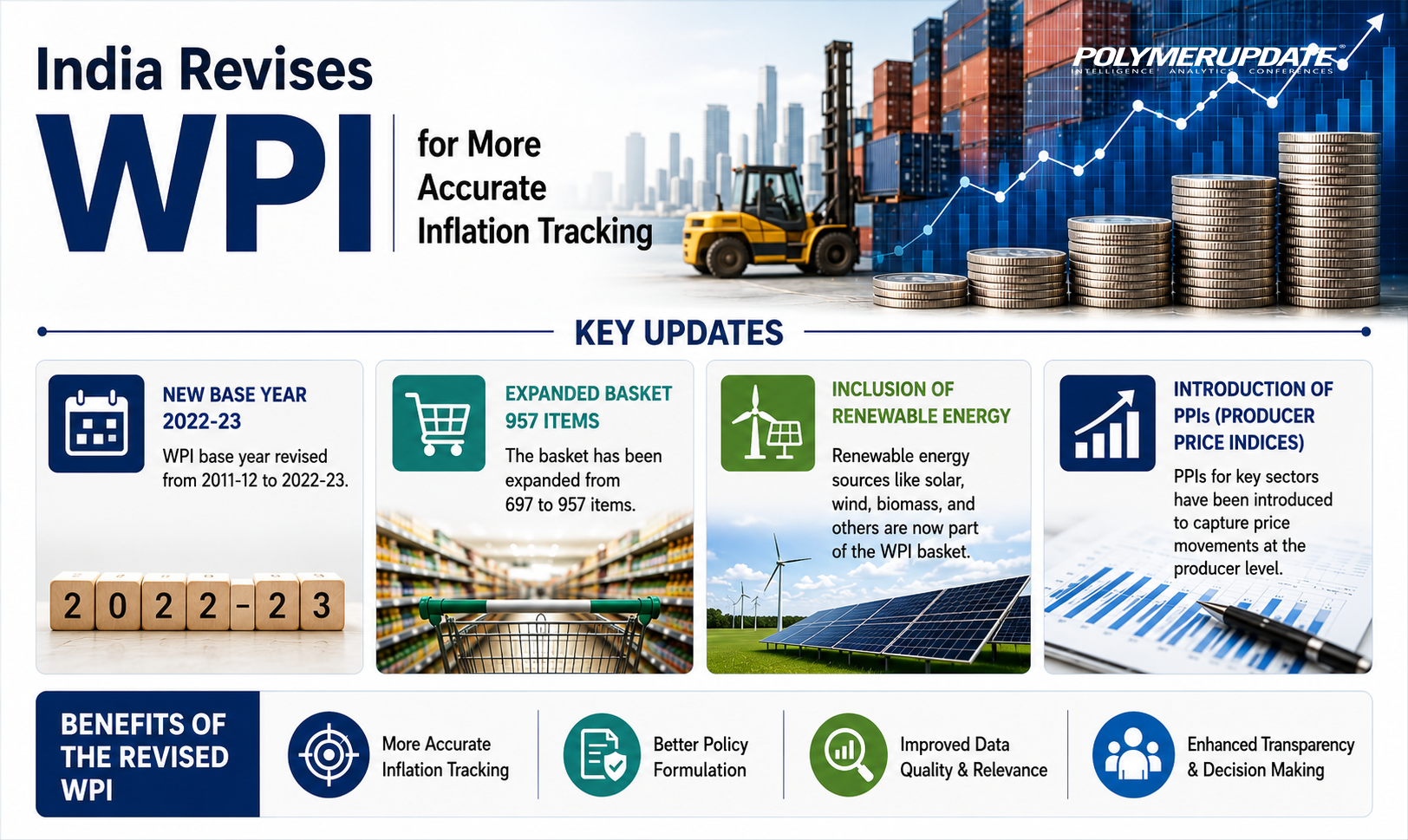
India has revised the base year for the Wholesale Price Index (WPI)-based wholesale inflation and also changed its composition in a bid to transform the entire calculation process and incorporate modern scientific methods of data presentation, the Union Ministry of Commerce and Industry said in a statement on Tuesday. The revised base year for WPI inflation now stands at 2022-23, compared with 2011-12 earlier. Scheduled to be released on June 15, the new series widens coverage, includes renewable energy components, and introduces improved methodology to strengthen price measurement.
The revision in WPI-based inflation measurement comes less than four months after the government revised the base year for the Consumer Price Index (CPI)-based inflation. The base year for CPI in India was revised from 2012 to 2024 on February 12, 2026, along with broader coverage and improved measurement of retail inflation in line with current market conditions. The updated CPI framework includes several modernizations to better reflect current spending patterns.
A Commerce Ministry official stated, “The revision of the WPI series marks a significant modernization of India’s inflation measurement framework, making it more aligned with the evolving structure of the economy and global statistical standards. The expansion of the commodity basket from 697 to 957 items, along with the inclusion of renewable energy sources such as solar, wind, and nuclear electricity, reflects the changing energy mix and industrial landscape of the country. The reclassification of crude petroleum and natural gas under the ‘Fuel and Power’ group will also provide a more coherent representation of energy-related price movements.”
He added, “Equally important are the methodological improvements introduced in the new series. The adoption of Gross Value of Output-based weighting, chain-based short-term index formulation, and targeted mean imputation strengthens the robustness, accuracy, and producer-side relevance of inflation measurement. The introduction of linking factors and the development of Output, Input, and Service PPIs based on updated National Accounts data will significantly enhance the analytical usefulness of India’s wholesale price indicators for policymakers, industry participants, and researchers.”
 Changes
The revision of the base year of the WPI from 2011-12 to 2022-23 and the compilation of Producer Price Indices (PPIs) were approved by the competent authority at its meeting held on May 25, 2026. Earlier, the recommended compilation methodology had been approved by the Technical Advisory Committee (TAC) on Statistics of Price and Cost of Living (SPCL). Subsequently, the methodology was also presented before the National Statistical Commission (NSC).
The Office of the Economic Adviser, DPIIT, will accordingly release the revised WPI series with base year 2022-23 on June 15, 2026, replacing the existing WPI series with base year 2011-12. In addition, the office will also release new series of the Output Producer Price Index (OPPI), Trial Input Producer Price Index (IPPI), and Service Producer Price Index (Service PPI) for seven services, namely banking, securities transactions, insurance, management of pension funds, railways, air passenger transport, and telecom, with base year 2022-23.
Discontinuation after five yearsConsidering the widespread use of the WPI in price escalation clauses, this index will continue to be released for five years from the date of launch of the revised series alongside the PPI, after which it will be discontinued. This would provide sufficient time for users to transition from the WPI to the PPI. The shift from the WPI to the PPI is aligned with global best practices adopted by advanced economies and the recommendations of the International Monetary Fund (IMF).
The availability of both the Output PPI and Input PPI provides a better understanding of price movements in output items vis-à-vis input items used in an industry. It also explains how inflation experienced by producers in input items is passed on through the output being produced. The Service PPIs for seven services have been compiled in the first phase based on the availability of data from administrative sources/agencies. More services are planned to be added to the Service PPI basket in subsequent phases, depending on data availability.
The WPI and Output PPI are being compiled on a monthly basis and will be released for May 2026 (provisional), along with the back series from April 2023 to April 2026 (37 months), on June 15, 2026. The monthly Trial Input PPI (only for the manufacturing sector) will be published on an experimental basis from March 2026 onwards. This would enable the department to examine data quality and also receive feedback from stakeholders and users. The Service PPI, compiled on a quarterly basis, will be released for Q4 of 2025-26 (provisional), along with the back series from Q1 of 2023-24 to Q3 of 2025-26.
Key highlightsThe total number of items in the new series has increased from 697 to 957. New sources of energy, such as solar and wind, have been added under the ‘Electricity’ group. In addition, nuclear electricity has also been included in the basket. Crude petroleum and natural gas have been shifted from the ‘Primary Articles’ group to the ‘Fuel and Power’ group. This reorganization is expected to provide better alignment, as the group already includes other major fuels such as coal, electricity, and petroleum products.
Gross Value of Output (GVO) has been used for preparing weights for the WPI (2022-23), as compared to the Net Traded Value method — i.e., GVO + Imports – Exports — used in the WPI 2011-12 series. This change has been made as weights based on GVO better reflect the economic significance of commodities from the producer’s perspective, since they represent domestic production. The elementary indices are now being compiled using a short-term formulation with a chain-based method, replacing the long-term formulation method used in the existing series. The ‘Targeted Mean Imputation’ method has also been introduced in place of the ‘Carry-forward’ method used in the existing WPI series.
The linking factor has been computed as the ratio of the geometric means of the 12-month indices of the old and new WPI series for the financial year 2024-25. This will be available for All Commodities and the Major Groups. The weights for the Output PPI and Input PPI have been derived using the Supply Table and Use Table, respectively, from the Supply & Use Tables of the National Accounts for the year 2022-23. The WPI, Output PPI, and Service PPI are being compiled on the basis of Basic Prices, which exclude net taxes and trade and transport margins, whereas the Input PPI is being compiled using Purchaser’s Prices, since industries purchase inputs from the market.
DILIP KUMAR JHA
Editor
dilip.jha@polymerupdate.com