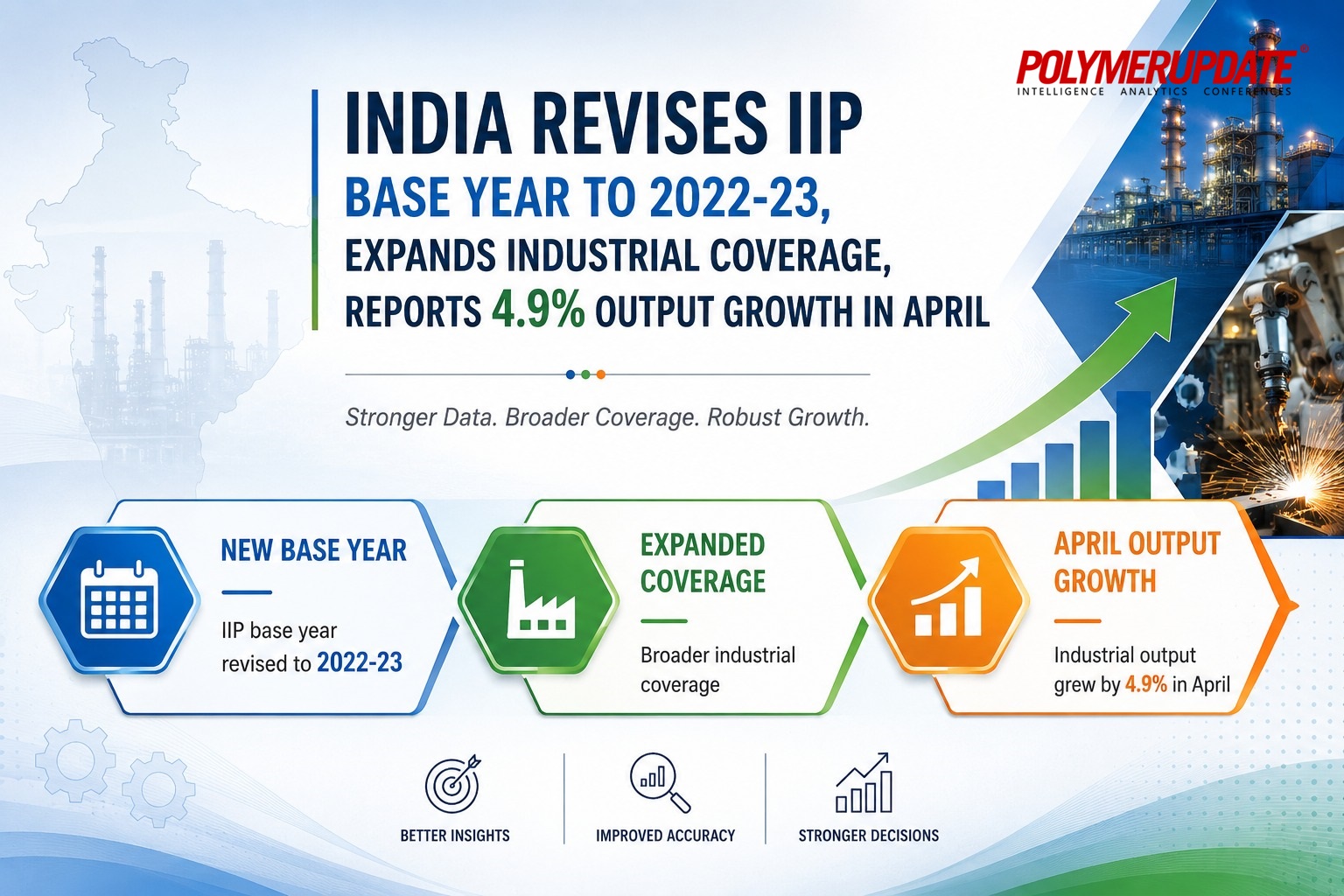
The base year for India’s Index of Industrial Production (IIP) has been revised to 2022–23 from 2011–12 to align factory output data with inflation figures based on the Consumer Price Index (CPI) and Wholesale Price Index (WPI), the Ministry of Statistics and Programme Implementation (MoSPI) said in a statement. The revision also aligns the IIP base year with other key economic indicators, such as gross domestic product (GDP), and the proposed producer price index (PPI). In addition to the base-year revision, the new series incorporates several key changes, including wider coverage, greater granularity, and factory substitution. Further enhancements to the IIP data series are also underway.
MoSPI said in a statement, “The base year of the All India Index of Industrial Production (IIP) has been revised from 2011–12 to 2022–23 with the objective of making the index more representative of the current structure and dynamics of the industrial sector. The revised series incorporates an updated item basket, a revised weighting structure, and enhanced sectoral coverage to better capture recent developments in industrial activity across the economy. The revision exercise was undertaken under the aegis of the Technical Advisory Committee for Base Year Revision of the All India Index of Industrial Production (TAC-IIP). The Committee's report was released on 25 May 2026, laying the foundation for a more robust, relevant, and comprehensive measure of industrial production in India.”
 Widening coverage
The new base year widens coverage to 463 groups from the current 407. As a result, 120 new items have been included, such as gas supply, water supply, sewerage and waste management, credit and debit cards, parts of aircraft and spacecraft, CCTV cameras, and vaccines, among others. Sub-indices have also been introduced to provide additional information, particularly for electricity — comprising renewable and non-renewable generation — and mining and quarrying, which now include fuel minerals, metallic minerals including rare earth minerals, and non-metallic minerals including minor minerals.
On the other hand, 64 outdated items, including kerosene, sewing machines, and tubes for bicycle and rickshaw tyres, have been removed. The weight of manufacturing has been marginally reduced to 76.06 percent from 77.63 percent, while the weight of mining and quarrying has declined to 11.05 percent from 14.37 percent. In contrast, the weight of electricity and gas supply has increased to 10.86 percent from 7.99 percent due to the inclusion of gas supply. A new category — water supply, sewerage and waste management — has also been introduced with a weight of 2.02 percent.
IIP@4.9 percentAs per the new IIP series, India’s industrial output grew by 4.9 percent in April, up from 3.2 percent in March. The improvement in industrial activity was driven by a strong acceleration in manufacturing sector growth to 6.2 percent in April from 3.9 percent in the previous month. As many as 17 out of 23 manufacturing sub-sectors recorded growth in output during April. The strongest gains were seen in textiles (15.6 percent growth), paper and paper products (13.8 percent), fabricated metal products except machinery and equipment (11.7 percent), electrical equipment (19.2 percent), machinery and equipment (12.9 percent), motor vehicles, trailers and semi-trailers (12.7 percent), and other transport equipment (18.9 percent).
A slight improvement in growth rates was also seen in electricity and gas supply, which rose by 4.9 percent in April compared with 4.4 percent in March, and in water supply, sewerage and waste management, which grew by 6.6 percent versus 6.4 percent in the previous month. However, growth in the mining and quarrying sector remained in negative territory for the fourth consecutive month. The contraction in the sector’s output widened to 5.1 percent in April from 2.5 percent in March.
Rajani Sinha, Chief Economist at Care Ratings Ltd, commented, “In terms of the use-based classification, positive performance continued in the output of capital and infrastructure/construction goods, which grew by 16 percent and 7.1 percent, respectively, in April. It remains encouraging to see capital goods output record sustained double-digit growth for the sixth successive month. Furthermore, growth in the consumer-oriented segment improved in April. Output of consumer durables was up 4.3 percent in April versus 2.4 percent in March.”
Additionally, consumer non-durables output grew by 2.8 percent in April, reversing the 0.9 percent contraction recorded in the previous month. Although the improvement in output across consumer-oriented segments is encouraging, the sustainability of this trend remains to be monitored given the high volatility in the performance of these segments. Consumption trends in the economy also warrant close monitoring amid headwinds from rising inflation, higher retail fuel prices, and risks to the monsoon outlook.
Segment-wise performanceWithin the manufacturing sector, 17 out of 23 industry groups recorded year-on-year growth during the month. As in the previous month, motor vehicles, trailers and semi-trailers, along with machinery and equipment, continued to provide upward support, registering growth rates of 12.7 percent and 12.9 percent, respectively, driven by passenger cars and cranes. Electrical equipment also recorded strong growth of 19.2 percent, supported by higher production of small transformers, circuit breakers, and other equipment. Within electricity and gas supply, growth was driven by renewable energy sources, while the impact of the West Asia crisis was reflected in the sharp contraction of 11.2 percent in gas supply.
Among the six use-based segments, capital goods maintained the highest growth at 16.0 percent year-on-year, followed by intermediate goods and infrastructure/construction goods. The increased weight of intermediate goods — 22.42 percent under the new base year compared with 17.22 percent under the old base year — along with its stronger growth, supported the overall expansion in industrial output.
OutlookWithin the manufacturing sector, 17 out of 23 industry groups recorded year-on-year growth during the month. As in the previous month, motor vehicles, trailers and semi-trailers, along with machinery and equipment, continued to support overall growth, registering increases of 12.7 percent and 12.9 percent, respectively, driven by higher production of passenger cars and cranes. Electrical equipment also posted strong growth of 19.2 percent, supported by increased production of small transformers, circuit breakers, and other equipment. Within electricity and gas supply, growth was driven by renewable energy sources, while the impact of the West Asia crisis was reflected in the sharp contraction of 11.2 percent in gas supply.
Among the six use-based segments, capital goods recorded the highest growth at 16.0 percent year-on-year, followed by intermediate goods and infrastructure/construction goods. The higher weight of intermediate goods — 22.42 percent under the new base year compared with 17.22 percent under the old base year — along with its stronger growth, contributed to the overall expansion in industrial output.
DILIP KUMAR JHA
Editor
dilip.jha@polymerupdate.com