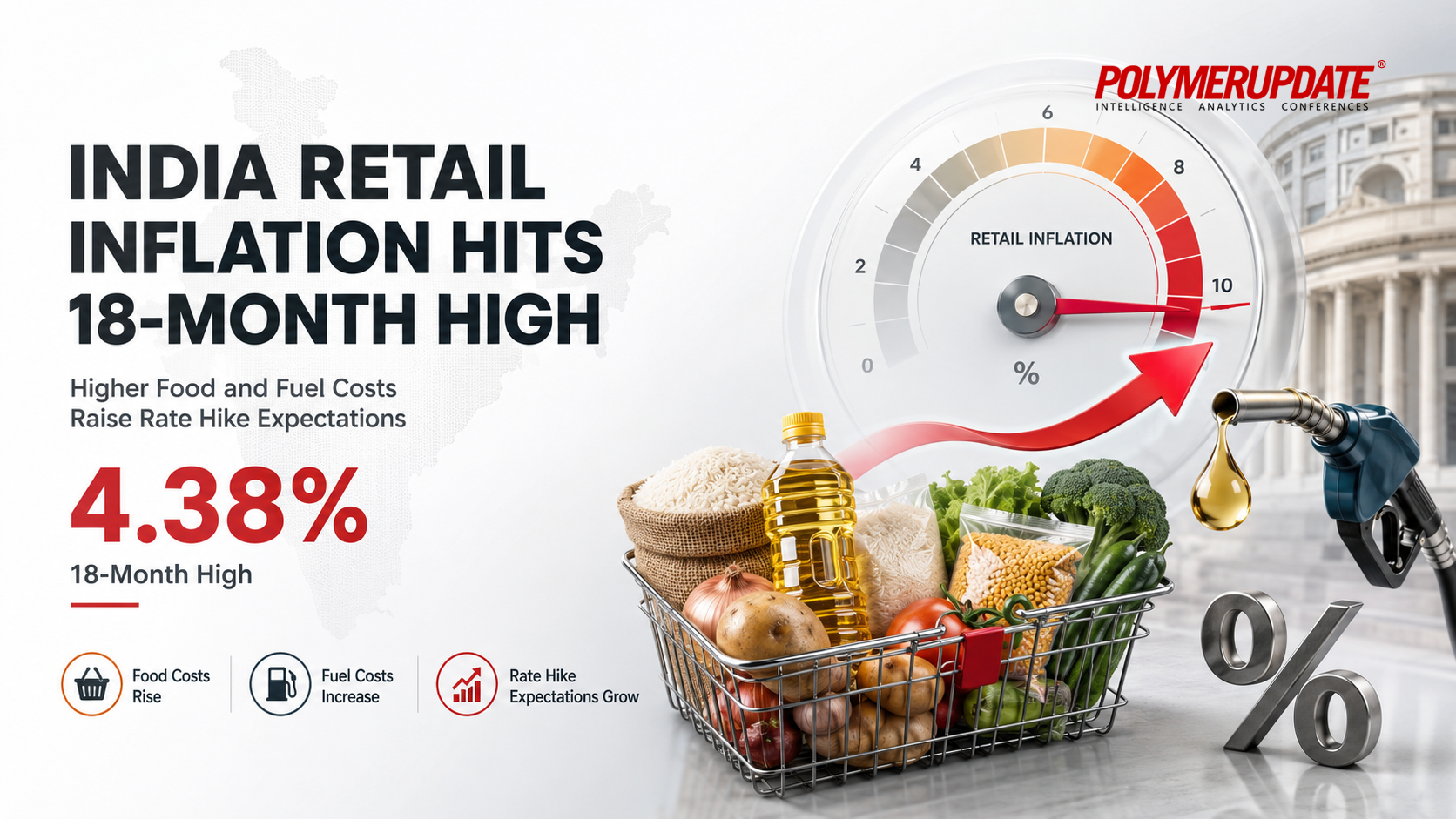
India’s retail inflation, measured by the Consumer Price Index (CPI), rose to an 18-month high of 4.38 percent in June, driven by a sharp increase in food and non-food prices, with the latter having a greater impact. The rise in the cost of most products and services was largely driven by external factors, particularly higher energy prices resulting from escalating tensions between the United States and Iran in the Middle East.
Notably, the June CPI print was significantly higher than the 3.93 percent recorded in May 2026 and more than double the 2.10 percent registered in June 2025. Inflation continued its upward trajectory in June 2026, surpassing the Reserve Bank of India’s (RBI’s) benchmark inflation target of 4 percent. The increase was primarily driven by higher prices of food, transport, and gold and silver, although the pace of increase in precious metals moderated.
“Year-on-year inflation rate based on All India Consumer Price Index (CPI) with base year 2024 for the month of June 2026 over June 2025 is 4.38 percent (provisional). Corresponding inflation rates for rural and urban are 4.74 percent and 3.92 percent, respectively. Year-on-year food inflation, based on Consumer Food Price Index stands at 5.32 percent in June 2026,” said a statement from the Union Ministry of Statistics & Programme Implementation (MoSPI).
Dipti Deshpande, Senior Director and Principal Economist at Crisil Ltd, said, “India’s retail inflation crossed the 4 percent mark for the first time since January 2025, with CPI inflation rising to 4.38 percent in June from 3.93 percent in May. While both food and non-food components contributed to the increase, the non-food component had a larger impact. On the non-food side, although global crude oil prices have eased from recent peaks, they remain significantly higher year-on-year.”
 Higher food inflation
The MoSPI reported that the year-on-year retail food inflation rate, based on the All India Consumer Food Price Index (CFPI), stood at 5.32 percent (provisional) in June 2026 compared with June 2025. The corresponding inflation rates for rural and urban areas were 5.45 percent and 5.09 percent, respectively. Prices in the food and beverages category increased by 5.05 percent, while the combined category of paan, tobacco and intoxicants recorded a price rise of 4.83 percent. In the services segment, the restaurants and accommodation category registered a price increase of 6.91 percent, while the personal care, social protection and miscellaneous category recorded a sharp rise of 16.72 percent.
Food inflation contributed around 185 basis points (bps) to the headline inflation rate, while non-food inflation contributed approximately 250 bps. Within the food category, apart from the fading favourable base effect, high summer temperatures continued to push food inflation higher from the record-low levels seen earlier. Looking ahead, uneven rainfall, a below-normal monsoon forecast, and the onset of El Niño conditions could exert further pressure on food prices. Deficient rainfall has also increased stress across most crops, except coarse cereals, soybean, and sugarcane. However, ample buffer stocks and timely policy intervention are expected to help contain sharp spikes in food inflation.
Non-food categoryThe June inflation data underscore three key developments. First, they reflect the full pass-through of higher crude oil prices following the increase in petrol and diesel prices from mid-May. Second, they highlight the continued upward trajectory of food prices due to deficient rainfall. Third, they point to mixed discretionary spending by households. Crisil Intelligence expects Brent crude prices to average US$82–87 a barrel this fiscal year, roughly 20 percent higher than a year earlier. Higher domestic fuel prices are also likely to exert broader inflationary pressures as rising input and transportation costs are passed on across the economy.
The impact of higher fuel prices was evident across several user groups. Transport inflation accelerated to 4.31 percent in June from 1.75 percent in May 2026, while inflation in the restaurants and accommodation category rose to 6.91 percent from 5.75 percent, underlining the impact of the ongoing West Asia conflict on commercial liquefied petroleum gas (LPG) prices. Household discretionary spending presented a mixed picture, with higher inflation in furnishings, household equipment and routine household maintenance, education, and clothing and footwear, while inflation in the health and personal care category remained relatively subdued, indicating softer demand.
According to Madan Sabnavis, Chief Economist at Bank of Baroda, “The four big-ticket inflation components were all driven by institutional factors, which can be reversed only if energy-related price increases are rolled back. Inflation in transport for private use rose to 7.4 percent as petrol prices increased, while transport for goods recorded inflation of 7.7 percent due to higher diesel prices. Inflation in paan and tobacco stood at 6.9 percent, with higher GST adding to costs. Other personal effects recorded inflation of 50 percent as rising gold and silver prices, coupled with higher duties, pushed up costs.”
Glassware and tableware witnessed higher inflation of 4.7 percent, driven by higher gas prices that have affected the industry. Rural inflation was higher at 4.7 percent because of the greater weight of food items, whose prices increased due to supply-side constraints. Education inflation, at 3.3 percent, though not very high, reflects fee revisions across various levels of educational institutions.
OutlookSabnavis expects inflation to remain elevated in the coming months, with the headline rate likely to move towards the 5 percent mark. Megha Arora, Director at India Ratings and Research, believes headline inflation is likely to rise further to 4.9 percent in July 2026 while remaining within the RBI’s upper tolerance limit of 6 percent.
Food prices are expected to continue rising, particularly for vegetables, fruits, and pulses, as reflected in current market trends. Inflation for the year is likely to average above 5 percent, given the monsoon pattern during the first five months of the season. Consequently, there could be one policy rate hike during the year, possibly after October, when the outlook for the kharif crop becomes clearer.
DILIP KUMAR JHA
Editor
dilip.jha@polymerupdate.com