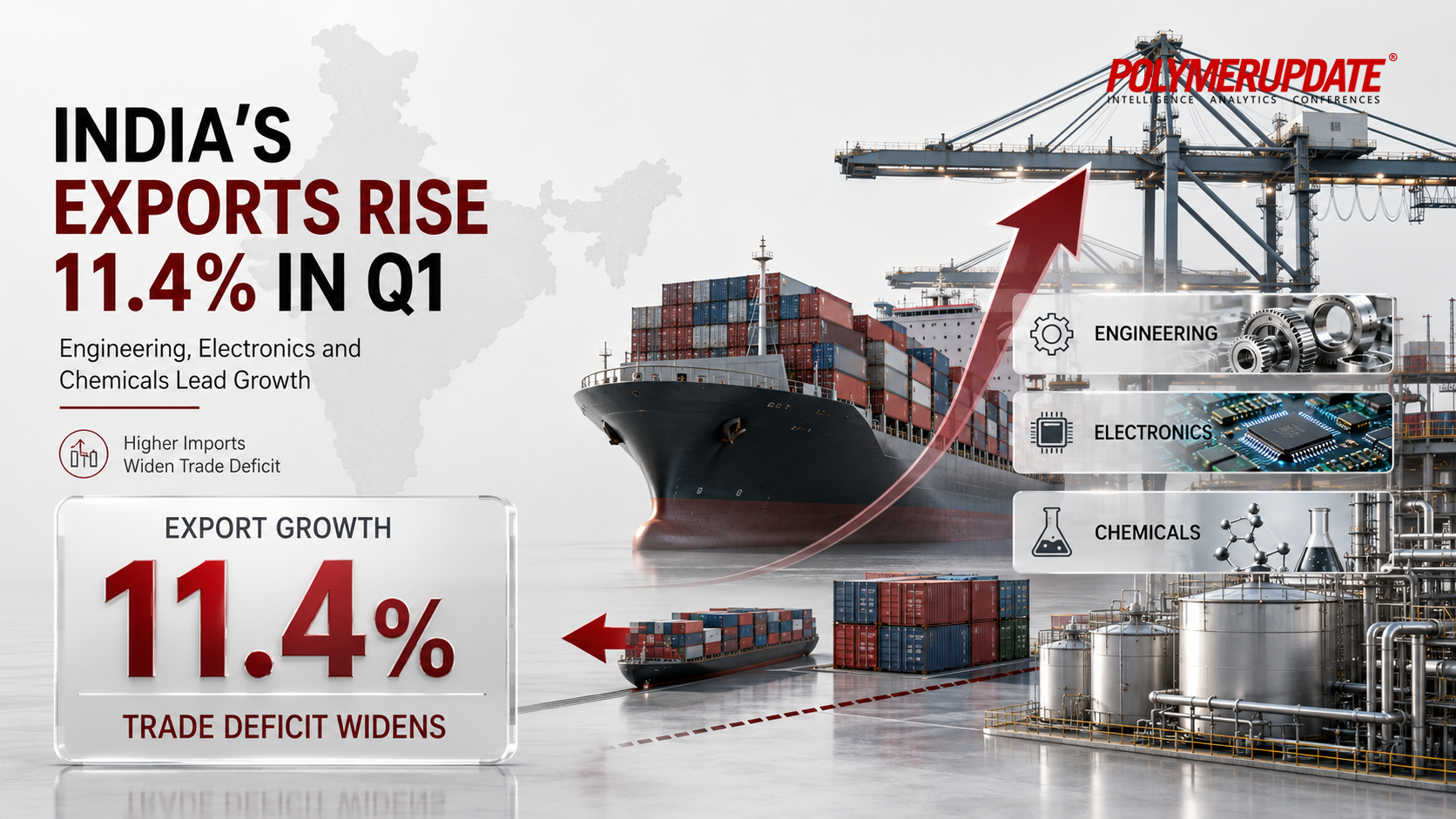
India’s exports maintained a strong growth momentum in the first quarter of FY2026-27, driven by robust performance in engineering goods, electronics, chemicals and gems and jewellery, even as a sharp rise in imports widened the country’s merchandise trade deficit amid higher crude oil prices and resilient domestic demand.
According to data released by the Ministry of Commerce and Industry on Sunday, the country's cumulative exports of merchandise and services during April-June FY2026-27 are estimated at US$ 232.73 billion, registering an 11.37 percent increase from US$ 208.98 billion in the corresponding period last year. Total imports during the quarter rose at a faster pace of 17.55 percent to US$ 270.15 billion, reflecting increased purchases of crude oil, intermediate goods and industrial raw materials.
The latest figures suggest that India's external sector has remained resilient despite global trade uncertainties, elevated geopolitical tensions in West Asia and volatile commodity prices. Strong domestic manufacturing activity, diversification of export markets and rising global demand for value-added products helped offset challenges posed by higher logistics and energy costs.
For June alone, India's combined merchandise and services exports were estimated at US$ 73.45 billion, up 9.48 percent from a year earlier. Total imports climbed 26.85 percent to US$ 88.76 billion, indicating sustained domestic demand and higher import bills, particularly for petroleum and industrial inputs.
 Double-digit growth in merchandise exports
Merchandise exports emerged as the key driver of overall trade during the first quarter. Outbound shipments rose 15.92 percent year-on-year to US$ 129.32 billion during April-June FY2026-27 from US$ 111.57 billion in the same period of the previous fiscal. Exports in June stood at US$ 40.41 billion, compared with US$ 34.98 billion in June 2025, underscoring the improving competitiveness of Indian manufacturers despite challenging global conditions.
Equally significant was the continued strength in non-petroleum exports. Cumulative non-petroleum exports increased 12.44 percent to US$ 106.30 billion during the April-June quarter from US$ 94.54 billion a year earlier, highlighting that export growth was broad-based rather than being driven solely by petroleum products. Non-petroleum and non-gems and jewellery exports—a closely watched indicator of underlying manufacturing strength—rose to US$ 99.04 billion during the quarter from US$ 87.88 billion in the corresponding period last year.
In June, these exports climbed to US$ 33.13 billion, compared with US$ 28.73 billion a year ago. The data indicate that sectors linked to manufacturing, engineering and technology continue to gain traction in overseas markets, supporting India's efforts to diversify its export basket.
Engineering goods, electronics and chemicals lead expansionEngineering goods remained India's largest export contributor, registering 20.74 percent growth in June to US$ 11.48 billion, up from US$ 9.51 billion a year earlier. The sustained expansion reflects healthy global demand for industrial machinery, transport equipment and fabricated metal products. Electronic goods also continued their remarkable growth trajectory, with exports increasing 18.93 percent to US$ 4.93 billion from US$ 4.14 billion in June 2025. The performance reinforces India's growing position in global electronics manufacturing under production-linked incentive (PLI) schemes.
Exports of organic and inorganic chemicals rose 19.42 percent to US$ 2.77 billion, while gems and jewellery shipments posted an impressive 34.64 percent jump to US$ 2.41 billion, suggesting improving international demand and easing inventory adjustments in major consuming markets. Rice exports increased 16.48 percent to US$ 1 billion, supported by steady overseas demand despite global concerns over food security and changing weather conditions. Several other sectors also recorded healthy growth during June, including other cereals, handicrafts, meat, dairy and poultry products, iron ore, plastics and linoleum, tobacco, marine products, petroleum products, drugs and pharmaceuticals, cotton textiles and processed food products.
Imports surge on higher energy and industrial demandWhile exports strengthened, imports grew even faster, reflecting India's expanding industrial activity and elevated crude oil prices. Merchandise imports during June increased to US$ 70.84 billion from US$ 54.08 billion in the corresponding month last year. During the April-June quarter, imports rose to US$ 216.18 billion, compared with US$ 180.31 billion a year earlier. Consequently, India's merchandise trade deficit widened to US$ 86.86 billion during the first quarter of FY 2026-27 from US$ 68.75 billion in the same period last year.
Non-petroleum and non-gems and jewellery imports reached US$ 140.22 billion during April-June, up from US$ 117.92 billion a year earlier, indicating stronger imports of machinery, industrial intermediates and capital goods required by the manufacturing sector. Among import categories, project goods, silver, pearls and precious stones, chemical materials and vegetable oils recorded declines during June, partly offsetting increases in petroleum-related imports.
Services continue to provide stabilityIndia's services sector continued to provide an important cushion to the country's overall external balance. Services exports during June were estimated at US$ 33.03 billion, compared with US$ 32.11 billion a year earlier. During April-June FY2026-27, services exports increased 6.16 percent to US$ 103.41 billion from US$ 97.41 billion in the corresponding period last year.
Services imports stood at US$ 53.97 billion during the quarter, resulting in a healthy services trade surplus of US$ 49.43 billion, marginally higher than US$ 47.90 billion recorded in the year-ago period.
The continued expansion of software, financial, business and professional services remains a critical strength for India's external sector, helping offset a substantial portion of the merchandise trade deficit.
New markets gain prominenceTrade data also pointed to India's continued success in diversifying export destinations beyond traditional developed markets. Among major destinations, exports to South Africa surged 114.04 percent in June, while shipments to Singapore increased 48.91 percent, China 31.49 percent, Oman 189.6 percent, and Malaysia 99.18 percent. For the April-June quarter, exports to Singapore more than doubled, while Tanzania, Sri Lanka, South Africa and China also recorded substantial increases, reflecting India's expanding commercial engagement across Asia and Africa.
On the import side, Russia remained India's fastest-growing major supplier, followed by China, the United States, the United Arab Emirates and Taiwan during June. During the quarter, imports from Oman and Brazil also recorded exceptionally strong growth, highlighting India's diversified sourcing strategy for energy and industrial commodities.
OutlookThe latest trade figures indicate that India's export sector has entered FY 2026-27 on a solid footing, supported by resilient manufacturing, expanding services exports and wider market diversification. However, the widening merchandise trade deficit underscores the challenges posed by elevated energy prices and robust domestic demand.
Going forward, export performance will depend on global economic growth, geopolitical developments in West Asia, crude oil price movements and demand conditions in major overseas markets. Nevertheless, continued strength in engineering goods, electronics, chemicals and value-added manufacturing, coupled with a stable services surplus, is expected to support India's external sector through the remainder of the fiscal year.
DILIP KUMAR JHA
Editor
dilip.jha@polymerupdate.com