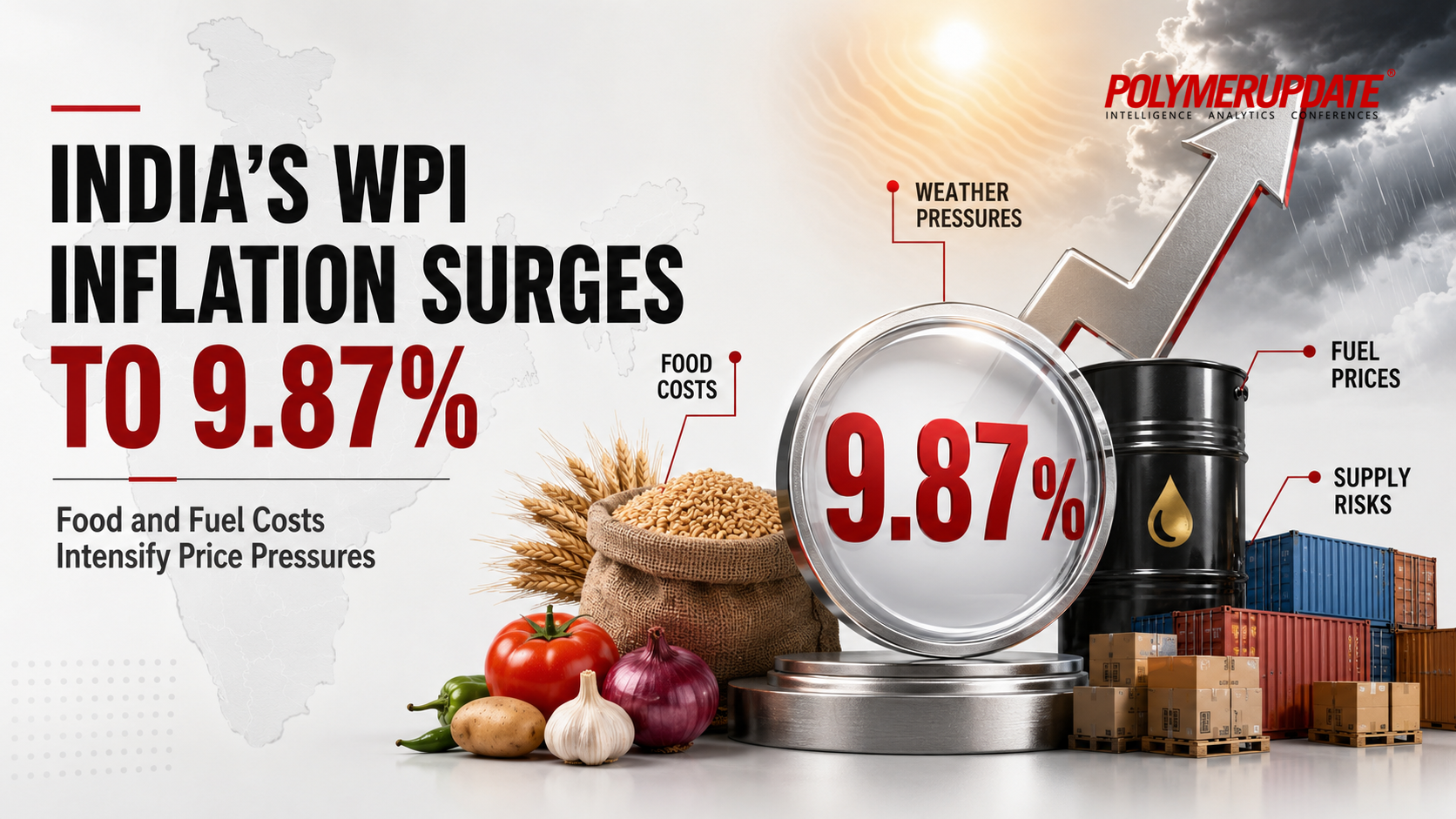
India’s Wholesale Price Index (WPI)-based inflation rose sharply to 9.87 percent in June, driven by a steep increase in the prices of food and minerals, primarily due to supply disruptions through the Strait of Hormuz caused by the ongoing geopolitical conflict in the Middle East. The increase reflects the sustained impact of the US-Iran conflict in West Asia and the effective blockade of the Strait of Hormuz, which disrupted India’s crude oil imports and had spillover effects on transportation fuels, energy products, and other non-energy commodities.
India’s WPI inflation stood at 9.68 percent in May 2026 and (-)0.13 percent in June 2025. The June reading is significant for two reasons. First, inflation has become more broad-based than before, indicating generalized price pressures across sectors. Second, it forms part of a steadily rising trend that began in November, when WPI inflation moved from negative territory to the current elevated level. Clearly, the period of low inflation appears to be over as geopolitical tensions in the Middle East have intensified, with both the United States and Iran exchanging missile strikes.
“Mineral Oils (containing Petroleum Products), Food Articles, Manufacture of Basic Metals, and Manufacture of Chemicals and Chemical Products were the major drivers of WPI inflation in June 2026,” the Ministry of Commerce and Industry said while releasing the WPI data on Tuesday. The Ministry uses 2022-23 as the base year for calculating the WPI. Although WPI data does not directly influence the monetary policy framework of either the Government or the Reserve Bank of India (RBI), it remains significant because of its lagged impact—typically over two to three months—on Consumer Price Index (CPI)-based inflation.
Rajani Sinha, Chief Economist at Care Ratings Ltd, said, “India’s WPI inflation rose to 9.9 percent in June from 9.7 percent in the previous month, on account of an uptick in inflation in primary articles. Food prices have shown an increase, with heatwaves across several regions and a delayed monsoon likely exerting upward pressure on food prices. Although inflation in the fuel and power category moderated following the recent correction in global energy prices, it remained at elevated levels, limiting the extent of the easing in overall WPI inflation.”
 Food inflation
Wholesale inflation in food articles accelerated sharply to 5.49 percent in June, compared with 3.60 percent in May, reflecting rising price pressures across key agricultural commodities. Food price inflation has been on an upward trajectory since November 2025, reaching a 17-month high of 5.49 percent in June 2026, driven by both the base effect and the impact of El Niño. Meanwhile, wholesale food inflation, which includes both primary and manufactured food items, climbed to 6.14 percent in June 2026, up from 4.49 percent in the previous month, indicating a broad-based increase in food prices.
The rise in food inflation was largely in line with economists' expectations, as below-normal monsoon rainfall during the early part of the season disrupted crop prospects and tightened supply conditions. Concerns were further amplified by forecasts of a deficient monsoon for the full season due to the emergence of El Niño, raising the risk of sustained upward pressure on food prices in the coming months. However, the situation is expected to be better this year than during previous El Niño episodes, supported by higher reservoir levels and comfortable foodgrain buffer stocks.
Moreover, historical trends indicate that not every El Niño year has resulted in a significant surge in food inflation. The eventual impact on food prices will largely depend on the effectiveness of government supply-side measures, including the timely release of buffer stocks and import policies, as well as the spatial and temporal distribution of monsoon rainfall across key agricultural regions. Effective policy intervention and well-distributed rainfall could help mitigate inflationary pressures despite an overall deficient monsoon.
Non-food inflationFuel and power inflation moderated to 27.41 percent in June from a peak of 30.33 percent in May 2026, marking the first decline since February 2026. The moderation was driven by lower prices of crude oil, petroleum products, natural gas, and mineral oils following the temporary easing of the West Asia conflict in June. Inflation in the electricity segment also softened for the second consecutive month, despite elevated summer demand. Meanwhile, inflation in manufactured products remained unchanged at 7.48 percent, as higher food product prices offset the impact of lower crude oil prices. Inflation in textiles continued its upward trajectory, while chemicals and chemical products recorded a moderation in price growth.
WPI inflation continued to be heavily influenced by the conflict in West Asia, with fuel-related categories—including mineral oils, gas, and fuel products—recording elevated price increases. Inflation in the fuel and power category stood at 27.4 percent, highlighting the sharp rise in input costs for user industries. These higher energy costs also spilled over into the manufacturing sector, where inflation for chemicals and chemical products rose 12.8 percent, while rubber and plastic products recorded inflation of 9.9 percent. Textile inflation also remained elevated as higher chemical input costs continued to push up production expenses.
Metal products registered inflation of 12.3 percent, broadly in line with trends in global commodity markets. A similar pattern was observed in electrical machinery. Primary articles inflation remained elevated at around 7 percent, with both food and non-food articles recording significant price increases. Within food articles, vegetables, fruits, eggs, meat and fish, and spices were the key contributors to inflation, with prices of spices surging by 22 percent year-on-year.
Domestic supply disruptionsPart of the increase in prices can be attributed to the heavy rainfall toward the end of the month, which disrupted supplies. Among non-food articles, fibres and oilseeds recorded inflation of more than 20 percent each. The sharp rise in oilseed prices reflected higher global edible oil prices, while the increase in fibre prices was driven by supply constraints amid strong demand, with exports also contributing to the upward price movement.
Madan Sabnavis, Chief Economist at Bank of Baroda, said, “While WPI inflation was expected to moderate following the signing of the peace treaty, the resumption of the conflict and renewed turmoil in the oil market could keep inflationary momentum elevated. Crude oil prices had fallen to the low US$70s per barrel after the peace accord. However, with prices now crossing the US$ 80 per barrel mark, it appears unlikely that any administrative measures will be taken to cool prices, and the status quo on domestic fuel prices is expected to continue for some time. Consequently, WPI inflation is likely to remain in the 9-10 percent range over the next couple of months. Much will also depend on the progress of the monsoon and the outcome of the kharif crop.”
OutlookGoing forward, the trajectory of fuel and power inflation will continue to depend on developments in global energy markets and the evolving geopolitical situation. In line with WPI inflation, output Producer Price Index (PPI) inflation also edged up marginally to 9.6 percent in June from 9.4 percent in May. Looking ahead, the inflation outlook remains subject to risks arising from external uncertainties and weather-related disruptions.
The US-Iran Memorandum of Understanding (MoU), signed in mid-June, provided short-term relief to global energy markets. However, recent flare-ups have renewed geopolitical concerns, leading to increased volatility in Brent crude oil prices. On the domestic front, inflation risks stem from below-normal rainfall and the growing likelihood of El Niño strengthening during the second half of the monsoon season. Food prices—particularly those of vegetables, pulses, and edible oils—remain the most vulnerable to weather-related disruptions and warrant close monitoring. Taking these factors into account, India’s WPI inflation is forecast to average around 7 percent in FY 2026-27.
DILIP KUMAR JHA
Editor
dilip.jha@polymerupdate.com