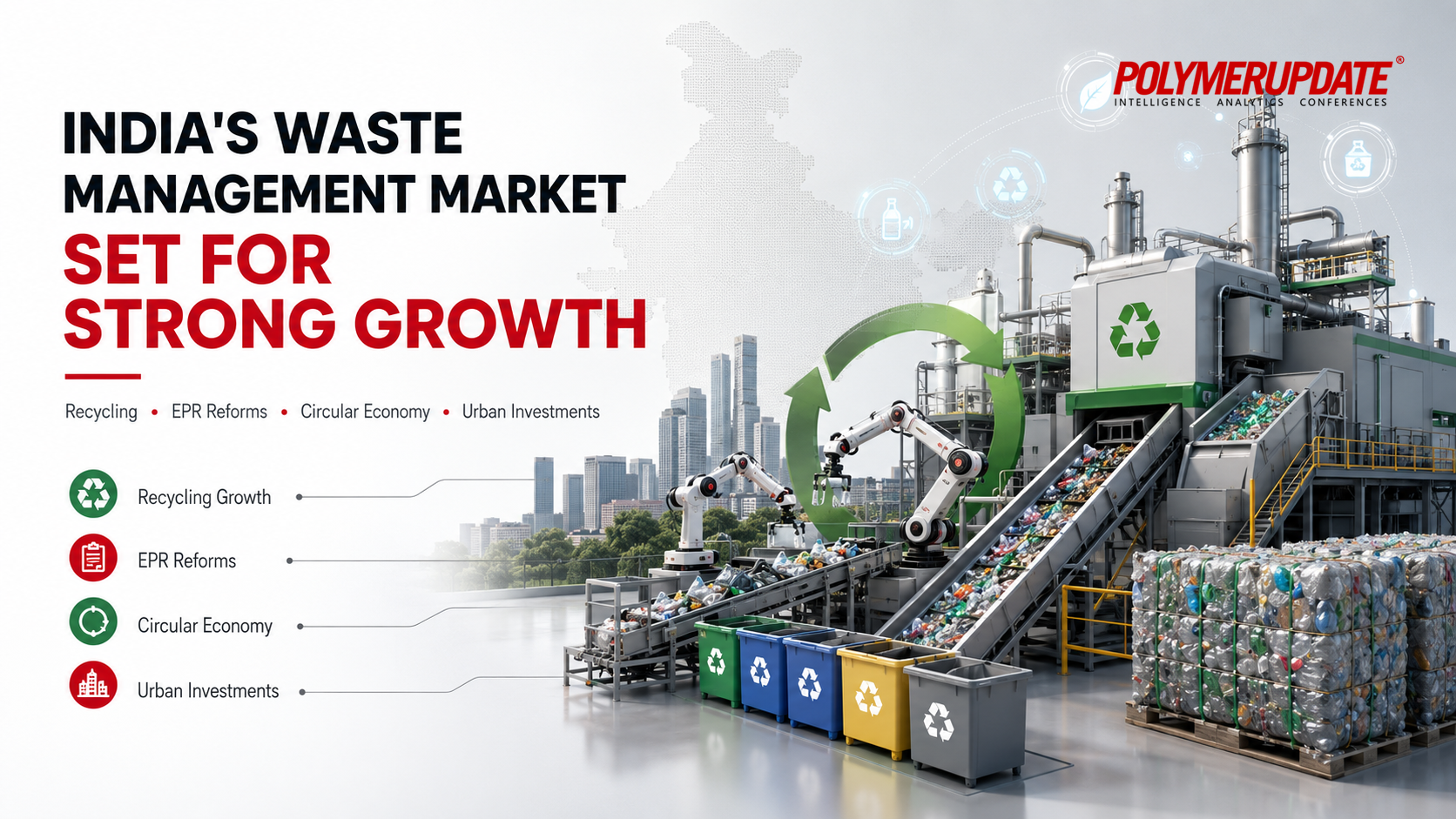
India's waste management sector is poised for steady expansion over the next five years, driven by stronger government regulations, rising investments in urban infrastructure, and an increasing shift towards a circular economy. According to a study by Mordor Intelligence, the Indian waste management market, valued at US$ 13.58 billion in 2025, is projected to grow to US$ 18.94 billion by 2031, registering a compound annual growth rate (CAGR) of 5.8 percent during 2026-2031.
The projected growth reflects a structural transformation in the country's waste ecosystem as policymakers tighten environmental regulations, expand municipal funding, and strengthen Extended Producer Responsibility (EPR) obligations for manufacturers and brand owners. Together, these measures are expected to accelerate investments in collection infrastructure, recycling technologies, and resource recovery while reducing dependence on landfills.
 Growing government’s focus
Industry analysts attribute much of the sector's momentum to strong regulatory support. Capital grants released under the 15th Finance Commission, amendments to the Plastic Waste Management Rules, and the implementation of the National Circular Economy Framework 2025 are encouraging municipalities and private companies to modernize waste collection, improve segregation, and increase recycling capacity.
At the same time, growing corporate responsibility for post-consumer waste is prompting manufacturers to secure long-term partnerships with organized recyclers. Companies are increasingly investing in recycling infrastructure and resource recovery systems to meet stricter compliance targets while reducing their dependence on virgin raw materials.
Operational headwindsDespite the favourable outlook, the sector continues to grapple with significant operational challenges. Low household waste segregation, delays in land acquisition for waste processing facilities, litigation involving waste-to-energy projects, and volatile carbon credit prices continue to affect project viability and profitability. Industry experts believe companies capable of securing long-term municipal contracts, deploying automation, and monetizing recycled materials through EPR credits will emerge as market leaders.
The study highlights significant shifts across various market segments. Residential waste remained the largest contributor, accounting for 48.83% of market revenue in 2025. However, the commercial segment is expected to outpace all others, expanding at an 8.6% CAGR through 2031, supported by rapid growth in organized retail, commercial real estate, logistics parks, and corporate campuses.
Within service categories, collection, transportation, sorting, and segregation accounted for 38.76% of total market revenue in 2025. However, recycling and resource recovery are projected to emerge as the fastest-growing segment, recording an 8.5% CAGR during the forecast period as higher commodity prices, EPR compliance, and improved recycling technologies make material recovery increasingly attractive.
Municipal solid waste leadsMunicipal solid waste continued to dominate India's waste stream, representing 57.3% of the market in 2025, while e-waste is forecast to grow at a 7.4% CAGR through 2031 amid increasing electronics consumption and stricter recycling mandates. Regionally, West India accounted for 26.76% of market revenue in 2025 owing to its dense urban population and established waste management infrastructure. North India is expected to register the fastest growth, expanding at a 6.5% CAGR through 2031 as cities accelerate investments in integrated waste processing and recycling facilities.
A major growth catalyst remains the financial support extended under the 15th Finance Commission, which has unlocked nearly US$ 18 billion for municipal solid waste management. The funding is enabling local bodies to procure collection vehicles, mechanized sweepers, transfer stations, and material recovery facilities while accelerating public-private partnership projects in cities such as Mumbai, Delhi, and Indore.
Performance-linked fundingPerformance-linked funding conditions requiring improved segregation and landfill diversion are also encouraging municipalities to adopt digital monitoring systems. Although land acquisition delays limited initial utilization of available funds, the programme is expected to contribute significantly to near-term market growth by improving collection efficiency and expanding processing capacity.
Another important policy driver is the National Circular Economy Framework 2025, which requires companies with annual turnover exceeding Rs 500 crore to recycle at least 30% of packaging waste and 50% of electronic products by 2028. Vehicle manufacturers have also been assigned stringent battery recovery obligations, with recovery targets reaching 95% of battery mass.
The framework has encouraged companies to enter multi-year supply agreements with organized recyclers to ensure compliance and hedge against fluctuations in virgin polymer prices. Industry observers believe successful implementation will depend on adequate certified recycling capacity and consistent enforcement, but the framework nevertheless establishes a clear roadmap for increasing recycling rates across industries.
Plastic wasteThe Plastic Waste Management Amendment Rules 2024 are also reshaping the market by tightening enforcement against non-compliant producers and introducing higher recycled-content requirements for packaging materials. Pollution control boards in several states have begun imposing penalties on companies failing to meet their obligations, resulting in larger volumes of post-consumer plastic entering formal recycling channels.
Standardized EPR credit audits supervised by the Central Pollution Control Board are creating an emerging market for plastic recycling certificates while improving transparency within the recycling ecosystem. Although implementation remains uneven in rural areas due to inadequate collection infrastructure, stronger enforcement in urban centres is steadily improving recovery rates.
EPR for EVsIndia's rapidly expanding electric vehicle market is creating another high-value opportunity through the implementation of FAME-III Battery EPR Rules. Effective from April 2025, EV manufacturers must recover 90% of battery capacity within seven years of sale. Approximately 50 GWh of lithium-ion batteries are expected to reach end-of-life by 2026, creating a substantial supply of valuable metals such as lithium, cobalt, and nickel for licensed recyclers.
Vehicle manufacturers have already initiated battery take-back programmes through dealership networks, while specialized recyclers continue investing in advanced metal recovery technologies. Although challenges related to fire safety, transportation, and non-standardized battery designs remain, the high intrinsic value of battery materials is expected to support attractive profit margins.
Nevertheless, India's waste management ambitions continue to face a major obstacle in the form of poor waste segregation at source. Mandatory household segregation into wet, dry, and hazardous waste categories remains largely ineffective, with national segregation rates remaining below 35% during 2025.
Poor public awareness, inconsistent enforcement, and uneven door-to-door collection continue to reduce the quality of recyclable material while increasing contamination costs for recyclers and composting facilities. Although some municipalities have introduced incentive-based programmes, including property tax rebates for households practicing segregation, these initiatives have yet to achieve nationwide scale.
Emerging commercial waste segmentCommercial waste, meanwhile, is emerging as one of the most attractive opportunities for private waste management companies. Expanding shopping malls, office complexes, logistics parks, and industrial clusters are generating larger, more predictable waste streams supported by long-term service contracts that offer significantly higher margins than residential waste collection.
Technology adoption is also improving operational efficiency within commercial waste collection. RFID-enabled bins, GPS-connected compactor trucks, automated route optimization, and on-site segregation facilities are reducing transportation costs while improving the quality of recyclable materials delivered to downstream processors. Industry participants continue expanding their commercial portfolios through long-term contracts with retail chains, business parks, hospitals, and educational institutions.
Waste collection and transportationWhile collection and transportation continue to account for the largest share of industry revenues, the future value creation is increasingly shifting toward recycling and resource recovery. Organized recyclers are investing in artificial intelligence-based optical sorting systems, robotic dismantling technologies, advanced mechanical recycling, and lithium-ion battery recycling facilities to maximize material recovery and improve profitability.
The recycling of electric vehicle batteries alone is expected to generate substantial new revenue streams as battery retirement volumes increase over the coming years. High recovery rates for critical minerals further strengthen the commercial viability of battery recycling while supporting India's broader objective of reducing dependence on imported raw materials. Beyond government initiatives and private investments, community participation is also playing an increasingly important role in strengthening India's waste management ecosystem. Grassroots initiatives are helping improve public awareness, increase collection efficiency, and integrate informal waste collectors into organized recycling networks.
Sectoral initiativesOne notable example is Sambhav Foundation's "My Village, My Responsibility" initiative, which has engaged nearly 600 stakeholders, including waste collectors, scrap dealers, retailers, village leaders, and government representatives. The programme has conducted awareness campaigns across five villages and facilitated the collection of approximately three tonnes of thermocol waste through a community-led recovery network, demonstrating how local participation can complement national policy efforts.
As India continues its transition towards a circular economy, the combined impact of supportive government policies, expanding recycling infrastructure, technological innovation, corporate responsibility, and community participation is expected to reshape the country's waste management landscape. While challenges surrounding segregation, infrastructure, and project execution remain, the sector's long-term fundamentals remain strong, positioning waste management as one of India's fastest-evolving environmental and infrastructure industries over the remainder of the decade.
DILIP KUMAR JHA
Editor
dilip.jha@polymerupdate.com