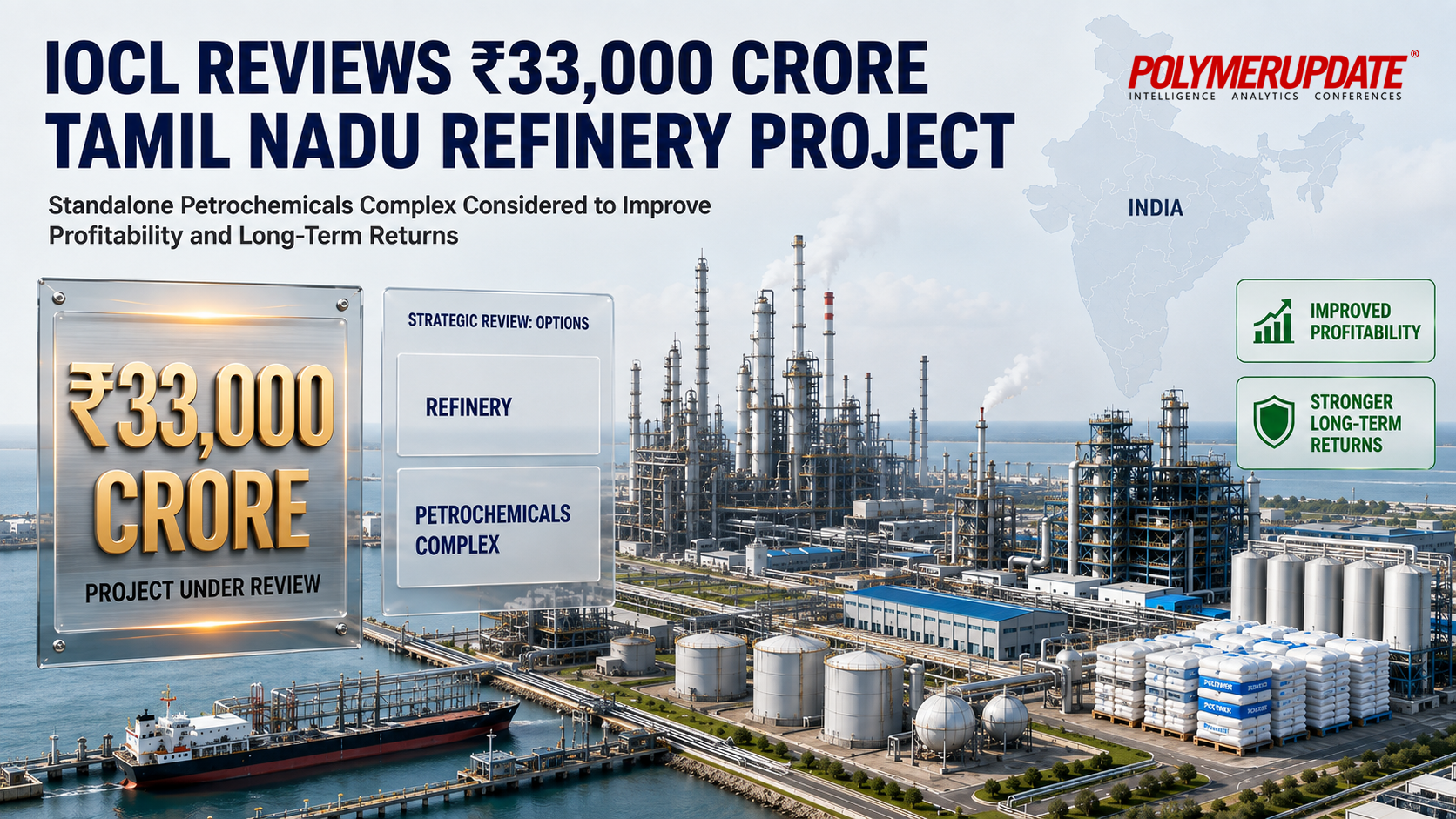
Indian Oil Corporation Ltd (IOCL) is reassessing its proposed 9 million tonne per annum (MTPA) greenfield refinery project in Tamil Nadu with a total capital expenditure (capex) proposal of Rs 33,000-crore. This signals a broader shift in India's downstream hydrocarbon investment strategy as state-run refiners increasingly prioritise high-value petrochemicals over conventional fuel refining. The move reflects changing market dynamics, where slowing growth in transport fuel demand, rising capital costs and the need for stronger returns on investment are prompting refiners to rethink large standalone refinery projects.
According to industry sources, the country's largest oil marketing and refining company is conducting an internal review of the proposed 9 MTPA refinery at Nagapattinam in Tamil Nadu after concerns emerged over the project's long-term commercial viability. As part of the reassessment, Indian Oil is exploring the possibility of replacing the refinery with a standalone petrochemicals complex that could offer higher profitability with comparatively lower investment requirements.
 Board approval five year ago
The proposed refinery was originally approved by Indian Oil's board in January 2021 with an estimated investment of Rs 29,361 crore. The project was planned as a joint venture in which Indian Oil and Chennai Petroleum Corporation Ltd. (CPCL) would each hold a 25 percent stake, while the remaining 50 percent would be owned by financial institutions. The refinery was envisioned as a key addition to India's refining capacity, supporting growing energy demand in southern India while enhancing fuel supplies for domestic and export markets.
However, the project's economics have undergone significant reassessment over the past few years. In March 2024, Indian Oil revised the project cost upward to Rs 33,023 crore, reflecting inflationary pressures, rising engineering and construction expenses, and changes in project configuration. Simultaneously, the company approved a revised ownership structure under which Indian Oil would increase its stake in the joint venture to 75 percent, while CPCL would retain the remaining 25 percent. The land required for the project has already been acquired, eliminating one of the major hurdles that typically delay large industrial investments.
Financial challengesDespite the revised ownership structure, the project has continued to face financial challenges. Sources indicated that Indian Oil had sought financial assistance from the Central Government to improve the project's viability, but the request did not receive approval. Without government support, the economics of developing a standalone greenfield refinery have become increasingly difficult, particularly in an environment characterised by volatile crude oil prices, uncertain fuel demand growth and tightening margins.
Industry experts note that the refining sector is undergoing a structural transformation worldwide. While demand for transportation fuels such as petrol and diesel is expected to continue growing in emerging economies, the pace of growth is projected to moderate over the coming decades as electric mobility expands, fuel efficiency improves and governments strengthen decarbonisation policies. These trends have prompted refiners globally to focus on integrated refining and petrochemicals operations that generate higher-value products and provide more stable earnings.
To focus on petrochemicalPetrochemicals, which are used as raw materials for plastics, synthetic fibres, packaging materials, consumer goods, automobiles and construction products, are expected to remain one of the fastest-growing segments of the hydrocarbon industry. Rising urbanisation, expanding manufacturing activity and increasing consumption of packaged goods continue to support robust demand for petrochemical products even as transportation fuel growth gradually slows.
Industry executives believe that a standalone petrochemicals complex could provide Indian Oil with a stronger long-term investment proposition than a conventional refinery. Such a facility would require comparatively lower capital expenditure while generating better margins through the production of high-value chemical feedstocks and specialty products. The strategy also aligns with the broader trend among global energy companies to maximise the conversion of crude oil into petrochemical products rather than transportation fuels.
Dependence on govt investmentLarge greenfield refinery projects also generally depend on substantial government support to remain financially viable. Such support often comes in the form of tax concessions, subsidised land, infrastructure assistance or fiscal incentives from either the Central or state governments. Without these benefits, the extended construction periods and long payback cycles associated with refinery projects can significantly weaken investment returns.
The changing investment landscape is evident across India's public sector refining industry. Bharat Petroleum Corporation Ltd. (BPCL) is proceeding with its proposed 9-11 MTPA greenfield refinery-cum-petrochemicals complex in Andhra Pradesh. The project, estimated to cost around Rs 1 lakh crore, has received a comprehensive incentive package from the Andhra Pradesh Government, substantially improving its commercial attractiveness. The proposed project is also expected to see participation from Saudi Aramco, strengthening its financial and technical capabilities while enhancing India's strategic energy partnership with the Middle East.
Similarly, Hindustan Petroleum Corporation Ltd. (HPCL) recently commissioned its integrated 9 MTPA refinery-cum-petrochemicals complex at Pachpadra in Rajasthan. The project represents one of India's largest integrated downstream investments and reflects the growing preference for combining refining with petrochemical production to enhance profitability and improve feedstock flexibility. The reassessment of the Nagapattinam project therefore appears consistent with the evolving strategic direction of India's refining sector. Rather than expanding refining capacity alone, public sector companies are increasingly seeking integrated value chains that enable greater production of petrochemical intermediates and specialty chemicals.
India-the fastest growing petrochemical marketIndia remains one of the world's fastest-growing markets for petrochemicals, supported by rising incomes, rapid industrialisation and expanding domestic manufacturing under the government's production-linked incentive and Make in India initiatives. Demand for polymers, packaging materials, engineering plastics and synthetic materials is expected to rise steadily over the coming years, creating significant opportunities for domestic producers to reduce import dependence and strengthen value addition within the country.
For Indian Oil, the final decision on the Tamil Nadu project will likely depend on the outcome of the ongoing economic assessment and future market conditions. While no formal announcement has yet been made regarding a change in project scope, the review underscores the increasing importance of commercial sustainability in large energy investments. Should the company ultimately opt for a standalone petrochemicals complex, it would mark another significant milestone in India's transition towards a more integrated and value-added downstream petroleum industry, where petrochemicals are expected to play an increasingly central role in future growth.
DILIP KUMAR JHA
Editor
dilip.jha@polymerupdate.com