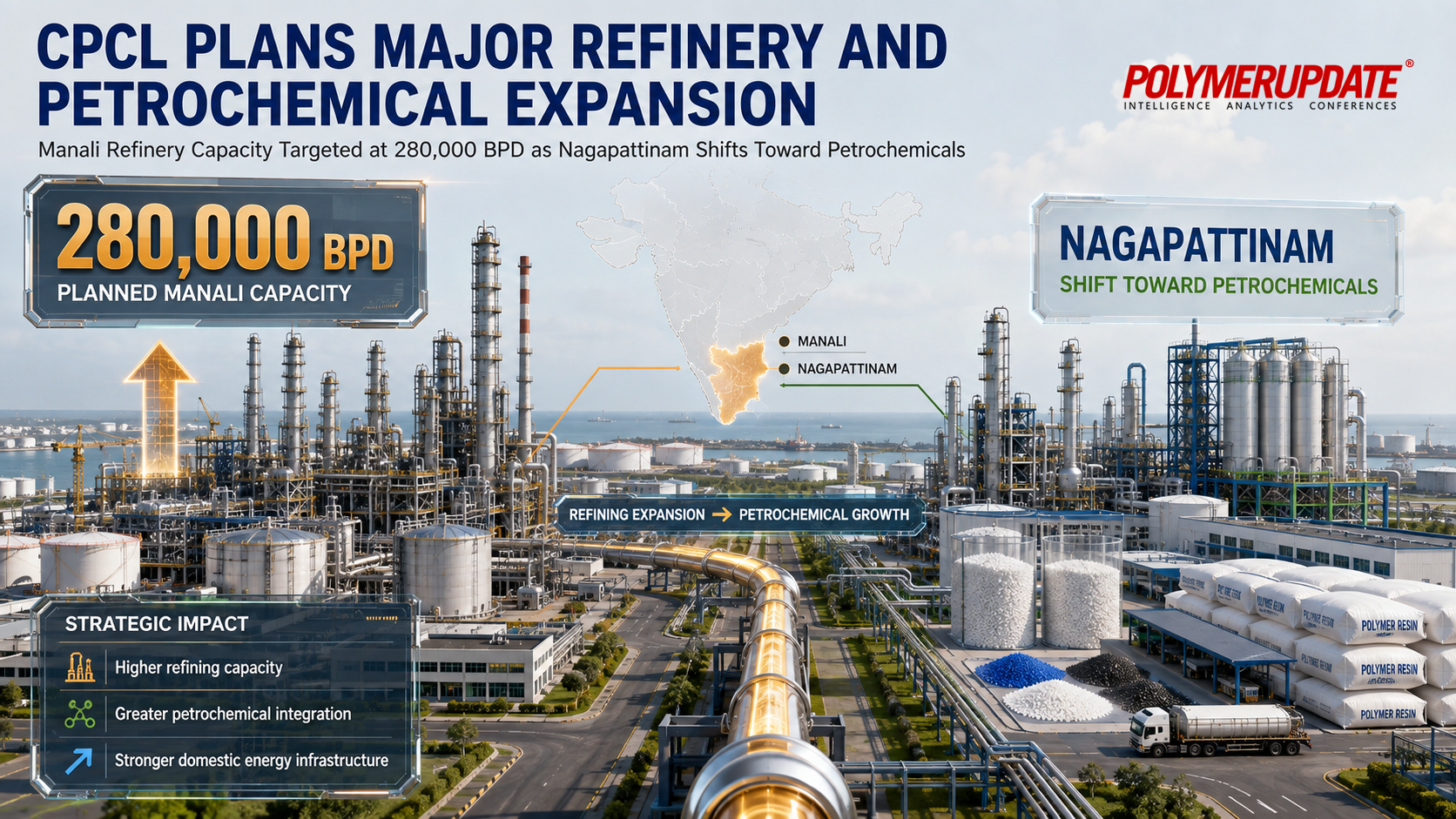
Chennai Petroleum Corporation Ltd (CPCL), the refining subsidiary of the public sector Maharatna Indian Oil Corporation Ltd (IOCL), is set to significantly expand its flagship Manali refinery in Tamil Nadu, underscoring India's continuing push to strengthen domestic fuel production while simultaneously repositioning future investments towards higher-value petrochemicals. CPCL said in its annual report 2025-26, the company plans to raise the crude processing capacity of its Manali refinery by one-third, from the current 210,000 barrels per day (bpd) to 280,000 bpd.
Although the company has not announced a timeline or investment outlay for the expansion, the proposal reflects its long-term strategy of enhancing refining capabilities while integrating downstream petrochemical production. The planned expansion comes at a time when India is emerging as one of the world's fastest-growing refining centres, driven by rising domestic demand for transportation fuels, petrochemical feedstocks and industrial products. With fuel consumption continuing to expand alongside economic growth, refiners are increasingly investing in capacity additions and refinery modernisation to reduce import dependence and improve product flexibility.
 An important refining asset
Located in Chennai, the Manali refinery is among southern India's important refining assets and produces a broad basket of petroleum products, including petrol, diesel, aviation turbine fuel, liquefied petroleum gas (LPG), lubricants, paraffin wax, specialty products and petrochemical feedstocks. The facility serves key markets across southern India and supports industrial demand in one of the country's largest manufacturing regions.
The proposed expansion is expected to improve economies of scale, enhance operational efficiency and enable CPCL to meet rising regional demand for transportation fuels and industrial raw materials. Larger refining capacity would also provide greater flexibility in processing different grades of crude oil while improving the company's competitiveness in domestic and export markets.
The Manali expansion gains additional significance in light of CPCL's strategic shift at its other major project in Tamil Nadu. The company had earlier operated the Cauvery Basin Refinery (CBR) at Nagapattinam, but the ageing refinery was decommissioned in 2019 because its existing configuration was unable to economically comply with increasingly stringent fuel quality specifications. Initially, CPCL had proposed rebuilding the Nagapattinam refinery as a modern refining complex. However, following a comprehensive review, the company and its parent, Indian Oil Corporation, decided to realign the project's priorities in favour of petrochemicals.
Increasing stakeEarlier this year, Indian Oil restructured the proposed project, increasing its stake to 75 percent, while CPCL retained the remaining 25 percent. Instead of focusing primarily on refining, the project will now be developed as a petrochemicals complex with significantly higher petrochemical intensity. CPCL said in its annual report that the Cauvery project would be reconfigured to enhance petrochemical production, reflecting changing market dynamics where demand for chemicals and specialty products is growing much faster than consumption of conventional transport fuels.
The strategic pivot mirrors a broader transformation taking place across the global refining industry. As electric mobility, fuel efficiency improvements and decarbonisation policies gradually moderate long-term fuel demand growth, refiners worldwide are increasingly integrating petrochemical production into their operations to improve profitability and diversify revenue streams. India, however, presents a different growth trajectory. Rapid urbanisation, industrialisation, infrastructure development and rising incomes continue to support robust demand for transportation fuels even as petrochemical consumption expands at an even faster pace.
This dual demand profile has encouraged refiners to simultaneously expand refining capacity while increasing production of petrochemical feedstocks and value-added chemical products. Industry analysts believe integrated refinery-petrochemical complexes offer significantly higher returns compared with conventional standalone refineries. Such facilities enable refiners to convert a larger proportion of crude oil into high-value petrochemicals, including polypropylene, polyethylene and specialty chemicals, reducing exposure to fluctuations in transportation fuel margins.
Focus on downstream value additionThe expansion of the Manali refinery, coupled with the petrochemical-focused redevelopment of the Nagapattinam project, illustrates CPCL's evolving strategy of balancing conventional fuel production with higher-margin downstream businesses. The company's plans also align with India's broader energy investment trends. According to the International Energy Agency's (IEA) World Energy Investment 2026 report, oil refining and solar power are expected to remain the two largest contributors to India's energy investments over the coming years.
The IEA noted that India's total energy investment has grown at an average annual rate of 11 percent over the past five years. During the same period, investment in solar photovoltaic projects increased by around 25 percent, while investment in oil refining rose by 23 percent, highlighting the country's parallel focus on energy transition and conventional energy infrastructure. Together, these two sectors have accounted for nearly one-fourth of India's overall growth in energy investment, reflecting the government's strategy of expanding renewable energy without compromising energy security or fuel availability.
The global energy watchdog also projects that sustained investment in refining will place India on track to expand its refining capacity by approximately 15 percent by 2030, strengthening the country's position as one of Asia's major refining hubs. India already ranks among the world's largest refining centres, with state-owned refiners, including Indian Oil, Bharat Petroleum Corporation Ltd and Hindustan Petroleum Corporation Ltd, alongside private sector majors Reliance Industries Ltd and Nayara Energy, pursuing capacity expansions and technology upgrades to meet rising domestic consumption and export opportunities.
OutlookFor CPCL, the Manali expansion represents more than a capacity enhancement. It forms part of a broader strategy aimed at improving refinery complexity, increasing operational flexibility and positioning the company for changing energy markets where integrated refining and petrochemicals are expected to drive future profitability.
While the company has yet to disclose implementation schedules or investment details for the Manali expansion, the proposal reinforces the long-term confidence of Indian refiners in domestic demand growth. Combined with the transformation of the Nagapattinam project into a petrochemicals hub, CPCL is seeking to build a more diversified downstream portfolio capable of supporting India's expanding energy and manufacturing sectors over the coming decades.
DILIP KUMAR JHA
Editor
dilip.jha@polymerupdate.com