The Reserve Bank of India (RBI) on Wednesday kept the key policy repo rate unchanged for the third consecutive time due to prevailing uncertainty over global economic growth stemming from the ongoing US-Iran conflict in the Middle East and disruptions to merchant vessel movement through the key maritime passage—the Strait of Hormuz. Supply disruptions have kept energy prices elevated, thereby sustaining inflationary pressures. However, resilient domestic demand, coupled with optimism over strong export growth driven by the large number of Free Trade Agreements (FTAs) signed in recent years, is expected to continue supporting India's economic expansion this year.
The decision was taken unanimously at the three-day Monetary Policy Committee (MPC) meeting held from August 3 to 5 to assess the current economic and financial situation and the future outlook. With the latest pause, the repo rate under the Liquidity Adjustment Facility (LAF) remains at 5.25 percent. Consequently, the Standing Deposit Facility (SDF) rate will remain unchanged at 5.0 percent, while the Marginal Standing Facility (MSF) rate and the Bank Rate will continue at 5.5 percent. The MPC also decided to retain the neutral policy stance for now.
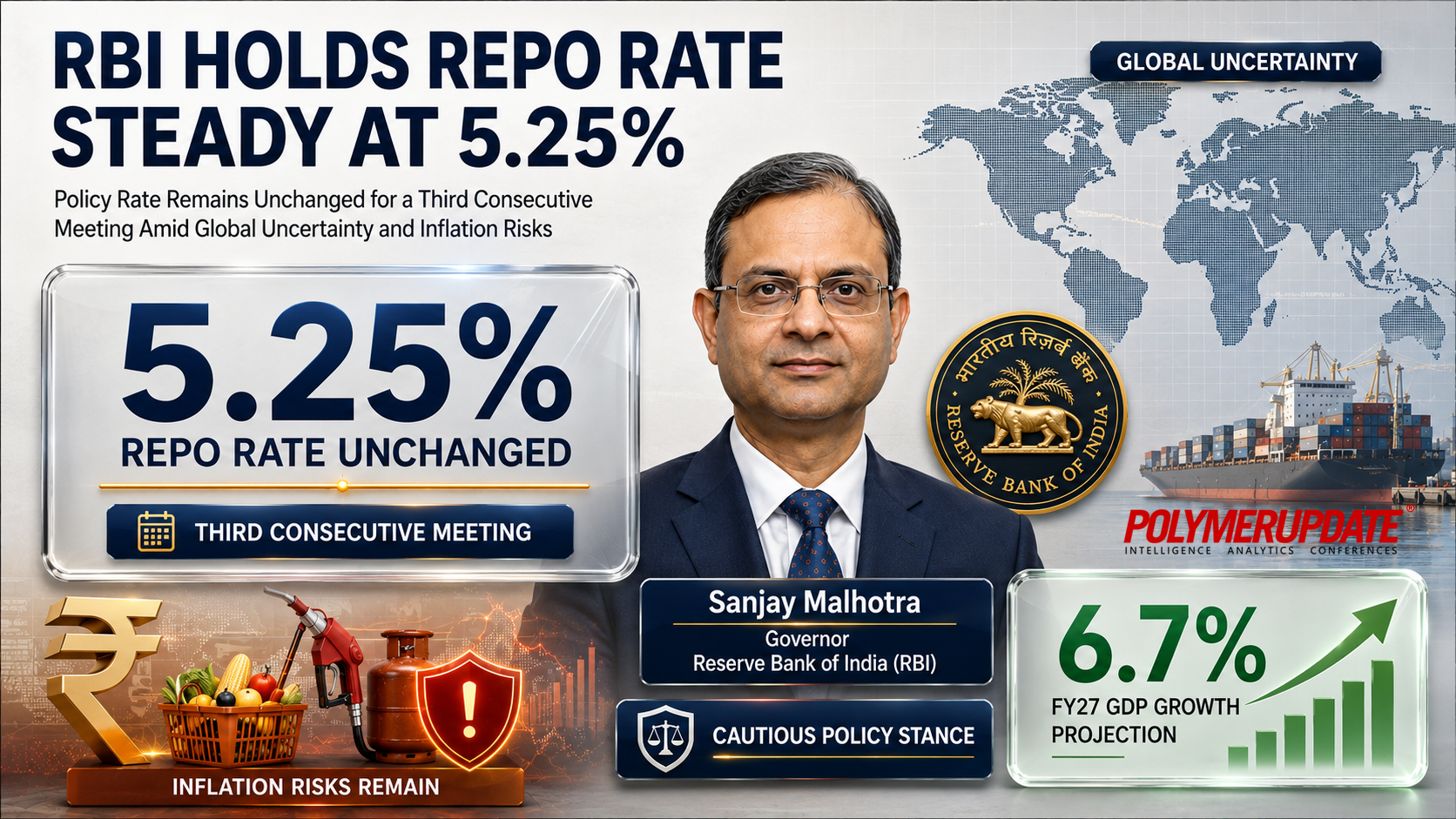
Announcing the policy decision, RBI Governor Sanjay Malhotra said, “In this global backdrop, the MPC met for its third bi-monthly meeting of the financial year 2026-27 to deliberate and decide on the policy repo rate. After a detailed assessment of the evolving macroeconomic and financial developments and the outlook, the MPC decided unanimously to keep the policy repo rate under the Liquidity Adjustment Facility (LAF) unchanged at 5.25 percent. The MPC also decided to continue with the neutral stance.”
Commenting on the policy, Dharmakirti Joshi, Chief Economist at Crisil Ltd, said, “The MPC stayed with the consensus on both rates and stance. In terms of the growth-inflation mix, there is a marginal improvement compared with the June forecast, with growth now projected to be 10 basis points higher and inflation 10 basis points lower. While retail inflation, as measured by the Consumer Price Index (CPI), moved above the 4 percent mark in June, the increase was largely supply-driven, led by higher crude oil and commodity prices and supported by a weak base effect. At the same time, India’s economic growth has remained reasonably resilient, supported by healthy domestic demand and strong corporate and banking sector balance sheets.”
The rationaleThe West Asia conflict continues to challenge the global economy by disrupting key trade routes and supply chains, amplifying market volatility, and dampening business sentiment. Trade uncertainty persists as the US has imposed fresh tariffs. The global economic environment has become increasingly unstable. Global growth is projected to soften, while inflation is forecast to be higher in 2026 than in the previous year. Some central banks have tightened monetary policy, while others remain vigilant. Crude oil prices, currencies, and financial markets remain volatile, fluctuating in line with the changing intensity of, and uncertainties surrounding, the West Asia conflict.
The MPC noted that headline CPI inflation edged above the target, as expected. However, realised inflation for the April-June quarter remained marginally lower than projected, reflecting the limited pass-through of cost pressures. The rise in inflation has been driven largely by fuel and food prices, with little evidence so far of broader price pressures becoming entrenched. Core inflation, excluding precious metals, continues to remain benign. As projected earlier, headline inflation is expected to rise further in the near term and peak in the October-December 2026 quarter, primarily due to food and fuel prices, before moderating thereafter.
Underlying inflation, as reflected in core inflation excluding precious metals, has remained benign for some time and is expected to converge with headline inflation towards the end of the financial year. Meanwhile, economic growth continues to be supported by resilient domestic demand, sustained expansion in manufacturing and services activity, and robust exports, reaffirming India's position as the world's fastest-growing major economy.
Economic growth projectionsThe supply-side pressures caused by the West Asia conflict have eased somewhat since June 2026, leading to the withdrawal of temporary measures undertaken by the government and the normalisation of key input supplies. However, the re-escalation of the conflict since the first week of July has amplified volatility in energy prices and renewed uncertainty over global supply chains. Early results from Indian corporates for the April-June 2026 quarter indicate healthy performance in the manufacturing sector. This is also corroborated by expansionary Purchasing Managers' Index (PMI) readings.
Services activity also maintained its momentum, supported by strong domestic demand. Private consumption continued to be driven by buoyant discretionary spending, while investment activity remained steady on the back of robust government expenditure on infrastructure and construction. Merchandise exports rebounded with double-digit growth, while services exports sustained their growth momentum. Overall, the Indian economy performed better than expected during the quarter under review.
Looking ahead, the outlook for agriculture is clouded by a deficient and uneven southwest monsoon amid El Niño conditions. On the demand side, the impact of a weak monsoon on rural consumption may be partly offset by supportive allied sector activities and various government schemes. However, renewed tensions in West Asia could continue to disrupt global supply chains and increase volatility in international financial markets. Taking all these factors into consideration, real GDP growth for 2026-27 is projected at 6.7 percent, with growth estimated at 7.0 percent in Q1 (April-June), 6.4 percent in Q2 (July-September), 6.5 percent in Q3 (October-December), and 6.8 percent in Q4 (January-March 2027). The risks are evenly balanced.
Inflation forecastsWhile CPI inflation increased to 4.4 percent in June 2026 after remaining below the target for 16 consecutive months, it was 30 basis points (bps) lower than projected for the April-June 2026 quarter. The increase in June was driven primarily by higher food, fuel, and fuel-induced inflation in select categories, such as restaurant services. Notwithstanding the pressure from higher input costs, core inflation (CPI excluding food and fuel) remained unchanged at 3.9 percent during May-June. Core inflation, excluding precious metals, was even lower at 2.3-2.5 percent during the period.
Going forward, the impact of El Niño on the temporal and spatial distribution of rainfall continues to pose a major risk, although proactive supply management and adequate foodgrain stocks should provide some comfort. Global oil prices have remained highly volatile, with sharp two-way movements triggered by geopolitical developments, clouding the near-term outlook. Although broad-based inflationary pressures have remained modest so far, the risk of second-round effects from higher food, fuel, and other input costs translating into more widespread inflation persists.
After considering all these factors, CPI inflation for 2026-27 is projected at 5.0 percent, with Q2 (July-September) at 4.7 percent, Q3 (October-December) at 5.9 percent, and Q4 (January-March 2027) at 5.5 percent. Inflation for Q1 of 2027-28 (April-June 2027) is projected at 5.3 percent. Core inflation is projected at 4.3 percent for 2026-27.
DILIP KUMAR JHA
Editor
dilip.jha@polymerupdate.com