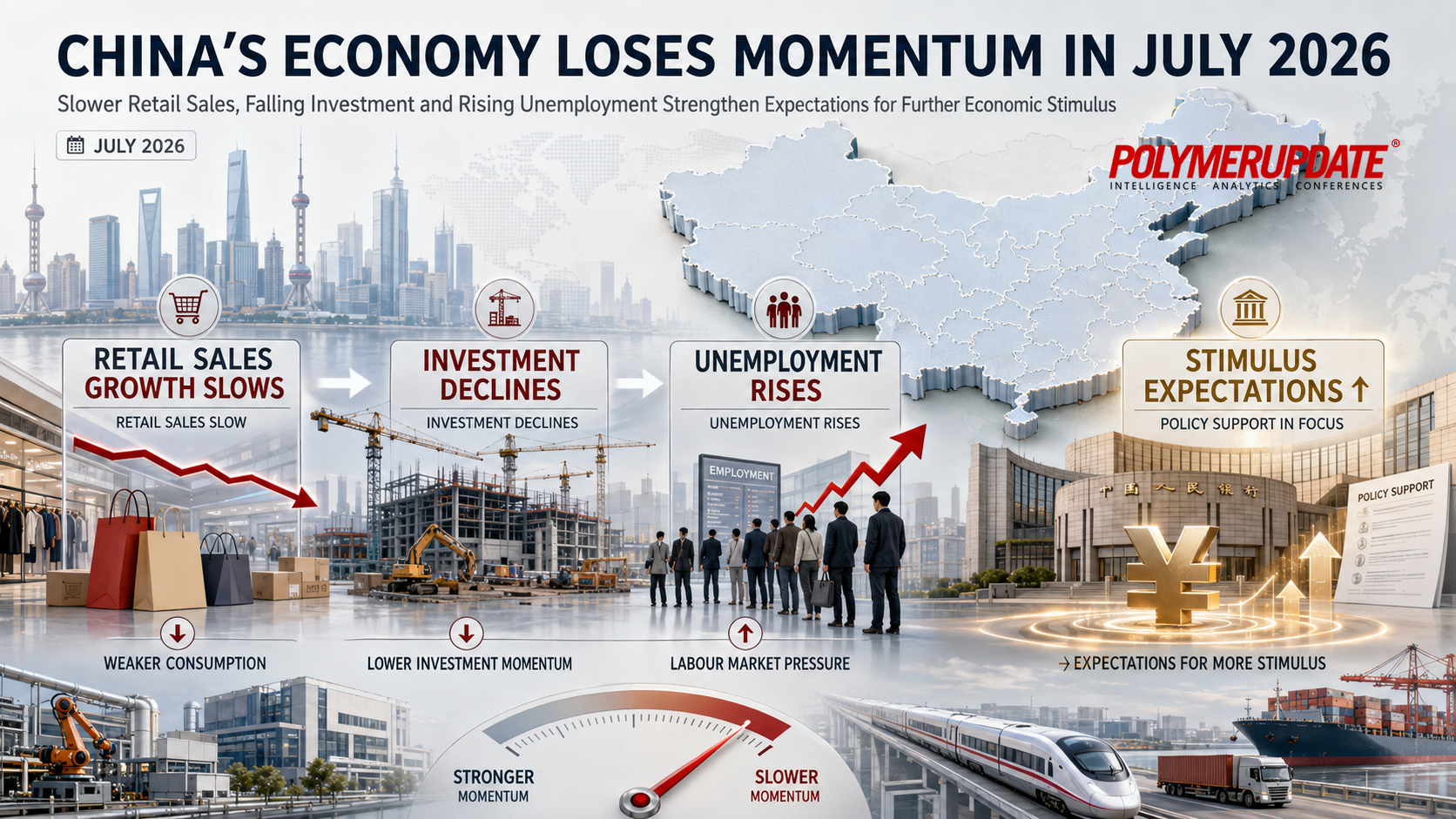
China’s economy lost momentum in July, signalling broad-based weakness, with consumer spending stagnating, urban investment declining, unemployment rising, the property sector deteriorating and retail sales slowing. The developments have prompted policymakers to consider the next round of economic stimulus measures to restore growth momentum. Official data released by China’s National Bureau of Statistics (NBS) on Monday showed that the world’s second-largest economy, after the United States, is relying heavily on exports to support economic growth, increasing the importance of exchange-rate policy and government efforts to prevent excessive appreciation of the yuan.
The NBS stated in its report that all regions and departments had fully implemented the decisions and arrangements made by the CPC Central Committee and the State Council, adhered to the general principle of pursuing progress while ensuring stability, responded effectively to external shocks and domestic difficulties, implemented more proactive and effective macroeconomic policies, and taken solid steps to promote high-quality development.
“As a result, production and supply grew steadily, employment and prices were generally stable, foreign trade demonstrated strong resilience, new growth drivers witnessed robust development, and the national economy was generally stable, with sustained momentum toward new growth drivers and an improved economic structure,” the NBS said in a statement.
 Industrial production
In the first seven months of 2026, from January to July, the total value added of industrial enterprises above the designated size grew by 5.3 percent year on year. In terms of sectors, the value added of mining increased by 2.5 percent year on year, manufacturing grew by 5.6 percent, and the production and supply of electricity, heat, gas and water rose by 5.4 percent. The value added of equipment manufacturing increased by 9.7 percent year on year, while that of high-tech manufacturing rose by 13.8 percent, 4.4 percentage points and 8.5 percentage points faster, respectively, than that of industrial enterprises above the designated size.
In July, the value added of industrial enterprises above the designated size increased by 4.5 percent year on year and by 0.11 percent month on month. The Manufacturing Purchasing Managers’ Index (PMI) stood at 49.2 in July, while the Production and Operation Expectation Index was 54.1. In the first six months of 2026, total profits of industrial enterprises above the designated size stood at 3,948.0 billion yuan, up 18.7 percent year on year.
Steady services sectorIn the first seven months of 2026, the Index of Services Production grew by 4.7 percent year on year. Specifically, the indices for information transmission, software and information technology services; leasing and business services; finance; and transportation, storage and postal services grew by 10.6 percent, 9.5 percent, 6.3 percent and 5.1 percent year on year, respectively. In July, the Index of Services Production increased by 4.3 percent year on year.
In July, the Business Activity Index for Services stood at 49.3 percent, while the Business Activity Expectation Index for Services was 56.0 percent. Specifically, the Business Activity Indices for postal, telecommunications, broadcasting, television and satellite transmission services, as well as culture, sports and entertainment, remained in the high-expansion range of 55.0 percent and above. In the first six months of 2026, the business revenue of service enterprises above the designated size grew by 5.9 percent year on year.
Slowing retail salesIn the first seven months of 2026, total retail sales of goods and services increased by 2.6 percent year on year, with retail sales of services rising by 5.0 percent and those of goods increasing by 1.1 percent. In terms of retail sales of services, communication and information services, tourism consultation and rental services, and cultural, sports and leisure services recorded strong growth. In the first seven months, retail sales of consumer goods reached 28,774.4 billion yuan, up 1.2 percent year on year.
By region, retail sales of consumer goods in urban areas reached 24,928.5 billion yuan, up 1.1 percent year on year, while those in rural areas stood at 3,845.9 billion yuan, up 2.4 percent. By consumption category, retail sales of goods amounted to 25,492.2 billion yuan, up 1.1 percent year on year, while catering revenue stood at 3,282.2 billion yuan, up 2.6 percent. In July, total retail sales of consumer goods reached 3,902.2 billion yuan, up 0.6 percent year on year and 0.06 percent month on month. In the first seven months, online retail sales of goods and services reached 11,721.4 billion yuan, up 4.8 percent year on year.
Declining fixed asset investmentIn the first seven months of 2026, investment in fixed assets (excluding rural households) reached 26,032.8 billion yuan, down 6.7 percent year on year. Excluding investment in real estate development, fixed-asset investment declined by 3.7 percent. Specifically, investment in intellectual property products increased by 9.1 percent year on year. By sector, investment in infrastructure declined by 3.6 percent year on year, investment in manufacturing fell by 1.7 percent, and investment in real estate development decreased by 19.2 percent.
Private investment declined by 9.4 percent year on year, or by 5.7 percent excluding investment in real estate development. Investment in high-tech industries grew by 5.0 percent year on year, with investment in information services, aerospace vehicle and equipment manufacturing, and electronic and communication equipment manufacturing increasing by 19.2 percent, 12.3 percent and 7.1 percent, respectively. In July, investment in fixed assets (excluding rural households) declined by 1.42 percent month on month.
Robust foreign tradeIn the first seven months of 2026, the total value of imports and exports of goods reached 30,126.4 billion yuan, an increase of 17.3 percent year on year. Specifically, the total value of exports stood at 17,440.0 billion yuan, up 14.0 percent, while the total value of imports reached 12,686.4 billion yuan, up 22.0 percent. During the same period, imports and exports under general trade increased by 10.2 percent year on year, while trade with Belt and Road partner countries grew by 15.5 percent.
Imports and exports by private enterprises increased by 17.2 percent, accounting for 56.9 percent of the total value of imports and exports. Exports of mechanical and electrical products grew by 21.2 percent, accounting for 63.8 percent of total exports. In July, the total value of imports and exports of goods reached 4,658.0 billion yuan, up 19.2 percent year on year. Specifically, the total value of exports stood at 2,712.5 billion yuan, up 17.8 percent, while the total value of imports reached 1,945.4 billion yuan, up 21.2 percent.
Stable employmentIn the first seven months of 2026, the average urban surveyed unemployment rate stood at 5.2 percent, unchanged from the first six months and the same period last year. In July, the urban surveyed unemployment rate was 5.2 percent, 0.2 percentage points higher than in the previous month.
The surveyed unemployment rate among the population with local household registration was 5.2 percent, while that among the population with non-local household registration was also 5.2 percent. Among the latter, the unemployment rate for the population with non-local agricultural household registration stood at 4.9 percent. The urban surveyed unemployment rate in 31 major cities was 5.2 percent, 0.2 percentage points higher than in the previous month. Employees of enterprises worked an average of 48.2 hours per week.
CPI inflation upIn the first seven months of 2026, the Consumer Price Index (CPI) increased by 0.9 percent year on year. By category, prices for food, tobacco, alcohol and dining out declined by 0.2 percent year on year; clothing prices increased by 1.6 percent; housing prices fell by 0.2 percent; prices for daily necessities and services rose by 1.7 percent; transportation and communication prices increased by 1.6 percent; education, culture and recreation prices rose by 1.2 percent; medical services and healthcare prices increased by 2.1 percent; and prices for other goods and services rose by 10.8 percent.
In the first seven months, producer prices for industrial products increased by 1.8 percent year on year. In July, producer prices rose by 3.5 percent year on year but declined by 0.7 percent month on month. During the first seven months, purchasing prices for industrial producers increased by 2.8 percent year on year. In July, purchasing prices rose by 5.5 percent year on year but declined by 1.0 percent month on month.
DILIP KUMAR JHA
Editor
dilip.jha@polymerupdate.com