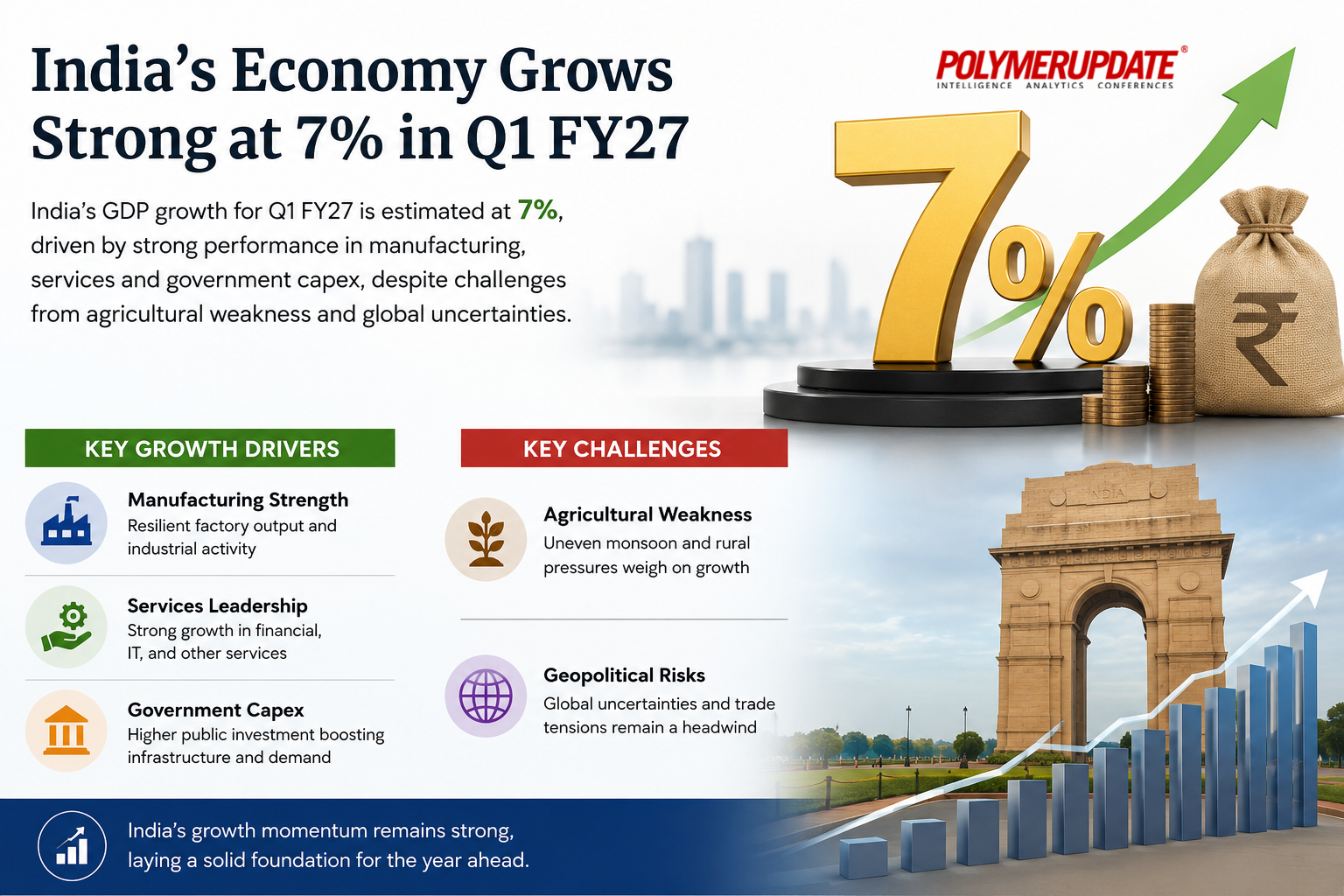
India's economy is estimated to have expanded by around 7 percent in the first quarter of FY2026–27, marking a modest improvement over the 6.8 percent growth recorded in the corresponding period last year. The economic growth was driven by resilient manufacturing, stronger government capital expenditure, robust financial services and a sharp rebound in electricity generation. The Ministry of Statistics and Programme Implementation (MoSPI) is expected to release the provisional GDP estimates later this month. Sonal Badhan, Economist, Bank of Baroda, believes growth could surprise on the upside, with the final print reaching 7.2 percent if manufacturing performs better than anticipated.
The April–June quarter reflected a mixed performance for the Indian economy, with strong momentum in industry and services offsetting weakness in agriculture. Manufacturing, infrastructure and financial services remained resilient despite supply-chain disruptions and cost pressures stemming from the prolonged West Asia conflict. In contrast, the farm sector lost pace as delayed onset of the southwest monsoon, prolonged heatwave conditions and emerging El Niño weather patterns adversely affected crop activity and reservoir levels during the quarter.
 Manufacturing and industry provide the growth engine
Industrial activity is expected to remain the principal driver of first-quarter growth. Overall industrial gross value added (GVA) is projected to expand 6.8 percent, supported by healthy factory output, improving corporate earnings and sustained infrastructure spending. Manufacturing is estimated to grow 7.8 percent, slightly below the exceptionally strong 10.4 percent recorded a year earlier but still reflecting solid momentum. Industrial production data showed manufacturing output rising 6.3 percent during the quarter compared with 4.1 percent in the same period last year, indicating continued resilience despite elevated input costs and supply-chain disruptions linked to tensions in West Asia.
Strong quarterly earnings from metals, power and infrastructure companies also reinforced the sector's recovery, with several firms reporting higher revenues and profits despite a challenging global environment. Mining, however, is expected to moderate to 3 percent growth from 4.5 percent a year earlier, reflecting softer commodity production. One of the biggest improvements is likely to come from the electricity sector. After contracting by 2 percent in Q1FY26, electricity generation is projected to expand 7 percent this year, aided by stronger power demand during the summer months and higher industrial consumption.
The construction sector is expected to grow 6 percent in the April–June quarter, improving from 5.3 percent in the corresponding period last year, driven by a strong pickup in public infrastructure spending. The Centre's capital expenditure rose by 23.6 percent during the quarter, boosting investment across roads, railways, housing and other key infrastructure projects. The sustained capex push has reinforced construction activity and strengthened its contribution to overall economic growth.
Agriculture slows after weather disruptionsThe farm sector is expected to emerge as the weakest segment of the economy in the first quarter. Agricultural GVA is projected to grow 3.5 percent, down from 4.4 percent in Q1FY26, as extreme heatwave conditions, delayed onset of the southwest monsoon, lower reservoir levels and moderate El Niño conditions weighed on crop activity. However, economists expect the slowdown to be temporary. Rainfall improved dramatically in July after June recorded precipitation nearly 40 percent below the long-period average.
The agricultural outlook has improved with July rainfall recovering to slightly above the long-period average after a weak start to the monsoon, raising expectations of stronger rural growth in the remaining quarters of FY27. However, the uneven spatial distribution of rainfall across regions remains a concern, while kharif sowing continues to be closely monitored as the cultivated acreage is still marginally below last year's level.
Services remain the strongest pillarIndia's services sector is expected to expand 8 percent during the April–June period, continuing its role as the largest contributor to economic growth. Financial services are projected to post the strongest performance, growing 9.2 percent on the back of healthy credit expansion and steady deposit growth across the banking system. Strong financial intermediation has continued to support both household consumption and business investment.
Public administration and defence spending is also expected to record robust growth as government net revenue expenditure, excluding interest payments, increased 19.5 percent during the quarter compared with 6.9 percent a year earlier. Trade, hotels and transport are likely to witness some moderation, with growth easing to 7 percent as higher fuel and logistics costs compressed business margins.
Commodity shock raises costs but tax collections cushion impactThe first quarter was also marked by extraordinary volatility in global commodity markets following the escalation of the West Asia conflict. According to World Bank commodity indicators, international crude oil prices surged 44.7 percent year-on-year during the quarter, reversing the sharp decline seen a year earlier. Urea prices rose an even steeper 73.5 percent, significantly increasing fertilizer costs. The impact quickly filtered into the domestic economy. Prices of commercial and domestic LPG, along with bulk diesel, were revised upward in May, while supply constraints affected several commodities.
As a result, the government's subsidy burden increased substantially. Food subsidies rose 17.9 percent, fertilizer subsidies climbed 57.6 percent, and petroleum subsidies increased 10.4 percent during Q1FY27. Nevertheless, stronger tax collections largely offset the higher subsidy bill, supporting overall fiscal stability and contributing positively to net taxes within GDP calculations.
FY27 outlook: Growth seen at 6.6–6.8%Despite a strong opening quarter, economists expect India's full-year GDP growth to moderate to 6.6–6.8 percent, reflecting persistent external uncertainties alongside improving domestic fundamentals. The biggest risk remains the geopolitical situation in West Asia. Although crude oil and urea prices softened in July—falling 2.3 percent and 11.7 percent, respectively—on hopes of renewed peace negotiations between the United States and Iran, the absence of a lasting ceasefire has pushed crude prices back above US$ 90 a barrel. Continued supply-chain disruptions could keep imported inflation elevated.
On the domestic front, the outlook remains comparatively favourable. Manufacturing continues to demonstrate resilience, government and private investment are gaining traction, and recently concluded free trade agreements are expected to support exports. Strong services exports, healthy remittance inflows and greater export diversification should also help cushion external headwinds. Stable inflation, a relatively steady rupee and sustained infrastructure spending are expected to broaden the recovery during the second half of the fiscal year.
While weather developments and geopolitical tensions will remain key variables, India appears well positioned to remain one of the world's fastest-growing major economies, with domestic demand and investment continuing to anchor growth through FY27.
DILIP KUMAR JHA
Editor
dilip.jha@polymerupdate.com