Haldia Petrochemicals Ltd’s planned commissioning of its Rs 6,000-crore phenol and acetone complex at Haldia on October 14 represents more than a large capacity addition. The project is a strategic investment in India’s downstream chemical value chain at a time when the country is attempting to reduce import dependence, strengthen domestic feedstock security and capture greater value from its expanding petrochemical market. West Bengal Chief Minister Suvendu Adhikari has announced that he will inaugurate the project on the scheduled date of October 14.
Developed under Haldia Petrochemicals’ subsidiary Adplus Polymers & Chemicals, the complex is expected to house India’s first on-purpose propylene plant based on olefin conversion technology and the country’s largest phenol production unit. The scale and product mix make the project particularly significant. Rather than adding capacity in a single commodity, HPL is positioning the investment across a chain of important chemical intermediates, potentially giving the company greater exposure to downstream growth and reducing its dependence on traditional refinery- and cracker-linked economics.
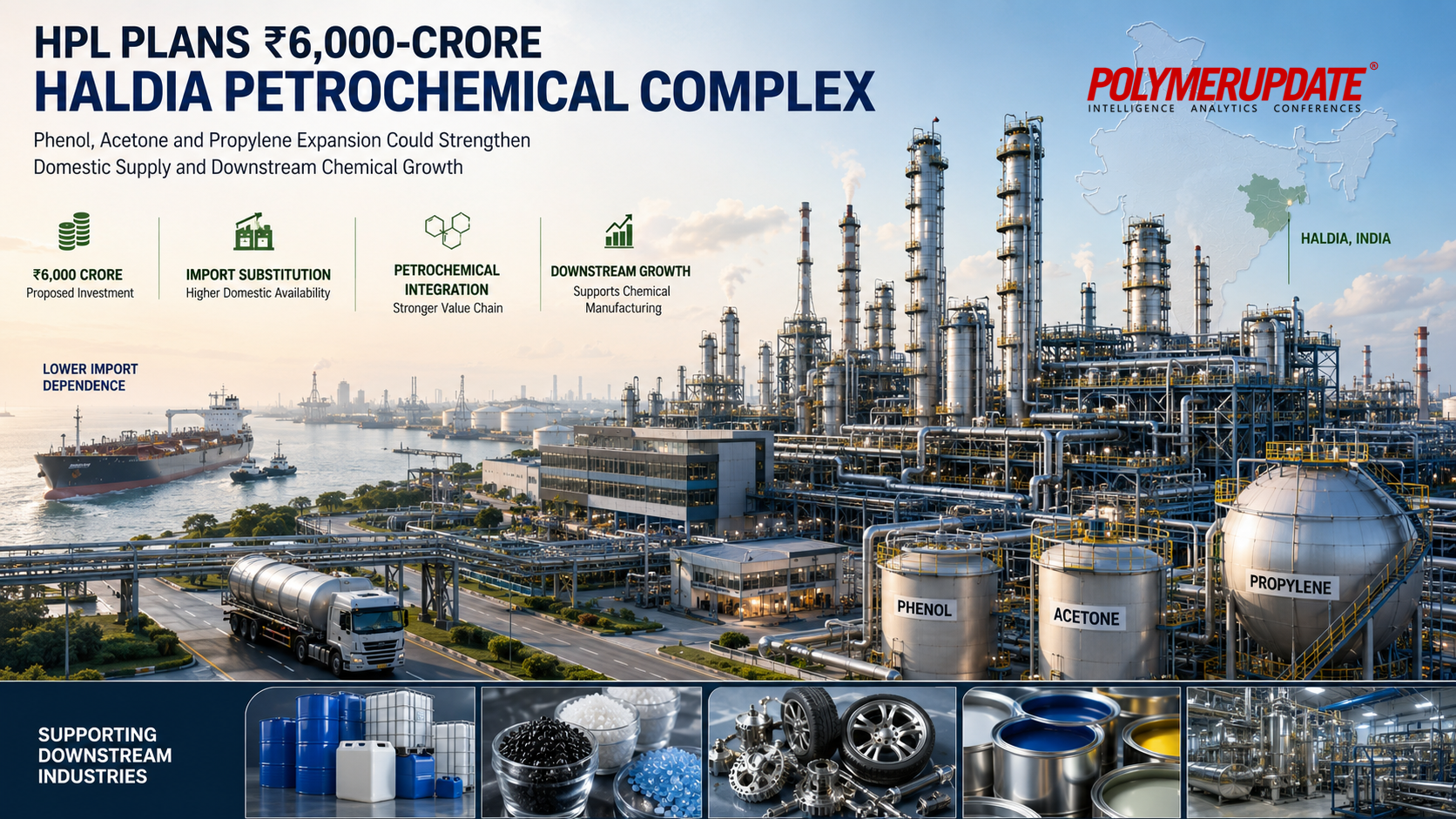 Moving up the petrochemical value chain
India’s petrochemical industry has expanded rapidly alongside rising demand for plastics, automobiles, construction materials, paints, pharmaceuticals, consumer products and industrial goods. Yet domestic production has not kept pace with demand for several chemical intermediates, leaving manufacturers dependent on imports. Phenol and acetone are among the products where domestic availability is strategically important. Phenol is used in phenolic resins, laminates, adhesives, engineering plastics and pharmaceuticals, while acetone is an important solvent and intermediate for coatings, paints, adhesives and pharmaceutical applications.
The addition of large-scale domestic capacity could therefore have a multiplier effect. The immediate impact would be an increase in local availability, but the longer-term significance lies in the possibility of developing additional downstream capacity around the new feedstock base. For Indian converters and chemical manufacturers, domestic sourcing can also reduce exposure to international freight rates, currency movements, geopolitical disruptions and sudden changes in import economics.
However, the project’s impact on imports and domestic prices will depend heavily on the scale of production, plant utilisation and prevailing global prices. Additional domestic capacity does not automatically translate into lower prices if international markets remain tight or if domestic demand grows rapidly.
Propylene capacity is the bigger strategic storyWhile the phenol and acetone units are likely to attract considerable attention, the propylene component could prove equally important from an industry perspective. Propylene is a critical petrochemical building block used in polypropylene and a wide range of chemical intermediates. Demand for propylene is closely connected to the expansion of plastics, packaging, automotive components, appliances, textiles and industrial applications. Traditionally, much of the world's propylene supply has been generated as a co-product of refinery operations or through steam cracking.
This creates an inherent limitation: production is influenced by the economics of the primary refinery or cracker operation rather than solely by demand for propylene. An on-purpose propylene facility changes that equation. By employing olefin conversion technology, HPL will be able to produce propylene through a dedicated process rather than relying entirely on conventional refinery-linked supply. This could provide greater flexibility in responding to market requirements and potentially improve feedstock integration within the complex. For India, where petrochemical demand is expected to continue growing, such dedicated propylene capacity could become increasingly valuable.
Import substitution could be a major economic benefitThe investment also fits into India’s broader strategy of reducing dependence on imported petrochemicals and chemical intermediates. Import dependence creates several risks for downstream manufacturers. Apart from the underlying product price, buyers are exposed to ocean freight, insurance, currency fluctuations, port congestion and geopolitical disruptions. These risks have become particularly visible in recent years as disruptions to global shipping routes have increased freight costs and extended delivery times.
Domestic production can reduce some of these vulnerabilities. For HPL, however, the economics will ultimately depend on whether the company can produce competitively against imports. Global chemical markets are highly cyclical, and domestic producers must compete with large-scale plants in the Middle East and Asia that often benefit from integrated feedstock systems and economies of scale. The competitive advantage of the Haldia project will therefore depend not simply on capacity, but on feedstock economics, energy costs, logistics, operating efficiency and the ability to maintain high utilisation rates.
Integration could support marginsOne of the project's strongest potential advantages is integration. An integrated petrochemical complex can capture value at multiple stages of the production chain and optimise the use of feedstocks and intermediates. This can provide greater resilience than operating standalone chemical units, particularly during periods when margins for individual products come under pressure. The combination of propylene production with phenol and acetone manufacturing gives HPL exposure to different demand centres. If margins in one product weaken, stronger economics elsewhere in the portfolio could partly offset the pressure.
That diversification could become increasingly important as global petrochemical markets experience structural changes. New capacity additions in China and the Middle East have periodically resulted in oversupply in several commodity chemicals, putting pressure on margins. At the same time, demand for specialised downstream products continues to expand. The Haldia investment therefore needs to be viewed not only in terms of tonnes added, but also in terms of the company's ability to manage the petrochemical cycle.
Haldia’s location provides a logistical advantageThe location of the project is another important component of its economics. Haldia has an established industrial base and port-linked infrastructure, providing access to domestic and international markets. Its location can give HPL an advantage in serving eastern and northeastern India, markets that can otherwise face significant logistics costs when supplied from western petrochemical clusters. The project could also strengthen Haldia as a regional chemical hub.
A larger local supply of chemical intermediates can encourage downstream producers to establish manufacturing facilities nearby, creating an industrial cluster around common feedstocks, logistics infrastructure and technical services. Such clustering can generate additional economic activity beyond the original investment, including demand for storage, transportation, engineering, maintenance, packaging and specialised industrial services.
Downstream investment will determine the multiplier effectThe ultimate economic impact of the ₹6,000-crore project will depend partly on what happens after the plant starts operating. If domestic availability of phenol, acetone and propylene encourages new investments in resins, adhesives, engineering plastics, coatings, solvents and other downstream products, the project could generate a much larger economic footprint than its initial capital cost.
This is particularly relevant for India because the country is seeking to move beyond being a large consumer of petrochemicals towards becoming a more competitive producer and exporter of higher-value chemical products. The development of downstream industries would also create additional employment and improve the competitiveness of domestic manufacturers by reducing dependence on imported intermediates.
Risks remain despite the strategic advantagesThe project is not without risks. The global petrochemical industry is currently characterised by substantial new capacity, particularly in Asia and the Middle East. Periods of oversupply can sharply compress margins even when demand continues to grow. HPL will therefore need to compete with international producers that may have advantages in feedstock availability and scale. Another challenge will be commissioning and ramp-up. Large chemical projects typically require time to stabilise operations and achieve designed capacity.
Any delay in achieving commercial operating rates could postpone the expected benefits. Market conditions will also remain a key variable. A sharp slowdown in global manufacturing or weaker demand from China could affect chemical prices and margins, while higher crude oil and feedstock costs could alter the competitiveness of domestic production.
A strategic investmentDespite these risks, the Haldia project represents an important development for India's chemical industry. Its significance lies in the combination of scale, product diversity and technology. The project adds domestic phenol and acetone capacity while introducing dedicated propylene production, potentially strengthening the country's petrochemical integration. For HPL, the investment provides an opportunity to diversify its product portfolio and capture greater value from downstream chemicals.
For West Bengal, it reinforces Haldia’s position as a major industrial centre. For Indian manufacturers, it could improve access to critical chemical intermediates and reduce exposure to global supply disruptions. The real test, however, will begin after the inauguration. The project's success will ultimately be measured by operating rates, production costs, domestic market penetration and the downstream investments it helps trigger.
If HPL can commission the units smoothly and operate them competitively through the petrochemical cycle, the Rs 6,000-crore investment could become an important building block in India's effort to deepen its domestic chemical manufacturing base. The October 14 inauguration will therefore mark only the beginning. The more consequential story will be whether Haldia can convert this large capital investment into sustained industrial integration, import substitution and downstream value creation.
DILIP KUMAR JHA
Editor
dilip.jha@polymerupdate.com